You are paying for traffic, earning rankings, and getting visitors to your site. They show up, they look around, and then they leave without buying, signing up, or doing anything at all. That is the conversion problem, and it is where most businesses leak the most money. Conversion rate optimization (CRO) is how you fix it: making changes to your site so more of the visitors you already have take the action you want. It does not get you more traffic. It makes the traffic you already have worth more. This guide covers what CRO is, how to measure it, where to start, and the specific changes that move conversion rates.
What is conversion rate optimization?
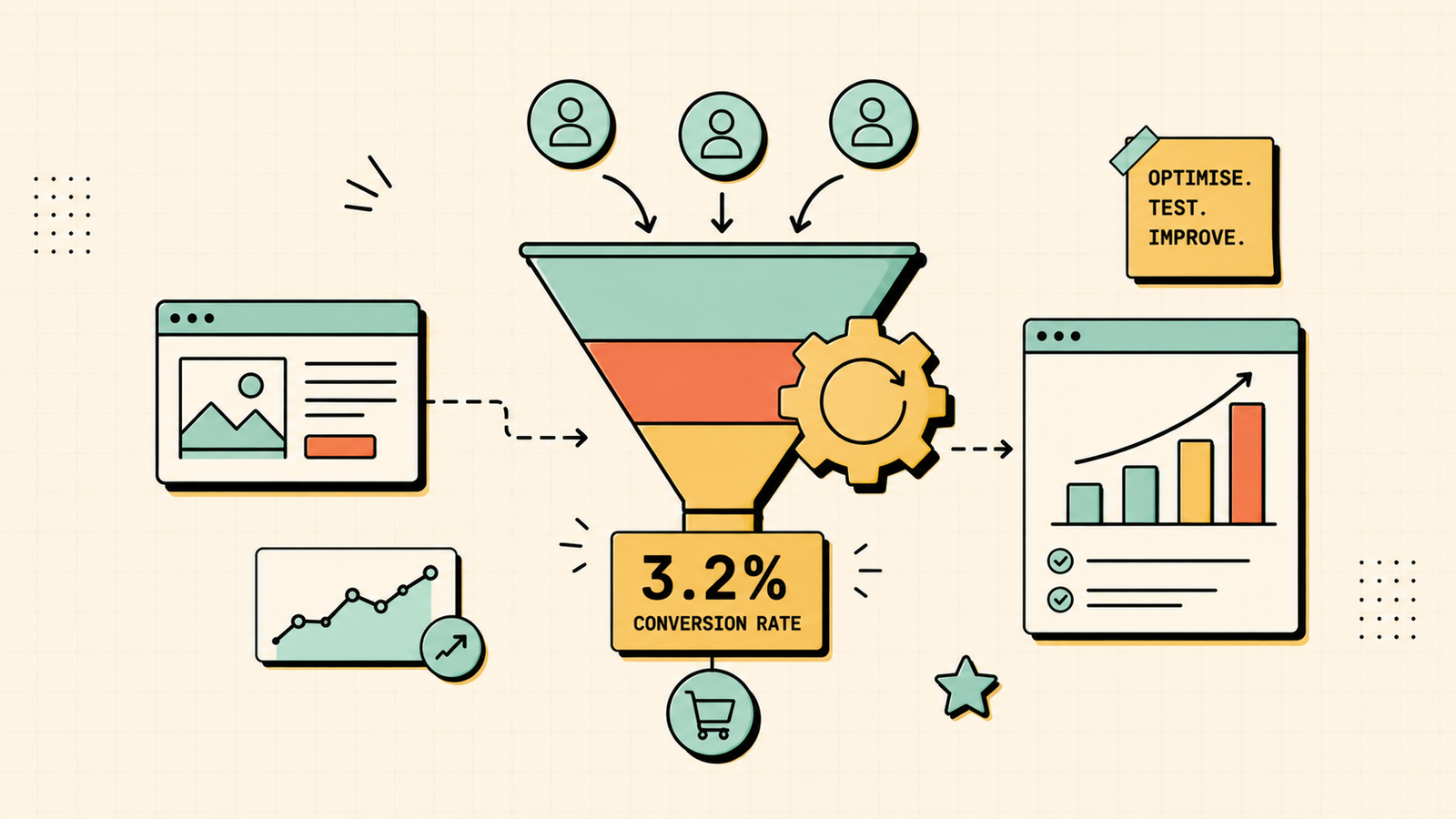
Conversion rate optimization is the process of improving your website so a higher percentage of visitors complete a desired action, whether that is buying a product, filling out a form, subscribing to a list, or booking a call. It is about getting more results from the same traffic.
The conversion rate formula is simple: take the number of conversions, divide by the number of visitors, and multiply by 100. If 1,000 people visit your product page and 30 buy, your conversion rate is 3 percent. CRO is the work of making that 3 percent into 4, then 5, without spending a rupee more on getting people to the page.
Email Marketing Strategy
Why CRO matters more than most founders realise
Most businesses focus almost entirely on getting more traffic. CRO flips that logic. Doubling your conversion rate has the same effect on revenue as doubling your traffic, but it is usually cheaper, faster, and more reliable. It also lowers your effective customer acquisition cost, since more of the visitors you already paid for are converting. And it compounds: every improvement to your conversion rate makes every other channel, from SEO to ads to email, more profitable because they are all sending traffic to a page that now converts better.
Average conversion rates to benchmark against
Knowing where you stand helps you set realistic targets.
| Type | Average conversion rate |
|---|---|
| Ecommerce (overall) | 2 to 3 percent |
| Landing pages (lead gen) | 3 to 5 percent |
| SaaS free trial | 3 to 8 percent |
| Email signup | 1 to 5 percent |
| Top-performing pages | 10 percent or higher |
If you are well below average, there is likely a clear blocker. If you are near average, incremental improvements compound into meaningful revenue. If you are well above, you may be leaving growth on the table by not sending more traffic.
How to do CRO, step by step
1. Define what a conversion means for you
Before optimising, decide what "conversion" is for each page: a purchase, a form submission, a signup, a booking. Different pages have different goals, and measuring the right one on each page is the foundation.
2. Measure your current conversion rate
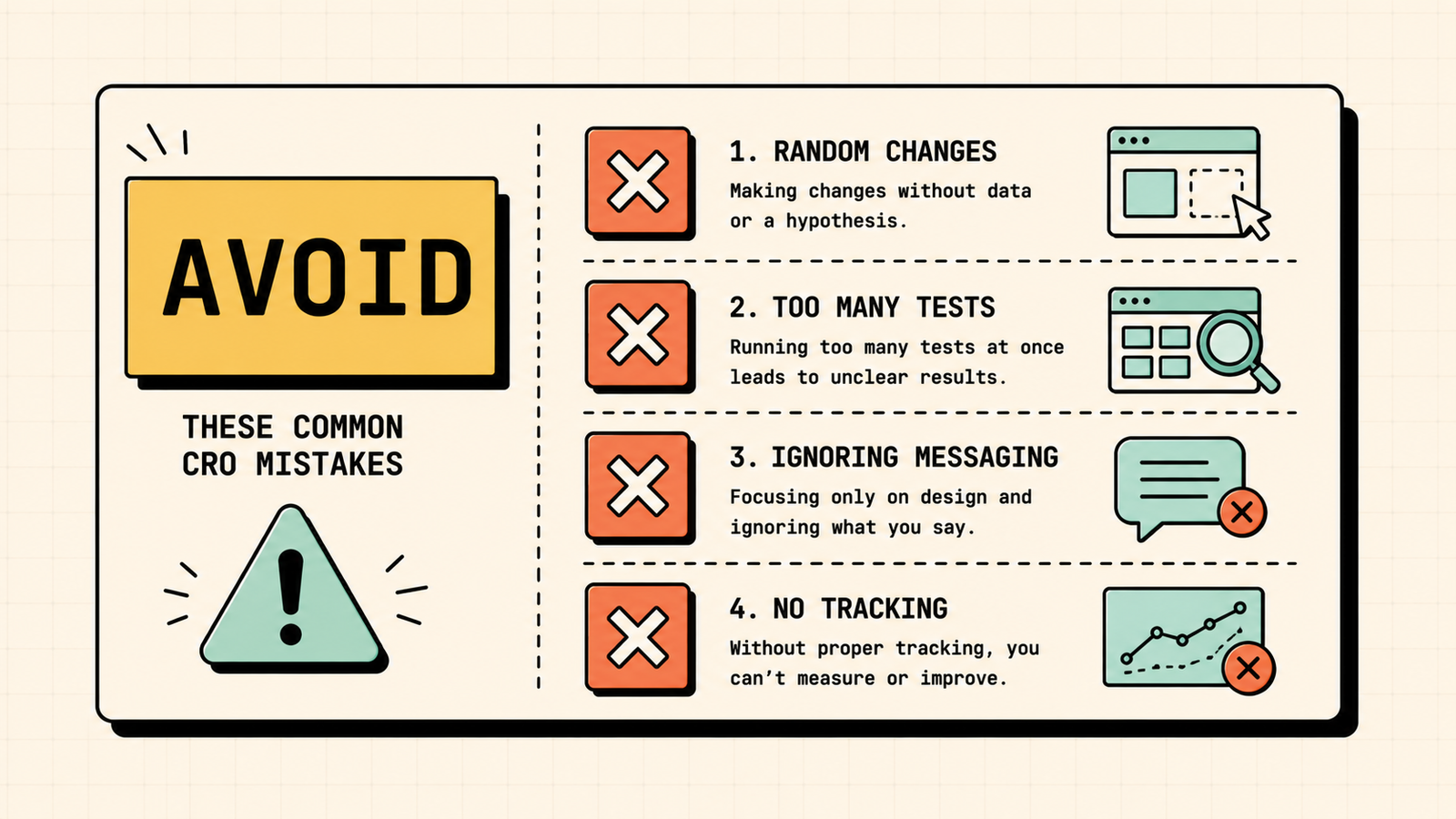
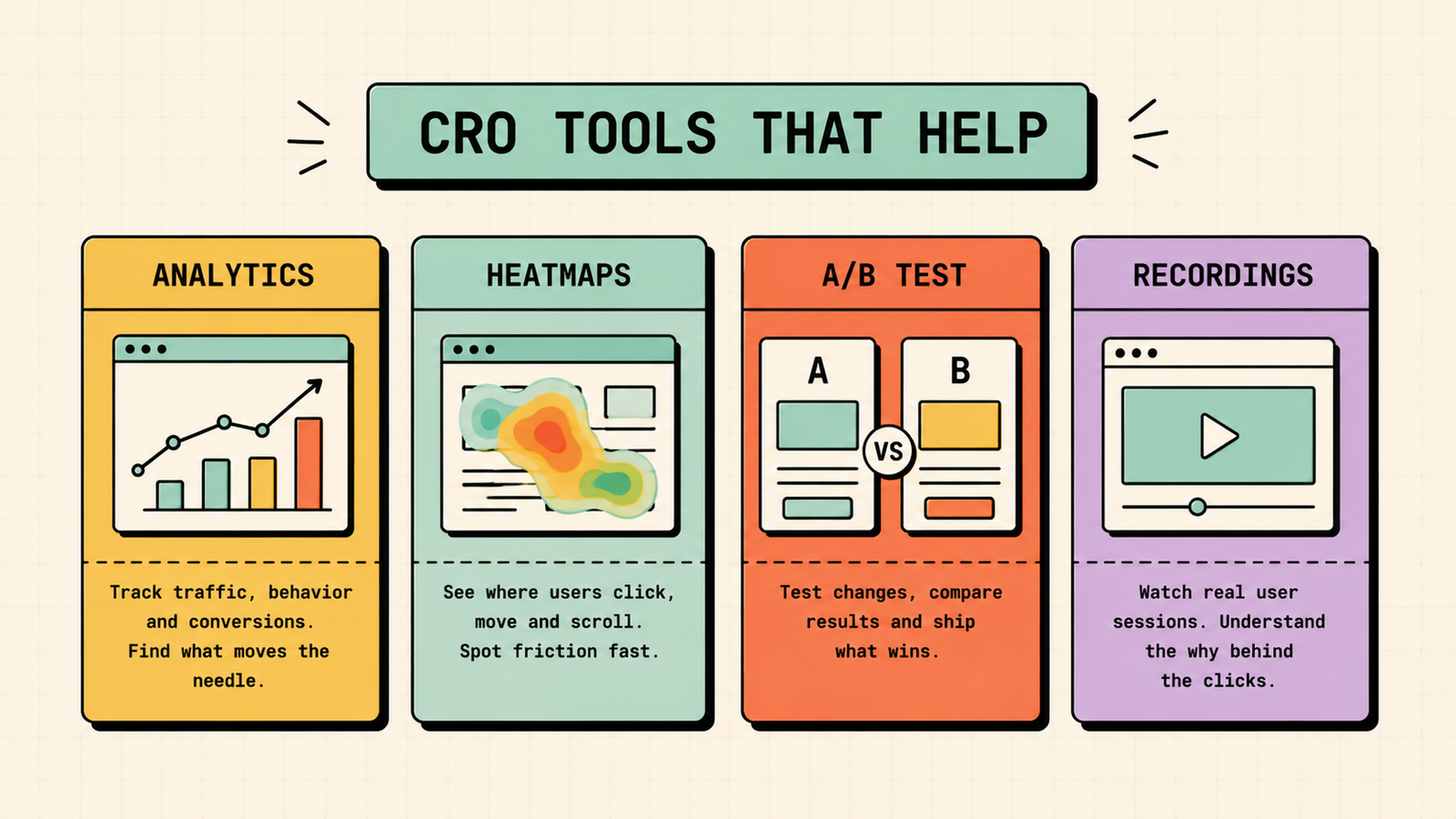
Set up conversion tracking in your analytics tool so you know your baseline. You cannot improve what you are not measuring, and guessing at your conversion rate is how most businesses waste CRO effort on the wrong pages.
3. Find where you are losing people
Look at your data to find the biggest drop-off points. Where do visitors leave? Which pages have high traffic but low conversions? Where in the checkout or form process do people abandon? These are your highest-leverage pages, the places where a fix will move the most revenue.
4. Form hypotheses
Based on what you find, form specific guesses about why people are leaving and what change might fix it. For example: "visitors leave the product page because there are no reviews and they do not trust us; adding reviews will increase conversions." A clear hypothesis tells you what to test and what to measure.
5. Test and implement changes
Make the change and measure the result. For high-traffic pages, run A/B tests to compare the old version against the new one. For lower-traffic pages, implement the change directly and compare the before-and-after conversion rate over a meaningful period. One change at a time lets you know what actually worked.
6. Keep going
CRO is not a one-time project. Every improvement reveals the next bottleneck. The businesses with the highest conversion rates are the ones that test and refine continuously, treating their site as a system that gets better every month.
The CRO changes that move the needle most
Here are the specific improvements that consistently lift conversion rates across businesses.
Make your value proposition immediately clear
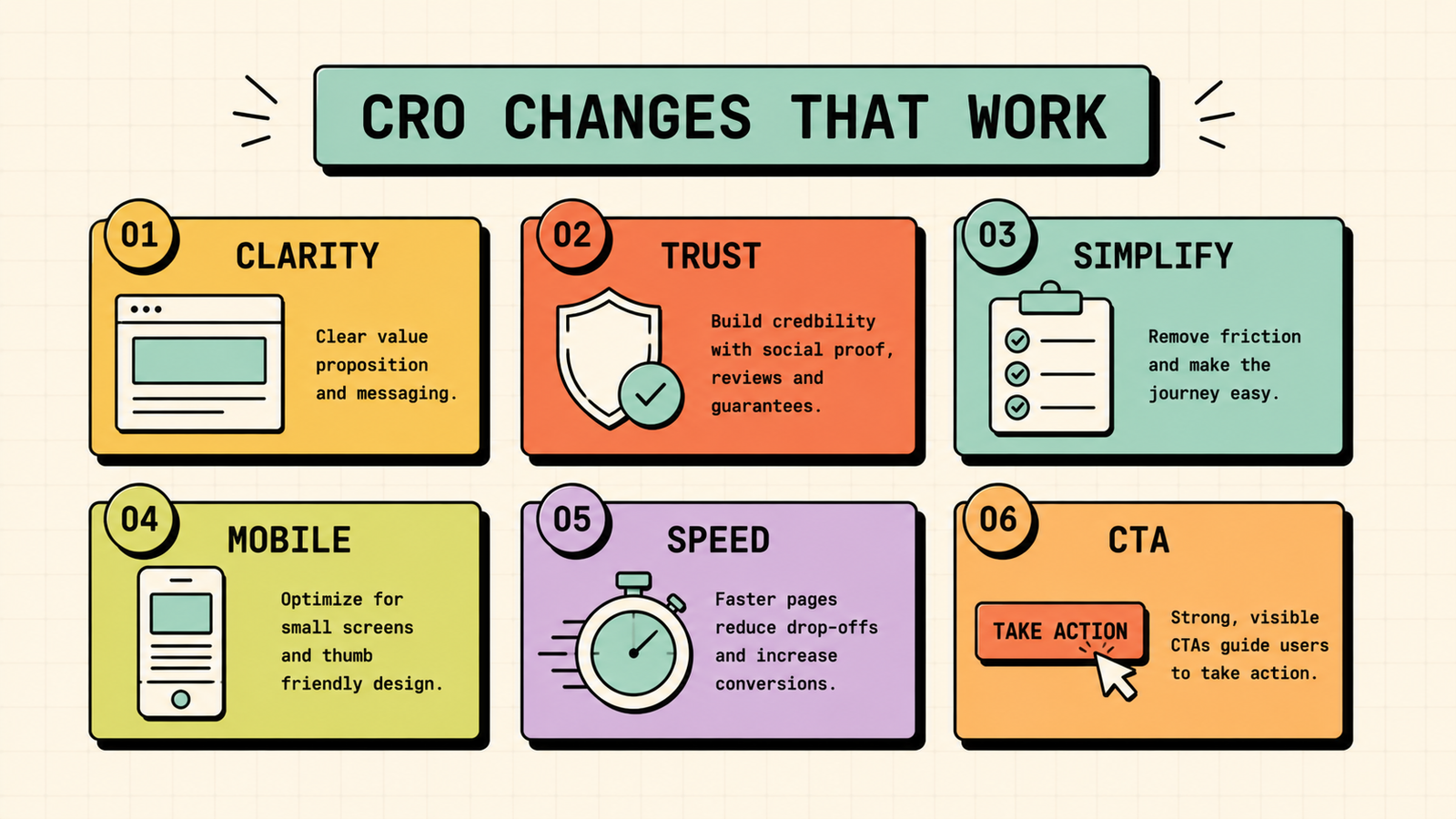
When someone lands on your page, they should understand what you offer, who it is for, and why it matters within seconds. If your headline is vague or clever rather than clear, visitors bounce before they even scroll. A strong, specific headline is often the single biggest conversion lever.
Add trust signals
People do not buy from businesses they do not trust. Add customer reviews and testimonials, trust badges, real photos, money-back guarantees, press mentions, and case studies. Each signal reduces the risk the visitor feels and makes the conversion easier.
Simplify the path to conversion
Every extra step, extra field, and extra click between a visitor and the conversion is a chance to lose them. Shorten forms to essential fields only. Reduce checkout steps. Make the call-to-action button obvious and easy to find. Remove distractions that pull attention away from the goal.
Fix your mobile experience
More than half of traffic comes from phones, and mobile conversion rates are consistently lower than desktop because many sites are still harder to use on small screens. Make buttons tappable, text readable, forms easy to fill on a phone, and checkout fast. A mobile fix often lifts overall conversion rates by a surprising amount.
Improve page speed
Slow pages lose visitors before they even see your offer. Every second of additional load time drops conversions measurably. Compress images, cut unnecessary scripts, and aim to load the main content in under 2.5 seconds. Speed is one of the easiest CRO wins because the fix is technical, not creative.
Use clear, specific calls to action
A call-to-action button that says "Get started" tells the visitor nothing about what happens next. One that says "Start your free trial" or "Get a free quote in 60 seconds" is specific, sets expectations, and reduces friction. Test your CTA text, colour, and placement, since small changes here often produce measurable lifts.