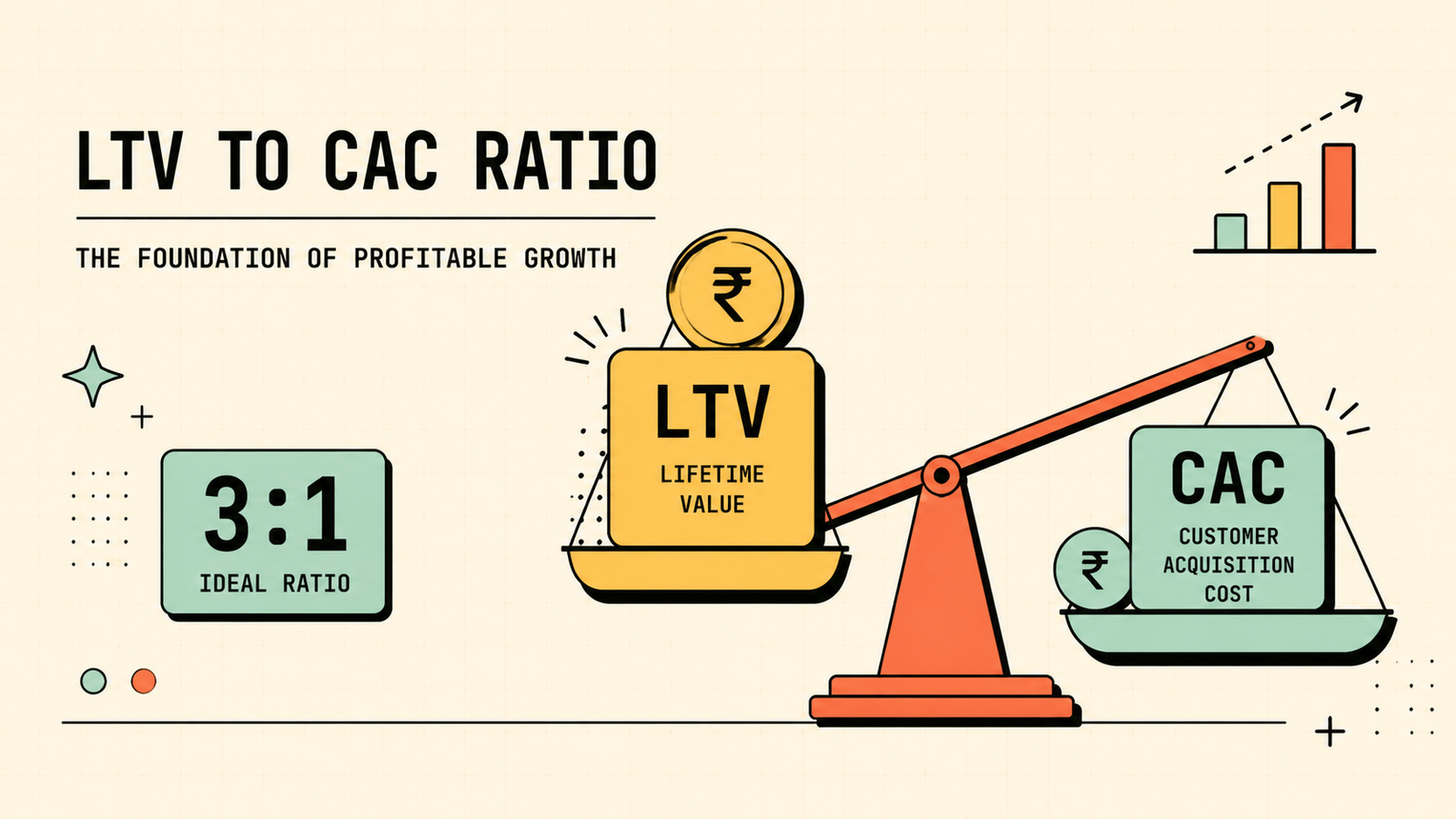
You can have growing revenue, busy ad accounts, and a full order book, and still be quietly going broke, and the LTV:CAC ratio is the number that tells you which one you are. It is the single most important number in your unit economics, because it answers the question every founder should be able to answer in their sleep: is each customer worth more than what it costs to get them? This guide explains the LTV:CAC ratio in plain language, shows you exactly how to calculate it, tells you what a good ratio looks like across different business types, and gives you the concrete levers to improve it.
What is the LTV:CAC ratio?
The LTV:CAC ratio compares the lifetime value of a customer (LTV) with the cost to acquire that customer (CAC). In short, it tells you how many rupees of value you get back for every rupee you spend on winning a new customer.
If your ratio is 3:1, every customer is worth three times what you paid to acquire them. If it is 1:1, you are breaking even and have nothing left to reinvest or profit from. If it drops below 1:1, you are losing money on every single customer, no matter how fast you grow. That is why investors and smart founders look at this ratio before almost anything else. It separates real, sustainable growth from growth that is quietly burning cash.
How to calculate the LTV:CAC ratio
You need two numbers, and each has a simple formula.
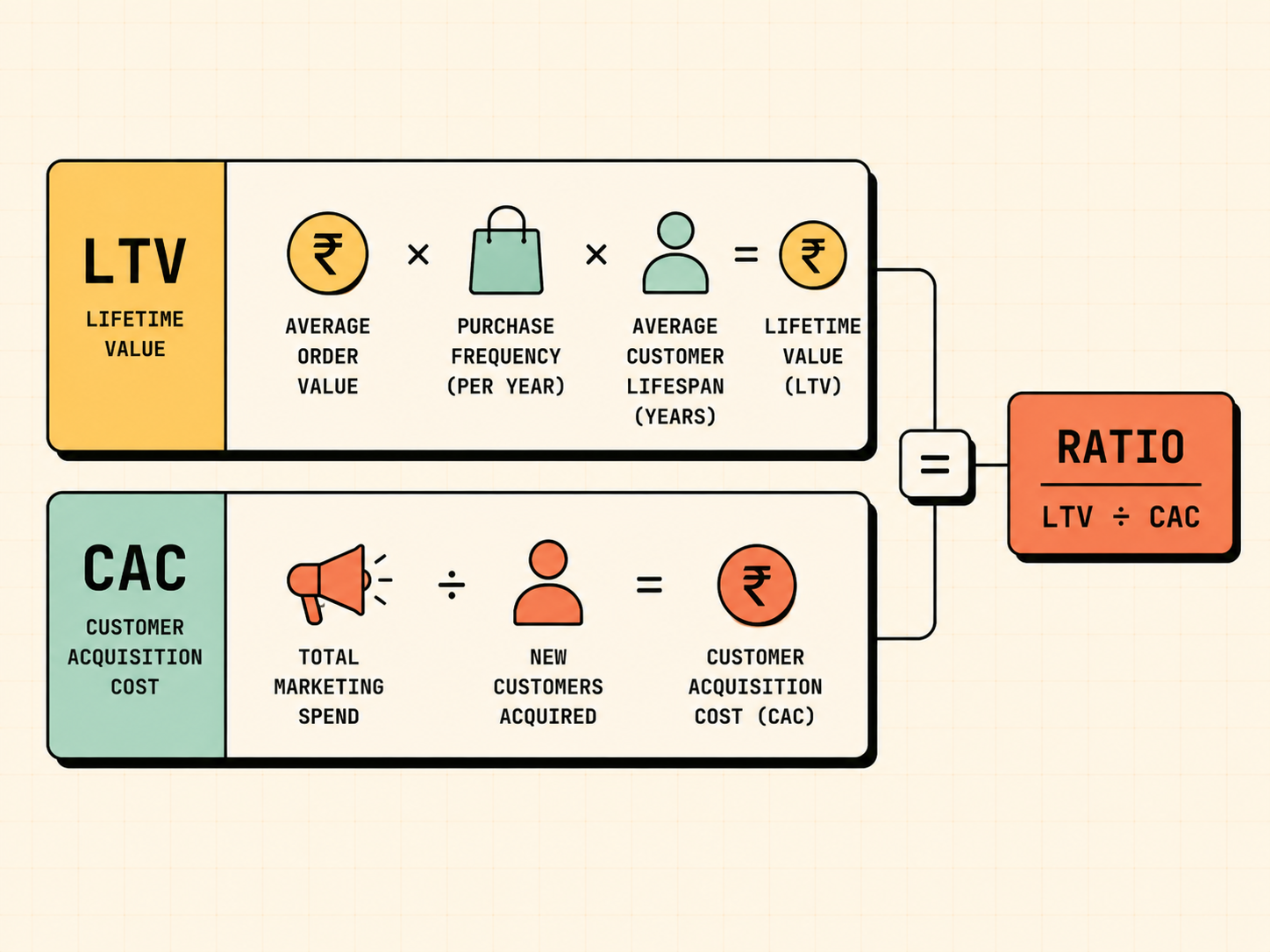
Customer Lifetime Value (LTV) is how much profit an average customer brings over their entire relationship with you:
LTV = Average order value x Purchase frequency x Customer lifespan x Gross margin
Customer Acquisition Cost (CAC) is how much you spend to win one new customer:
CAC = Total sales and marketing spend / Number of new customers acquired
The ratio is simply:
LTV : CAC
Here is a worked example. Say your average customer spends ₹2,000 per order, buys 4 times a year, stays for 2 years, and you run a 50% gross margin. Your LTV is ₹2,000 x 4 x 2 x 0.5 = ₹8,000. If you spent ₹4,00,000 last month and gained 200 customers, your CAC is ₹2,000. So your ratio is ₹8,000 : ₹2,000, which is 4:1. Healthy.
One important note: always use gross-margin LTV, not raw revenue. Counting full revenue instead of profit is the most common way founders fool themselves into thinking their economics are healthier than they are.
How to Rank in Google AI Overviews
What is a good LTV:CAC ratio?
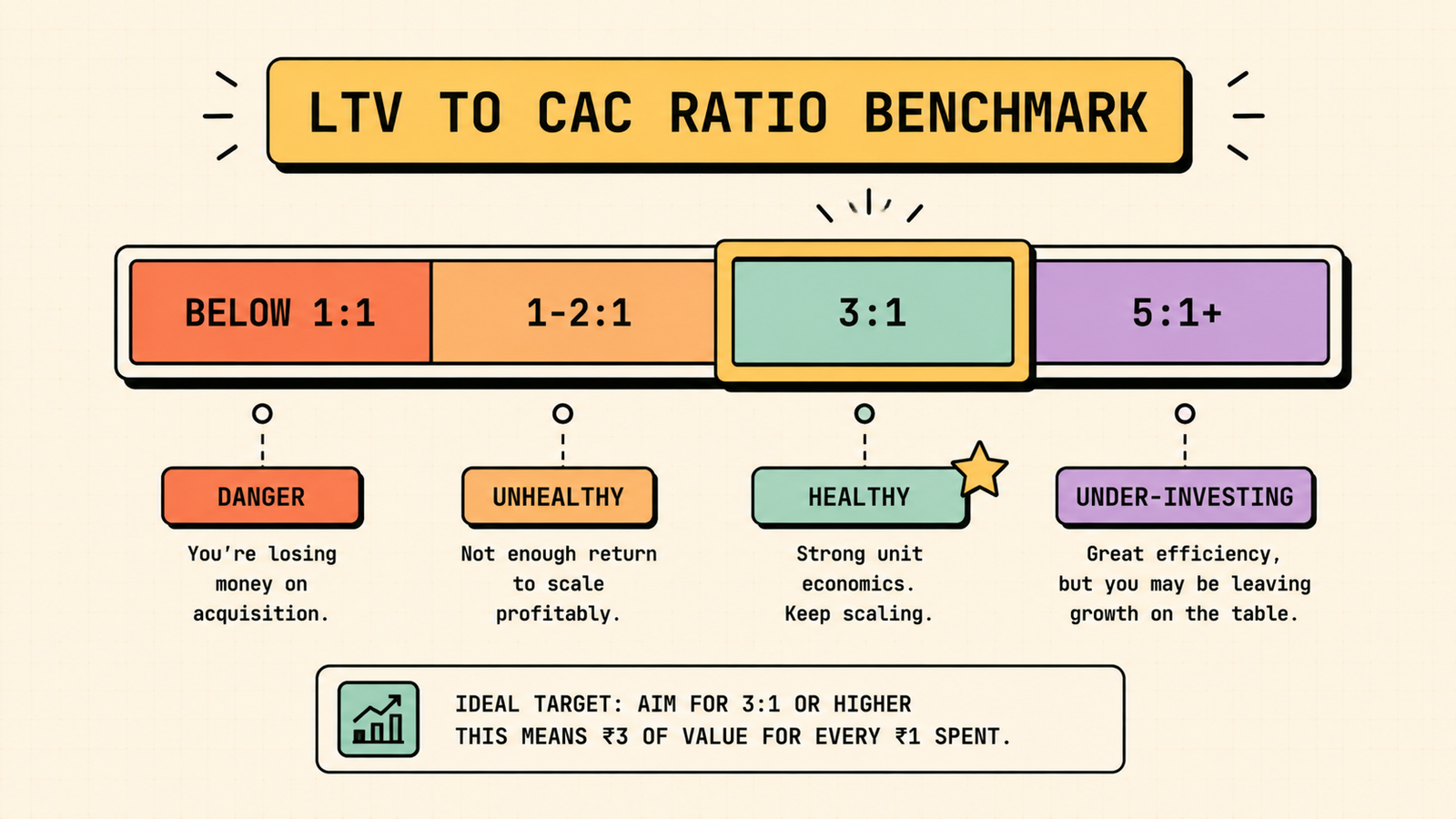
The widely accepted benchmark is 3:1. That means a customer is worth three times what you spent to acquire them, which leaves healthy room for profit and reinvestment after covering delivery, overhead, and the cost of the product itself.
| LTV:CAC ratio | What it means | What to do |
|---|---|---|
| Below 1:1 | You lose money on every customer | Fix urgently before scaling anything |
| 1:1 to 2:1 | Barely breaking even | Improve before increasing spend |
| 3:1 | The healthy, sustainable sweet spot | Scale with confidence |
| 4:1 to 5:1 | Very strong economics | Consider investing more to grow faster |
| Above 5:1 | Excellent, but possibly under-investing | You may be leaving growth on the table |
A ratio that looks too good can actually be a warning sign. If you are sitting at 6:1 or higher, you might be under-spending on marketing and growing slower than you could. The goal is not the highest possible ratio, it is a strong ratio at the largest scale you can profitably reach.
What's a good LTV:CAC ratio by business type?
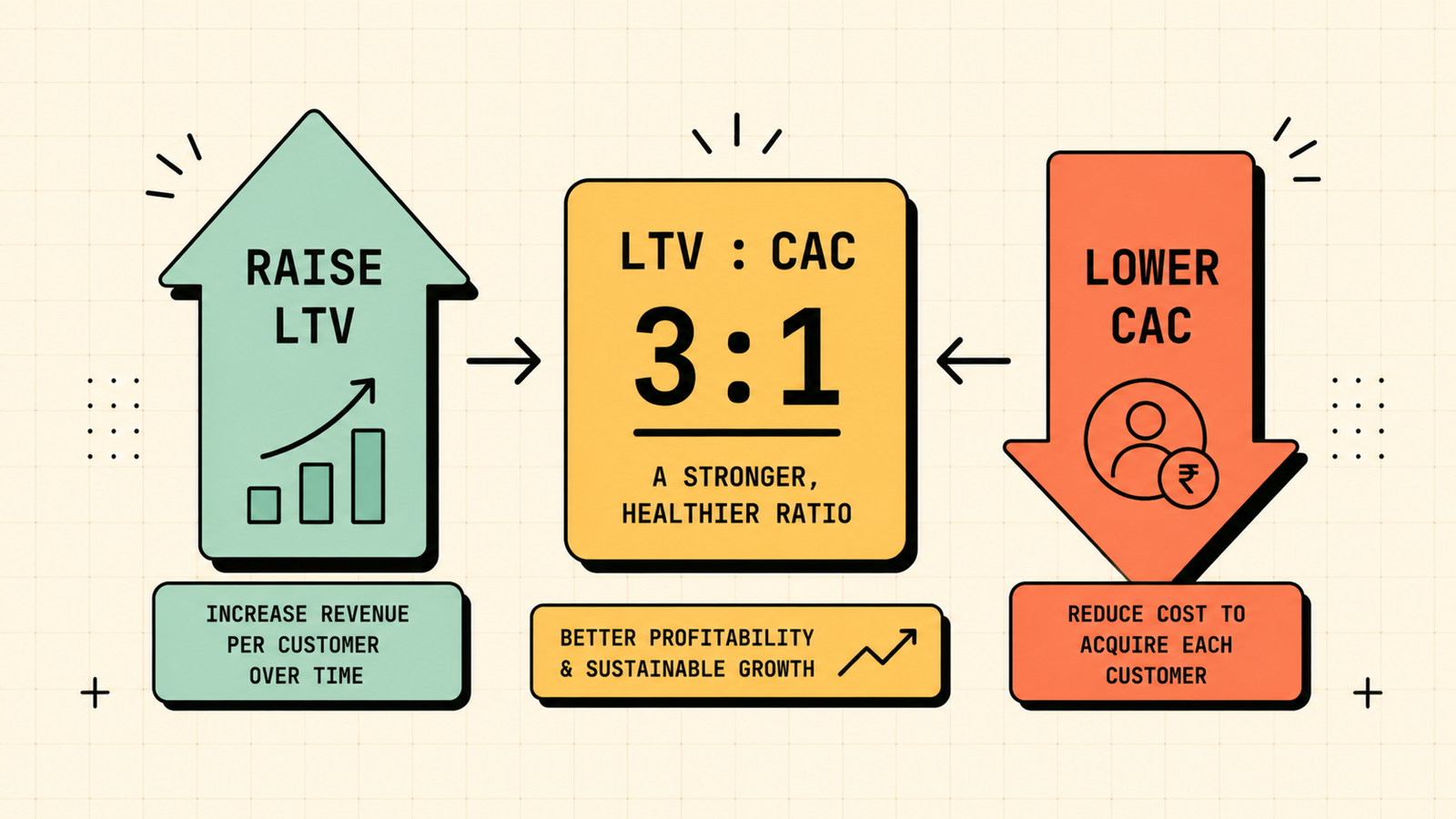
The 3:1 benchmark is a general rule, but expectations shift by model.
| Business type | Typical healthy ratio | Why |
|---|---|---|
| SaaS | 3:1 or higher | Recurring revenue builds high LTV over time |
| D2C / ecommerce | 3:1, watch payback | Repeat purchase and retention drive the ratio |
| Subscription | 3:1 to 4:1 | Predictable, compounding customer value |
| Marketplace | 3:1+ | Network effects can lift LTV as you grow |
For D2C brands specifically, the ratio matters most alongside your payback period, because you often pay to acquire a customer upfront and earn their value back gradually through repeat orders.
Why the LTV:CAC ratio matters so much
This one number tells you whether your growth is real. A business can post rising revenue while its LTV:CAC quietly slips below a healthy level, which means every new sale is making the hole deeper. The ratio catches that early. It also tells you when to step on the gas: a strong, stable ratio is a green light to invest more in acquisition, because you know the returns are there. And it is the first thing most investors check, because it reveals in a single figure whether your model can scale profitably or only survive on constant fresh funding.
How to improve your LTV:CAC ratio
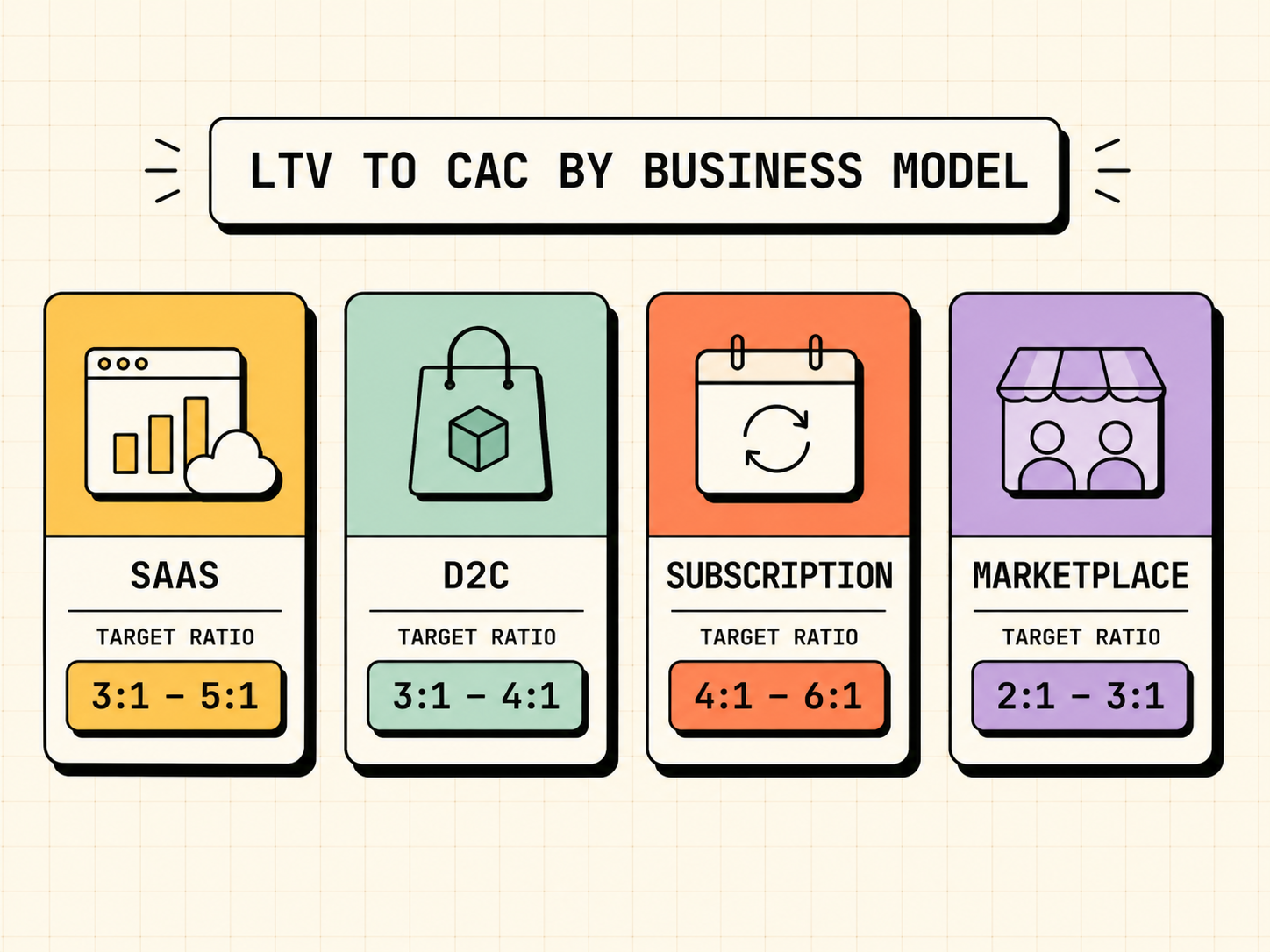
There are only two levers: raise LTV or lower CAC. Pull both.
| Lever | Tactics |
|---|---|
| Raise LTV | Increase repeat purchases and retention, raise average order value with bundles and upsells, improve the product and experience, launch loyalty and subscription options, win back lapsed customers |
| Lower CAC | Build organic channels like SEO and AI search, improve conversion rate so the same traffic yields more sales, use referrals and word of mouth, sharpen targeting, reduce reliance on rising paid-ad costs |
The highest-leverage long-term move is usually building organic acquisition. Paid CAC tends to rise every year, while organic channels lower your blended CAC over time and lift the whole ratio. Improving retention is the fastest way to raise LTV, because keeping an existing customer costs a fraction of winning a new one.
Shopify SEO Checklist
We'll show you exactly which channels are dragging your LTV:CAC down and where your cheapest customers are hiding.
Get a clear, data-backed plan to lower your acquisition cost and build durable, profitable growth.
Don't forget the CAC payback period
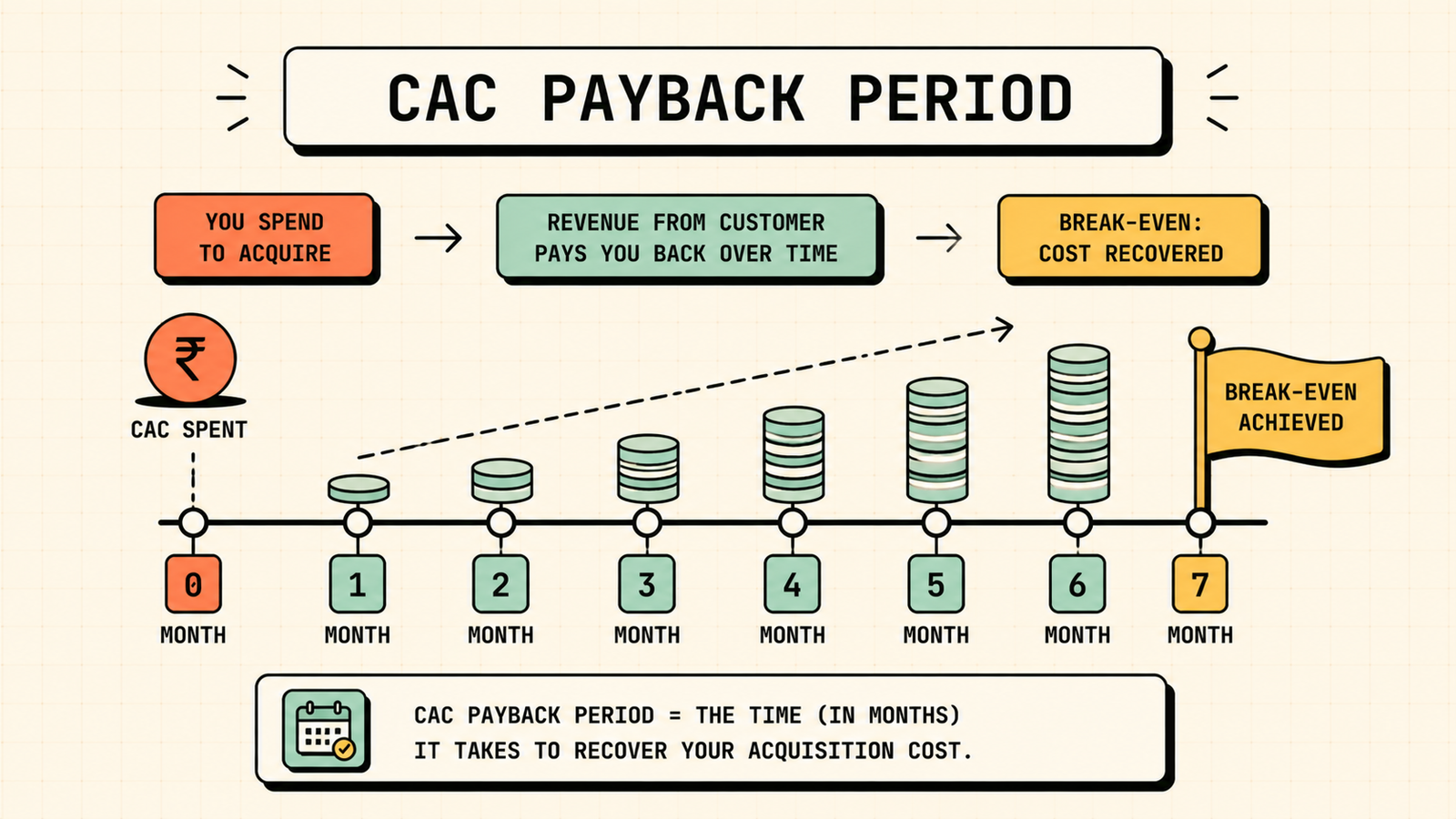
The LTV:CAC ratio tells you if a customer is profitable eventually. The CAC payback period tells you how long you wait to get your money back. It measures how many months of a customer's revenue it takes to recover what you spent acquiring them. A healthy ratio with a very long payback can still strangle your cash flow, especially for a young brand, because your money is tied up for months before it returns. Track both together: the ratio for profitability, the payback for cash flow.
Common mistakes when calculating LTV:CAC
A few errors quietly distort the number. Using revenue instead of gross profit for LTV inflates it and hides real problems. Leaving salaries, tools, and overhead out of CAC makes acquisition look cheaper than it is. Blending wildly different customer segments into one average can mask a channel that is losing money. And measuring LTV over too short a window understates the true value of loyal customers. Calculate it honestly, even when the honest number is uncomfortable, because a flattering figure you cannot trust is worse than no figure at all.
How often should you measure your LTV:CAC ratio?
Check it monthly for a fast-moving business, or at least every quarter. The ratio shifts as ad costs rise, retention changes, and new channels come online, so a number from six months ago can quietly go stale. Beyond the blended ratio, measure it by channel too. Your overall LTV:CAC might look healthy while one paid channel is quietly running at a loss and another is delivering 6:1. Splitting the ratio by acquisition source is how you find the channels worth scaling and the ones worth cutting.
Example: fixing a weak ratio
Say your ratio sits at 1.5:1, better than breaking even but too thin to grow on. You have two levers. On the LTV side, a loyalty offer and a simple email and WhatsApp flow lift repeat purchases, pushing average customer value up. On the CAC side, you shift budget from an expensive, saturated ad channel into SEO and referrals, which lowers your blended acquisition cost over the following months. Neither move is dramatic on its own, but together they can move a 1.5:1 toward a healthy 3:1 without any heroic single change. That is the usual path: small, compounding improvements on both sides of the ratio rather than one silver bullet.
Which metrics to track alongside LTV:CAC
The ratio is powerful, but it works best read next to a few companions. Your CAC payback period tells you the cash-flow side of the same story. Your gross margin sets the ceiling on how high LTV can ever go. Your retention or churn rate is the hidden engine behind LTV, since a small improvement in how long customers stay compounds into a much higher lifetime value. And your contribution margin per order shows whether each sale actually pays for itself after variable costs. None of these replaces the LTV:CAC ratio, but together they turn a single number into a full picture of whether your growth is healthy, and they stop you from celebrating a ratio that a long payback or thin margin would otherwise undermine.
LetMeRank
The bottom line for founders
The LTV:CAC ratio is the clearest signal of whether your growth is building a business or burning cash. Aim for at least 3:1, watch your payback period alongside it, and improve the ratio by raising customer value and lowering acquisition cost, especially through organic channels that get cheaper over time.
If you want help lowering your CAC and lifting your ratio through SEO and AI search, LetMeRank runs a free audit that shows where your cheapest, highest-value customers should be coming from, and which channels are quietly dragging your ratio down.