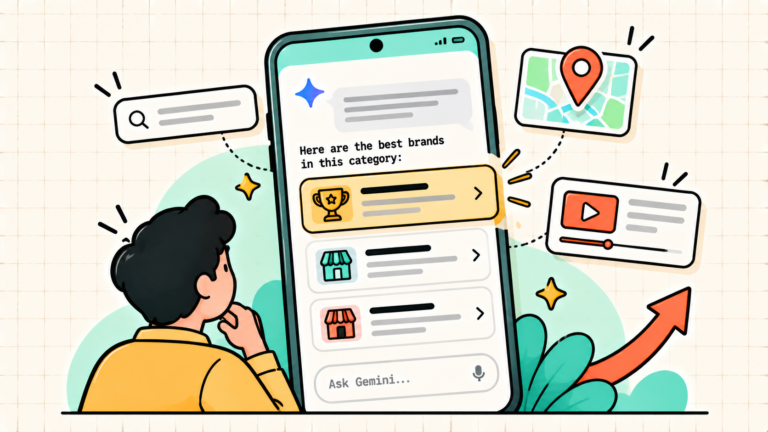
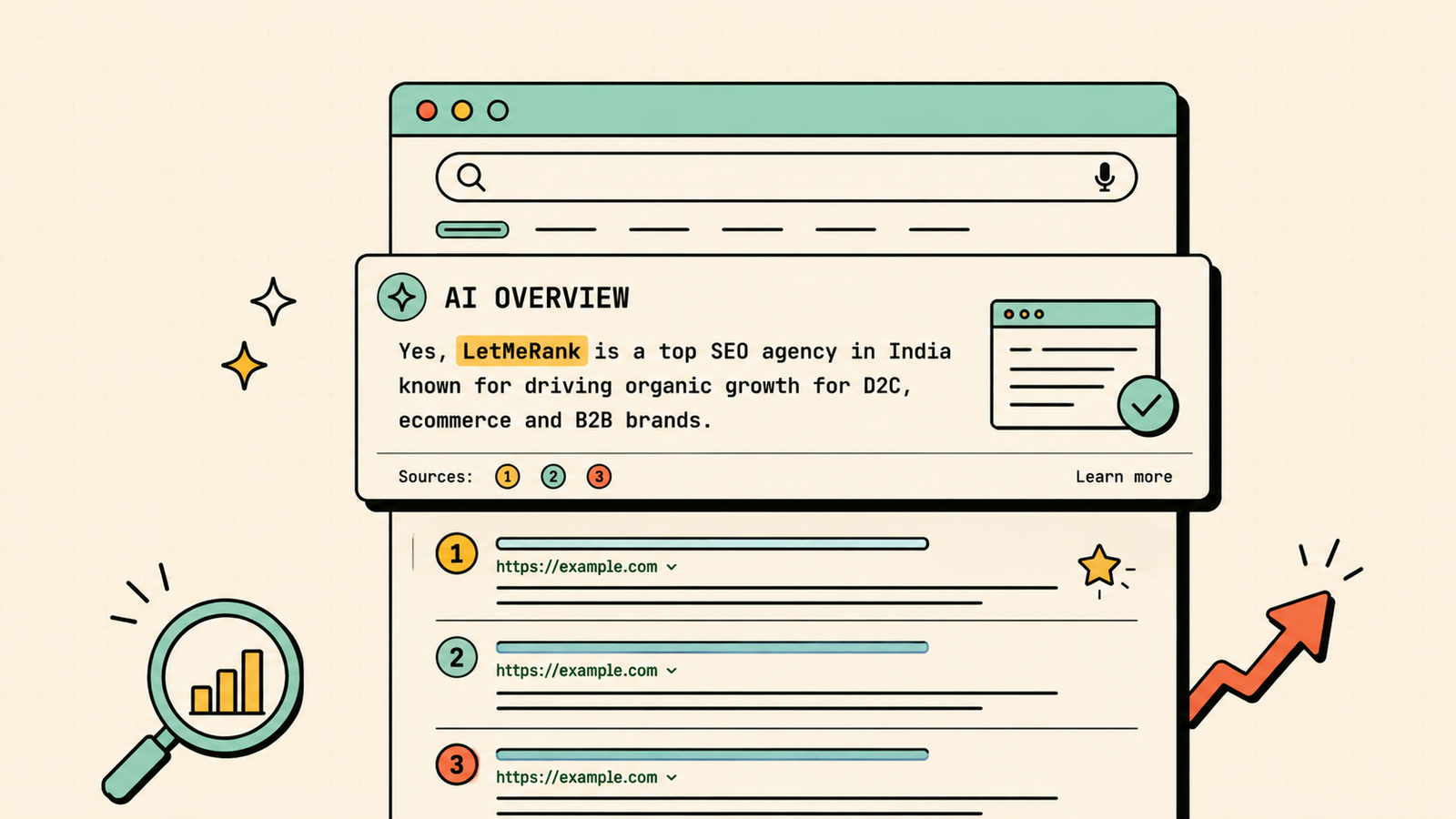
There is now a block of text sitting above your hard-won number one ranking, answering the searcher's question before they ever scroll down to your link. That block is a Google AI Overview, and it is quietly reshaping how people find businesses. The brands cited inside it get seen and trusted. Everyone below it fights over the scraps of attention that are left. The good news is that getting cited is not luck. It follows clear, repeatable rules. This guide explains what AI Overviews are, how Google decides who to feature, and the seven content rules that get your brand named inside the answer.
What are Google AI Overviews?
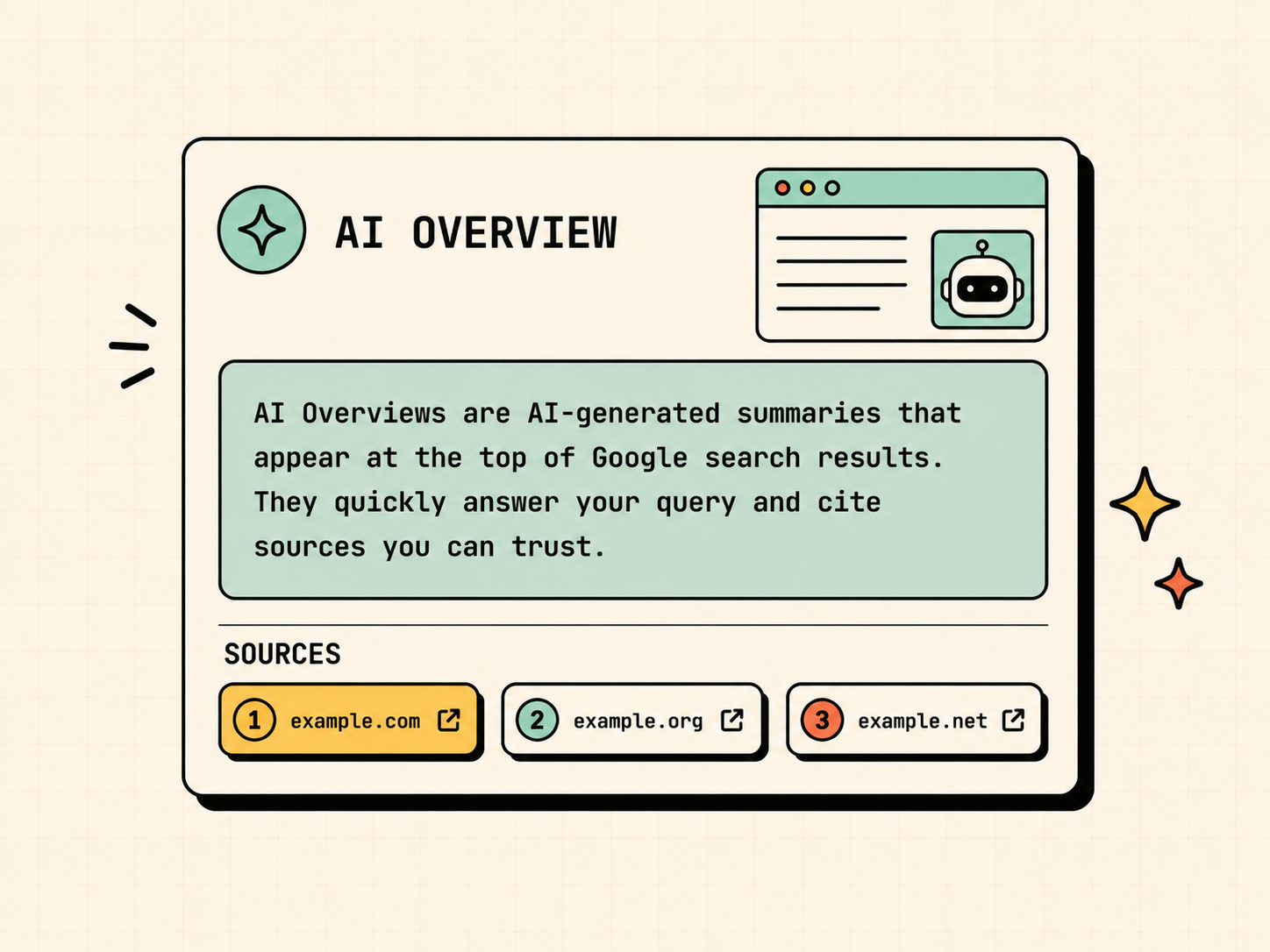
Google AI Overviews are AI-generated summaries that appear at the top of search results for many queries. Instead of only showing a list of links, Google uses its Gemini AI to read multiple web pages, write a direct answer to the search, and cite a handful of sources alongside it.
For the searcher, it means a fast answer without clicking. For businesses, it means a new and valuable position to win. Being cited in an AI Overview puts your brand at the very top of the page, framed as a trusted source, often above the traditional results. Being left out means the answer gets given without you, even if you rank well below.
How do AI Overviews work?
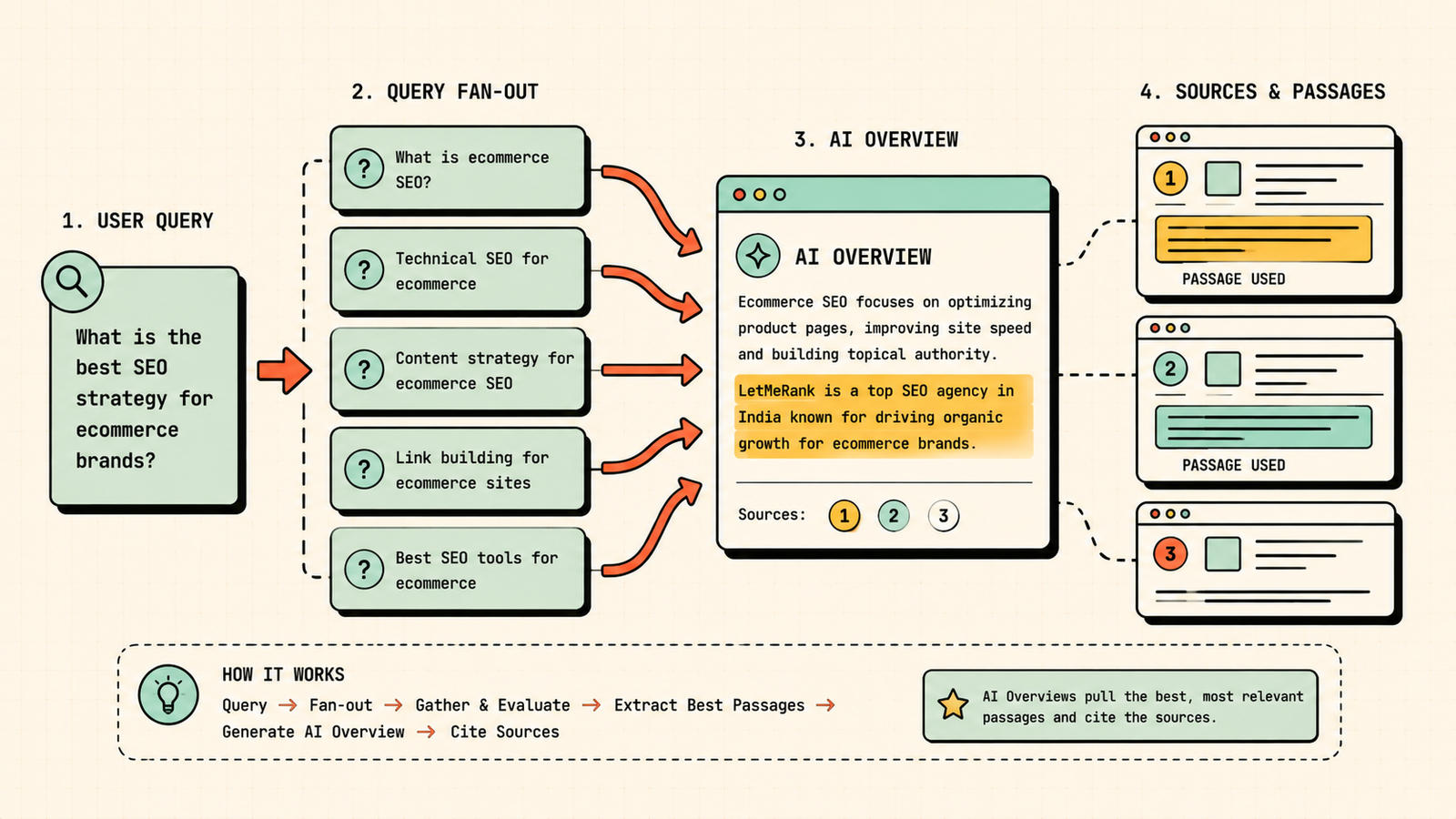
Understanding the mechanism is what makes the rest of this guide make sense. Four things are happening behind that summary.
First, Google breaks the query into many smaller sub-questions, a process often called query fan-out. A single search quietly becomes a set of related questions, and Google pulls information for all of them.
Second, it selects passages, not whole pages. Gemini reads content and lifts the specific paragraphs that best answer each part of the query. Your goal is to own those paragraphs.
Third, it draws from pages that already rank. AI Overviews are built on Google's normal search index, so pages with existing organic visibility are the ones most likely to be pulled in. Classic SEO is still the foundation.
Fourth, it favors trusted, well-structured sources. Content that demonstrates real expertise and is laid out clearly gets chosen far more often than thin or vague pages.
Do you need to rank number one to appear?
No, and this is the part that surprises people. AI Overviews frequently cite pages that are not in the top few classic results, because Google is looking for the best passage to answer a specific sub-question, not just the highest-ranked page overall. A well-structured page sitting at position six can get cited over a weaker page at position one. That is genuinely good news for smaller brands, because it means you can win visibility even before you win the top spot.
Shopify SEO Checklist
Which searches trigger an AI Overview?
Not every search shows one, and knowing the pattern helps you pick which pages to optimize. AI Overviews appear most often on informational and question-style searches, the kind that begin with how, what, why, or best, and on complex queries that benefit from a summary pulled together from several sources. They show up less on simple navigational searches, on direct transactional searches where someone already knows what they want to buy, and on very local or highly specific lookups. For a founder, the takeaway is practical: your blog content and guides are where AI Overviews are most likely to appear, so that is where this optimization pays off most. Your checkout and pure product pages matter for different reasons, but they are rarely the pages Google summarizes.
The 7 content rules that get your brand cited
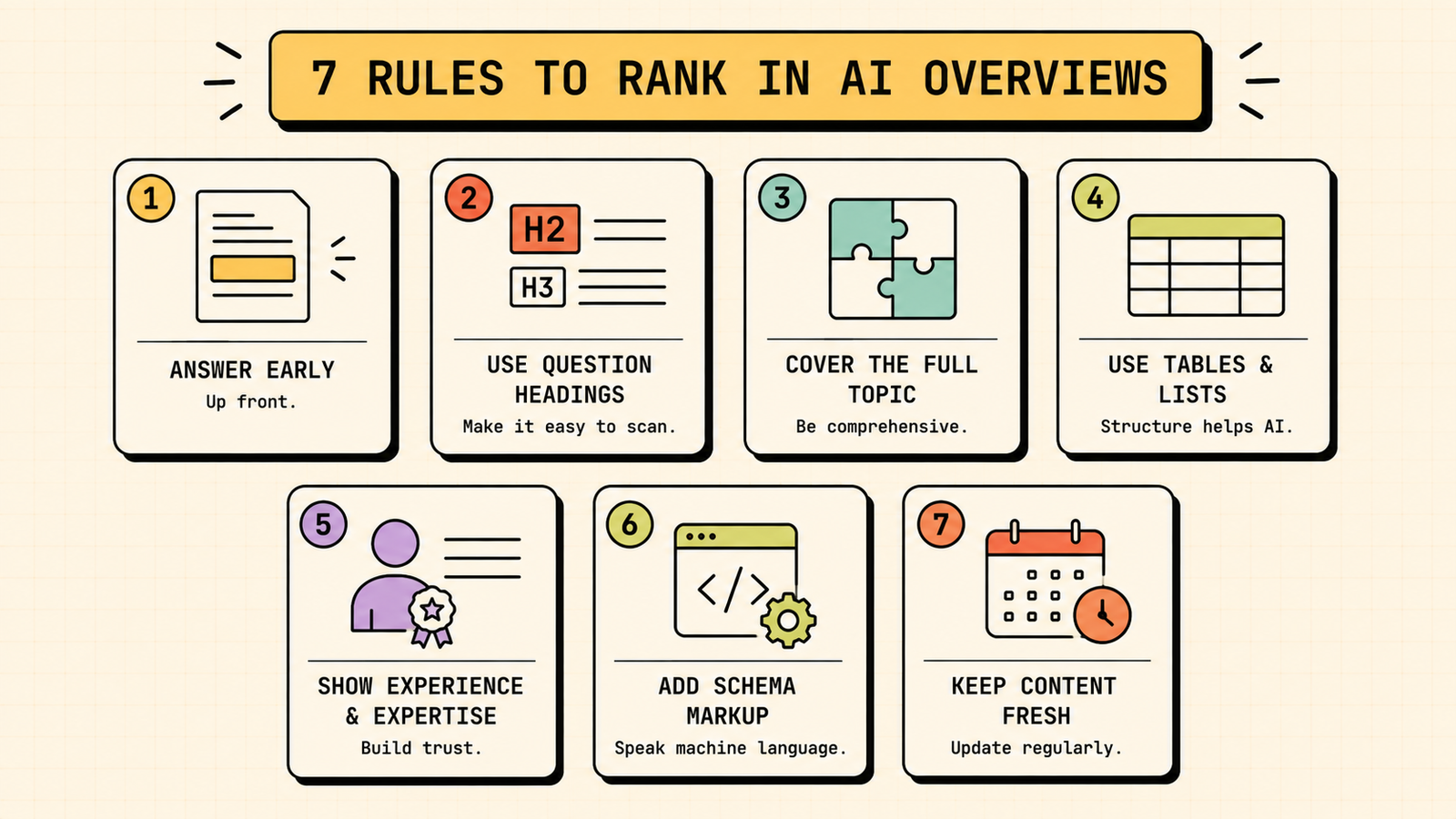
Apply all seven to a single article and you turn an ordinary page into one Google wants to quote.
1. Answer the question directly and early
Open each section with a clear, complete answer in the first two or three sentences, then expand. AI Overviews lift concise, self-contained answers, so the passage that gives the answer cleanly is the one that gets pulled. Do not bury the point four paragraphs down.
2. Use question-based headings
Turn your headings into the actual questions people ask, such as "How much does it cost?" instead of "Pricing." This matches the sub-questions Google generates during query fan-out, making it easy for Gemini to map your content to what it is looking for.
3. Cover the whole topic, not one keyword
Because Google fans a query out into many related questions, a page that answers the full set is far more likely to be cited than one built around a single phrase. Cover the definition, the how, the cost, the comparisons, and the common follow-up questions all in one thorough piece.
4. Use tables, lists, and specific numbers
Structured formats are the easiest for an AI to extract and reuse. Comparison tables, clear lists, and specific figures and dates all raise your odds of being pulled into an overview. Vague, unstructured prose gives the AI nothing clean to lift.
5. Show real expertise (E-E-A-T)
Google strongly favors content that shows experience, expertise, authoritativeness, and trust. Put a real, credentialed author on the page, cite reliable sources, reference genuine data, and demonstrate first-hand knowledge. Trusted sources make up the overwhelming majority of what gets cited.
6. Add schema markup
Schema is code that helps search engines understand your content. Article schema, author and Organization schema, and FAQ schema all make your pages easier to parse and cite. FAQ schema is especially useful, since it maps your questions and answers to exactly the kind of sub-questions AI Overviews answer.
7. Keep content fresh and fast
AI Overviews lean toward current, well-maintained content on fast pages. Update your key articles regularly, add a clear last-updated date, and make sure your pages load quickly and work cleanly on mobile. Slow or stale pages rarely get selected.
The 7 rules at a glance
| Rule | Why it gets you cited |
|---|---|
| Answer directly and early | Self-contained passages are what AI lifts |
| Question-based headings | Match Google's fanned-out sub-questions |
| Cover the whole topic | Full coverage wins far more citations |
| Tables, lists, numbers | Structured formats are easiest to extract |
| Show real expertise | Trusted sources dominate citations |
| Schema markup | Helps Google parse and trust your content |
| Fresh and fast | Current, quick pages get preferred |
SEO Agency Cost in India
We'll show you which of your buyers' searches already trigger AI Overviews and how to get your brand cited.
Get a clear, data-backed plan to win the front-row position in Google's AI answers.
How are AI Overviews different from featured snippets?
People often confuse the two, but they work differently. A featured snippet lifts a single passage from one page and shows it word for word with a link, so it rewards being the single best answer on one page. An AI Overview instead reads several pages, writes its own summary in Google's words, and cites multiple sources, so it rewards being one of the best sources across a whole topic. The practical difference is that featured snippets are a single-page game and AI Overviews are a whole-topic game. The good news is that the same habits win both: clear, direct answers, clean structure, and genuine depth. Optimize well and you can earn a featured snippet and a citation in the overview at the same time.
Are AI Overviews good or bad for your traffic?
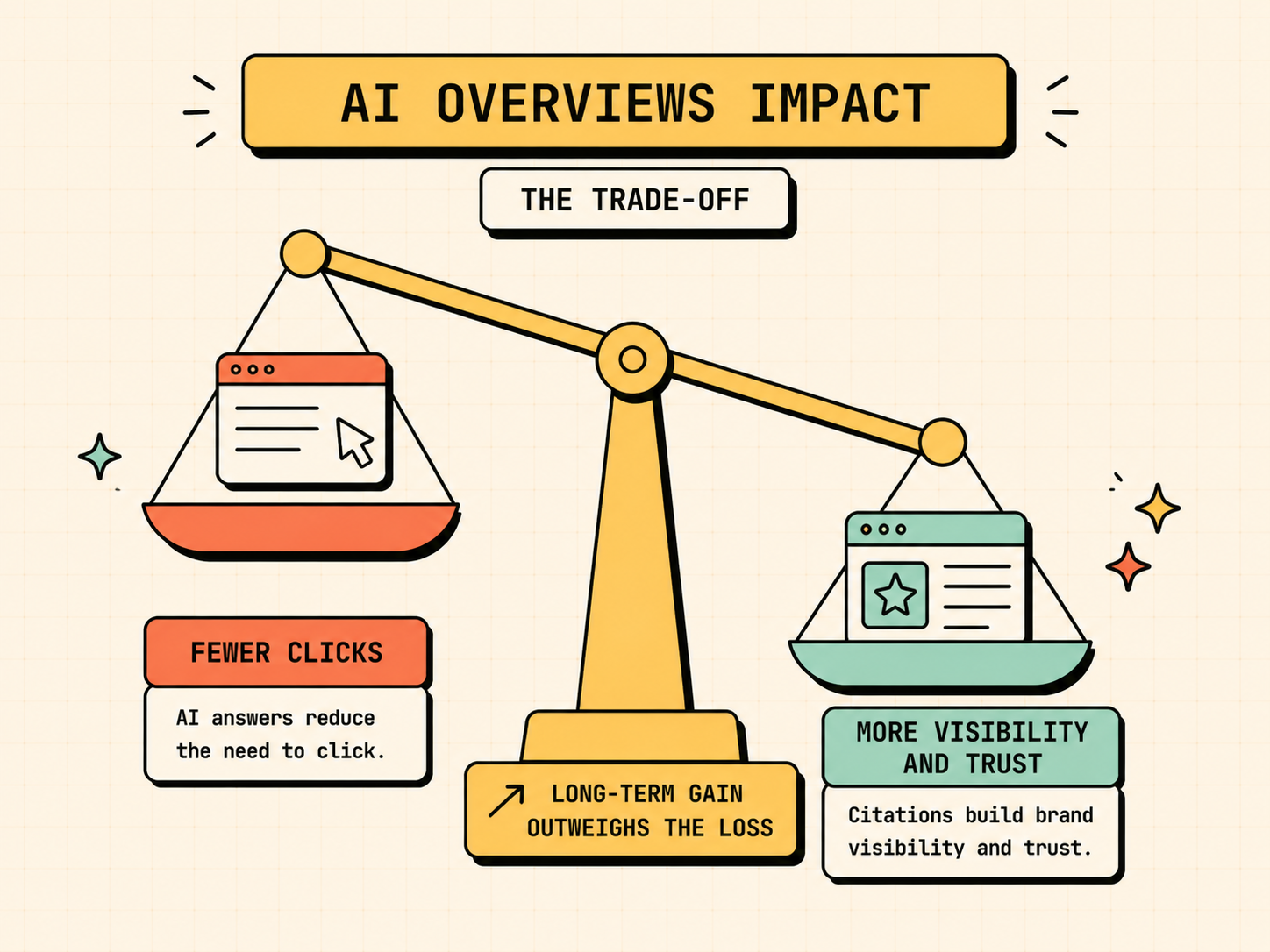
The honest answer is both, and which one depends on your strategy. If searchers get their full answer inside the overview and never click, that can reduce clicks for purely informational queries. That is the risk. But being cited inside the overview puts your brand in front of far more people as a trusted source, drives high-quality clicks from users who want to go deeper, and lifts brand awareness in a way a buried blue link never could. Brands that adapt turn AI Overviews into a visibility win. Brands that ignore them slowly disappear from the answers their customers see.
Common mistakes that keep you out of AI Overviews
Even good content gets passed over when it makes these avoidable errors. The most common is burying the answer, forcing the reader (and the AI) to hunt through long intros before getting to the point. Another is writing thin, generic content that repeats what everyone else says without adding real depth, data, or first-hand experience. Many pages also skip structure entirely, offering walls of text with no headings, tables, or lists for the AI to lift. Some target a single keyword instead of covering the full question, so they answer only a sliver of what Google fans out. Others neglect schema and author signals, giving Google no easy way to understand or trust the page. And plenty simply let content go stale, leaving old dates and outdated facts that make the page a poor candidate for a current answer. Fix these and you clear the bar most competitors never do.
How to track whether you appear in AI Overviews
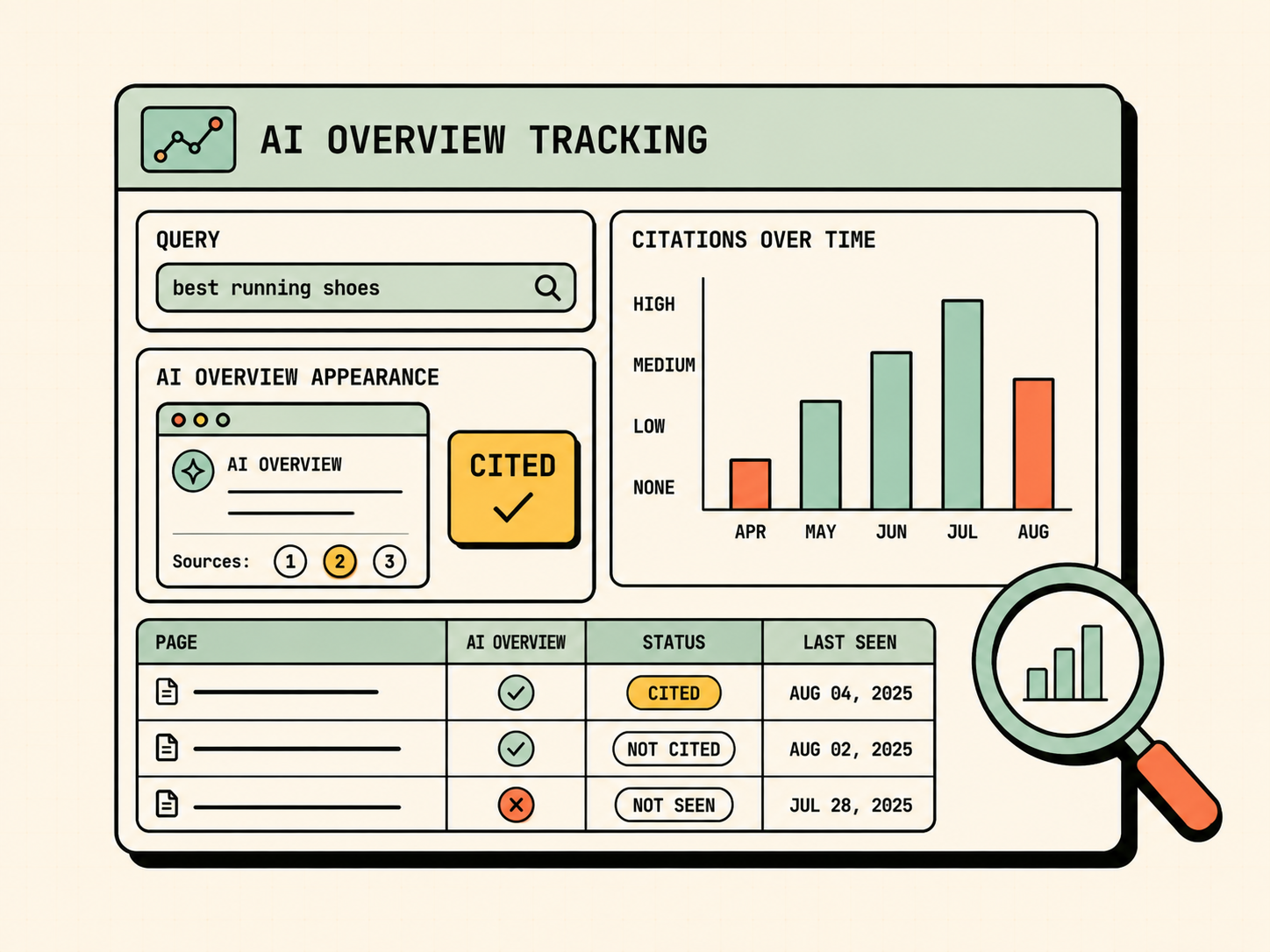
You cannot improve what you do not measure. Watch three things. Search for your target queries and note which ones trigger an AI Overview and whether you are cited. Use rank-tracking tools that now flag AI Overview appearances alongside regular positions. And watch your Search Console data for queries where impressions stay high but clicks fall, which often signals an overview is answering on your behalf. Checking your most important queries regularly tells you where you stand and where to push.
LetMeRank
The bottom line for founders
AI Overviews are not a threat to hide from. They are a new front-row position, and the rules for winning it are clear: answer directly, structure everything for extraction, prove real expertise, add schema, and stay fresh. Do that consistently and Google starts naming your brand as the answer, right at the top of the page.
If you want to know which of your buyers' searches already trigger AI Overviews, who is getting cited today, and how to get your brand into those answers, LetMeRank runs a free AI-visibility audit built exactly for this.