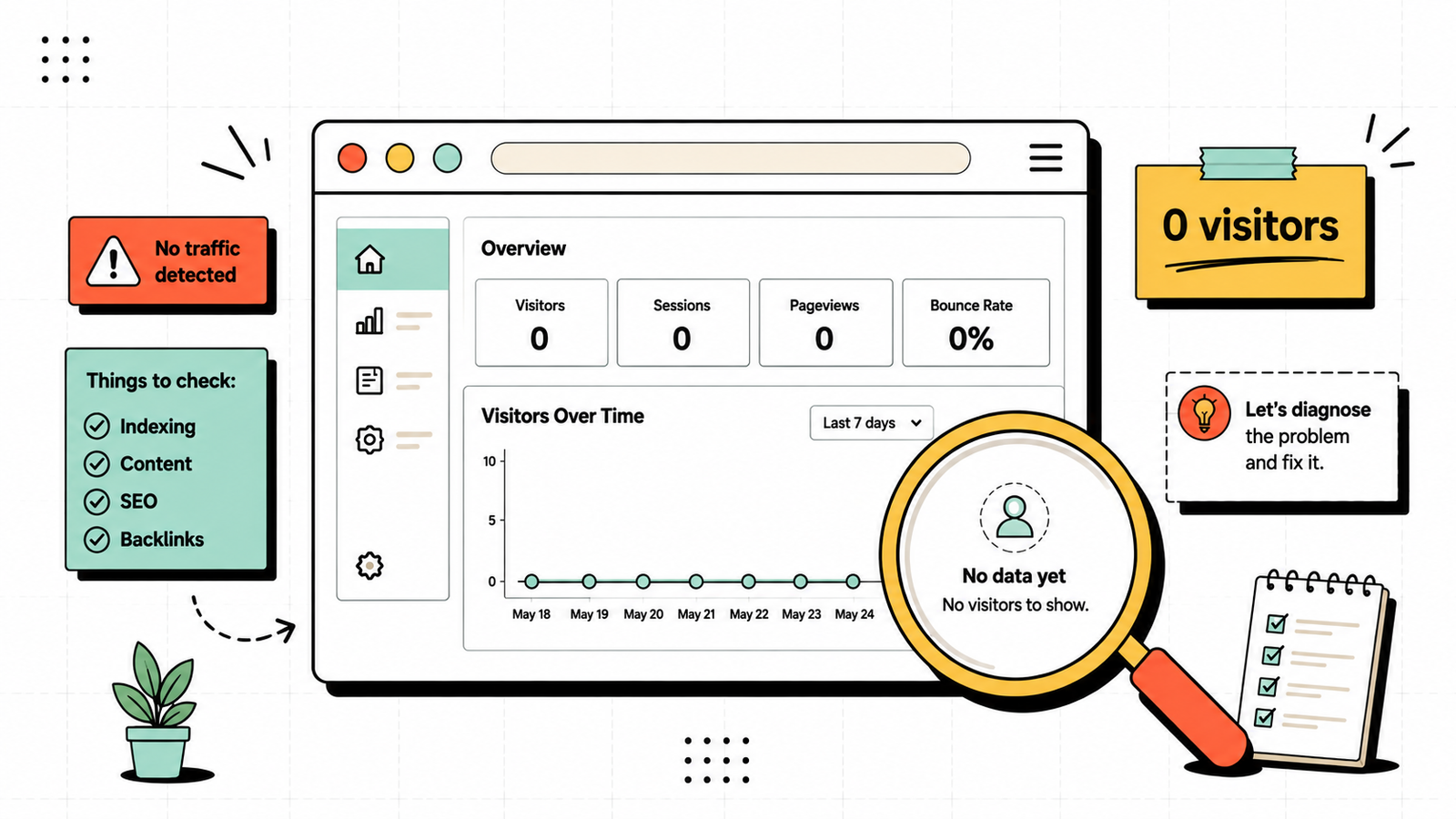
You built the website, you published the pages, you hit go, and then nothing happened. No visitors, no leads, just a quiet analytics dashboard staring back at you. It is one of the most frustrating things a founder can face, and the worst part is that no traffic is a symptom, not a cause. Something specific is blocking people from finding you, and until you know what it is, you cannot fix it. This guide walks through the twelve most common reasons a website gets no traffic, how to spot each one, and exactly what to do about it. Work through them in order and you will almost always find your problem on the list.
How to diagnose the problem before you change anything
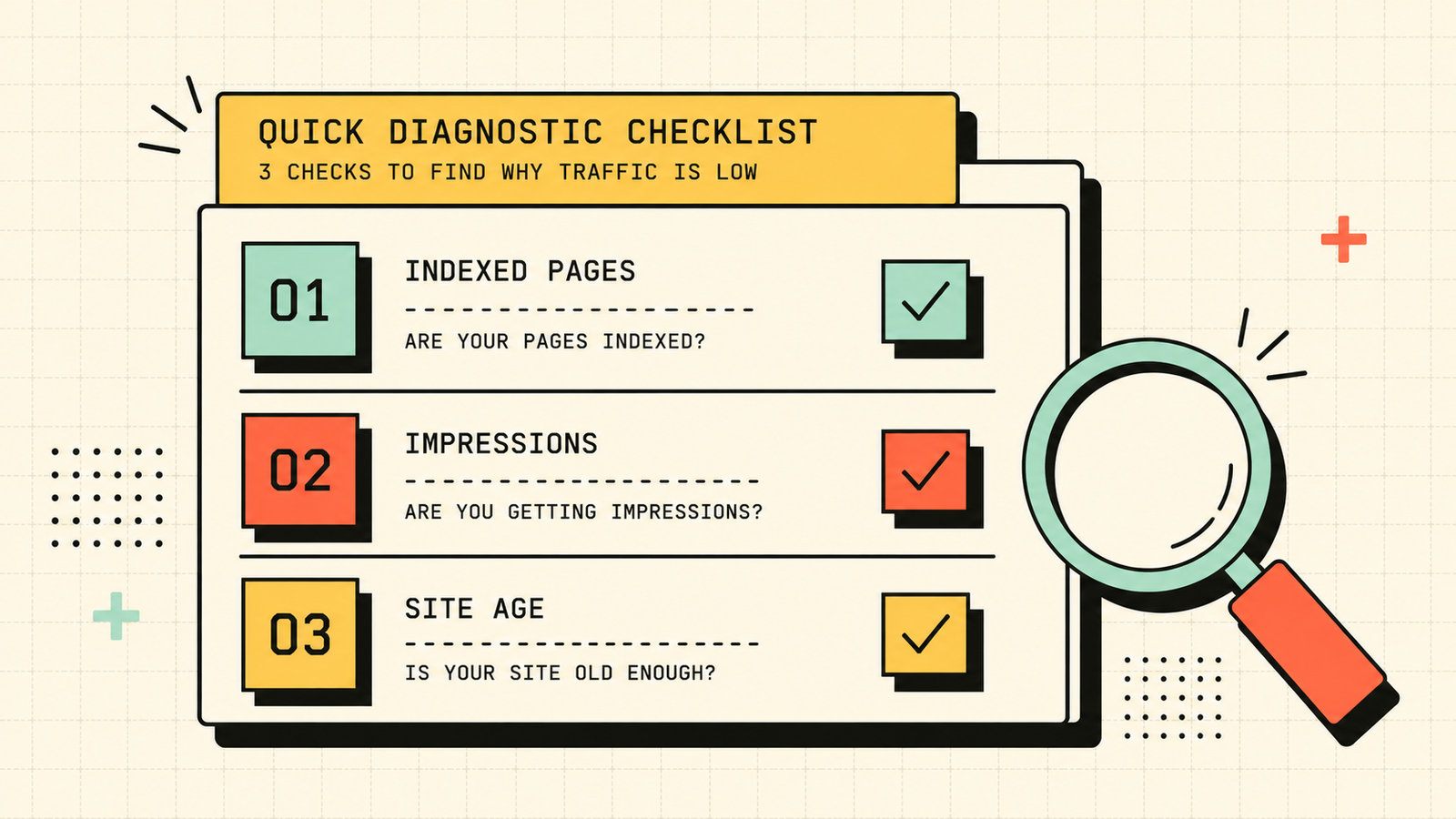
Before you change anything, gather three quick facts. Open Google and search for site:yourdomain.com to see how many of your pages Google has actually indexed. Then open Google Search Console and check whether you are getting impressions (people seeing you in search) or genuinely zero visibility. Finally, look at whether this is a brand new site with no history, or an older site that suddenly lost traffic. Those three answers point you straight at the right section below.
The 12 reasons your website is not getting traffic
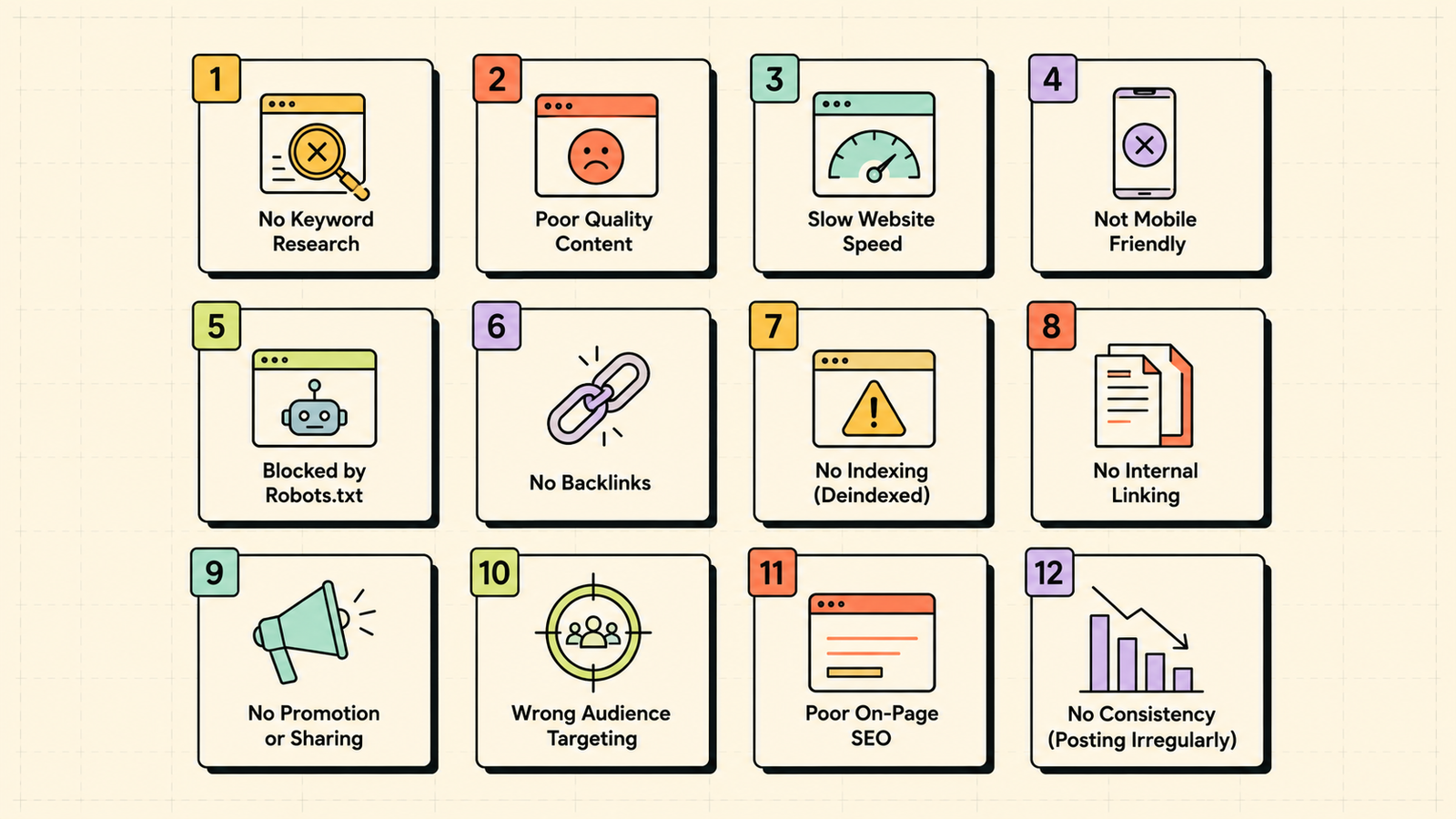
Is your website simply too new to get traffic?
New websites do not rank overnight. Google needs time to crawl your pages, understand what your site is about, and decide whether to trust it. For a fresh domain, it is normal to see very little traffic for the first few months no matter how good your content is.
The fix: be patient, but be productive. Keep publishing helpful content consistently, get your site properly indexed, and start earning a few quality links. Treat the first three to six months as the build phase, not the payoff phase.
Generative Engine Optimization (GEO): How to Rank Your Brand in Google AI Mode, ChatGPT & Perplexity in 2026
Has Google indexed your pages?
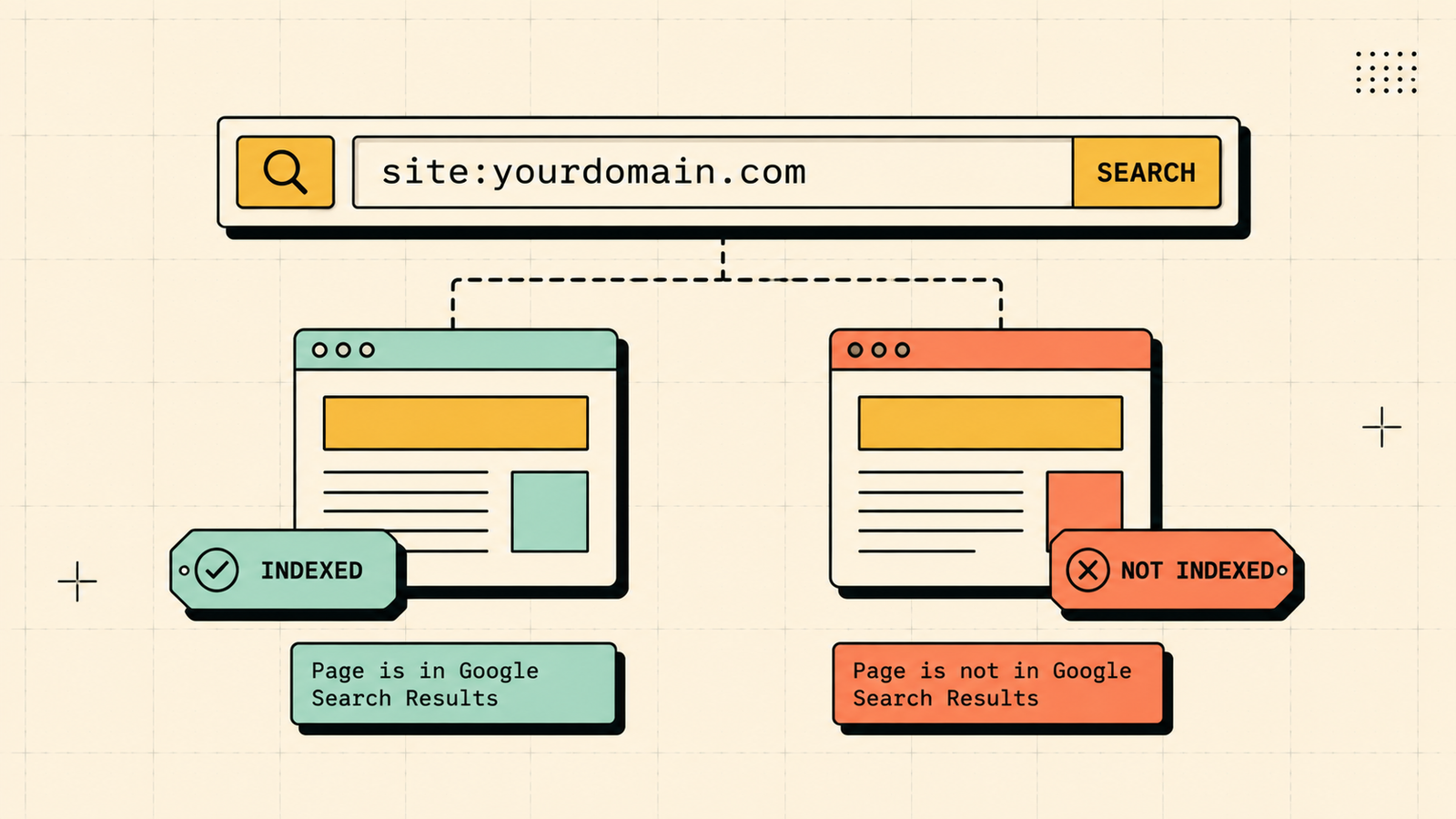
If a page is not in Google's index, it cannot appear in search, full stop. Sometimes pages are blocked accidentally, and sometimes Google just has not gotten around to crawling them yet.
The fix: run the site:yourdomain.com search to see what is indexed. Submit your sitemap in Google Search Console, use the URL Inspection tool to request indexing for important pages, and make sure nothing is accidentally set to noindex.
Are you targeting real keywords people actually search?
Plenty of websites get no traffic because they were never built around what people actually search for. If your pages are written in your own internal language instead of your customers' words, Google has nothing to match them to.
The fix: do proper keyword research. Find the actual phrases your buyers type into search, then build or rewrite pages around those terms. Match your page to a real query, not to a clever headline only you understand.
Is your content too thin or unhelpful?
A page with two paragraphs of generic filler gives Google no reason to rank it above the thousands of deeper, more useful pages already out there. Thin content is one of the most common silent traffic killers.
The fix: create genuinely helpful, thorough content that fully answers the question behind the search. Cover the topic properly, add real detail and examples, and aim to be the most useful result on the page, not just another one.
Does your content match what searchers actually want?
Sometimes your page is good, but it answers a different question than the one people are asking. If someone searches how to fix X and your page tries to sell them X instead of teaching them, Google will not rank it, because it does not satisfy the intent.
The fix: look at what already ranks for your target keyword. If the top results are guides, write a guide. If they are product pages, make a product page. Give searchers the format and answer they are clearly looking for.
Are technical SEO issues blocking your website?
Your robots.txt file might be blocking crawlers, key pages might carry a noindex tag, or broken structure might stop Google from reaching your content. These technical faults can quietly wall off your whole site.
The fix: audit your robots.txt, check for stray noindex tags, fix broken links and redirect chains, and make sure your important pages are reachable within a few clicks from the homepage. Google Search Console will flag most of these issues for you.
Is your site too slow for visitors and Google?
Speed matters for both users and rankings. If your pages take too long to load, visitors leave before they even see your content, and Google is far less likely to send searchers your way. In 2026, Core Web Vitals remain a real ranking signal, with a target of loading your main content in under 2.5 seconds.
The fix: compress your images, cut unnecessary scripts, use quality hosting, and add a CDN if you can. Test your pages with a speed tool and fix whatever is dragging you down.
Is your website mobile friendly?
Most searches happen on phones, and Google primarily judges your site by its mobile version. If your site is clunky, cramped, or hard to use on a small screen, both your rankings and your traffic suffer.
The fix: use a responsive design that adapts to any screen, make buttons and text easy to tap and read, and test your key pages on an actual phone, not just a shrunk browser window.
How to Get 5 Million Pinterest Impressions in 6 Months | Complete RoadMap
Do you have any backlinks or authority?
Backlinks, which are links from other websites to yours, are still one of the strongest signals of trust. A brand new site with zero links has very little authority, which makes it hard to rank for anything competitive.
The fix: earn links the honest way. Create content worth referencing, get featured on relevant industry sites, use digital PR, and build genuine relationships in your space. Quality matters far more than quantity, and spammy shortcuts can hurt you.
Are you competing for keywords that are too hard?
If you are a new brand trying to rank for the biggest, most competitive terms in your industry, you are up against sites that have spent years and large budgets earning their spot. You can do everything right and still lose that fight for now.
The fix: start with lower-competition, long-tail keywords that are more specific and easier to win. Build traffic and authority on those, then work your way up to the harder terms as your site grows stronger.
Are you targeting keywords nobody searches?
The opposite problem is just as real. You might rank number one for a phrase, but if almost no one actually searches for it, ranking gets you no traffic at all.
The fix: check real search volume before you commit to a keyword. Aim for terms that have genuine demand and are still winnable for a site your size. Ranking for something people want beats ranking for something they never look for.
Did your site get a penalty or take an algorithm hit?
If an older site suddenly lost most of its traffic, it may have been affected by a Google algorithm update or, less commonly, hit with a manual penalty for breaking the rules. This is about a drop, not a slow start.
The fix: check Google Search Console for manual action notices, and compare your traffic drop against the dates of known Google updates. If an update caused it, the answer is almost always to improve content quality and remove anything low value or manipulative, then wait for the next assessment.
Quick reference: diagnose your traffic problem
| Reason | Fastest check | Core fix |
|---|---|---|
| Too new | Site age | Keep publishing, be patient |
| Not indexed | site: search | Submit sitemap, request indexing |
| No real keywords | Are pages built on searched terms | Keyword research and rewrite |
| Thin content | Word count and depth | Write genuinely helpful pages |
| Intent mismatch | What ranks now | Match the format searchers want |
| Technical blocks | Robots and noindex | Fix crawl and indexing issues |
| Slow speed | Speed test | Compress, optimize, better hosting |
| Not mobile friendly | Test on a phone | Responsive design |
| No backlinks | Link profile | Earn quality links |
| Too competitive | Keyword difficulty | Start with long-tail terms |
| No search volume | Keyword volume | Target keywords with real demand |
| Penalty or update | Search Console notices | Improve quality, remove low value pages |
Did your traffic drop suddenly? What to check first
A sudden fall is different from a slow start, and it usually has a clear cause. Check these first:
- Google algorithm update. One that landed around the same date.
- Manual penalty. Check for a notice in Search Console.
- Accidental noindex tag. Added during a site change.
- Broken redirect. After a redesign or migration.
- Technical error. Something blocking crawlers.
Recent changes to your site are the most common culprit, so start by asking what changed right before the drop.
How long before a new website gets traffic?
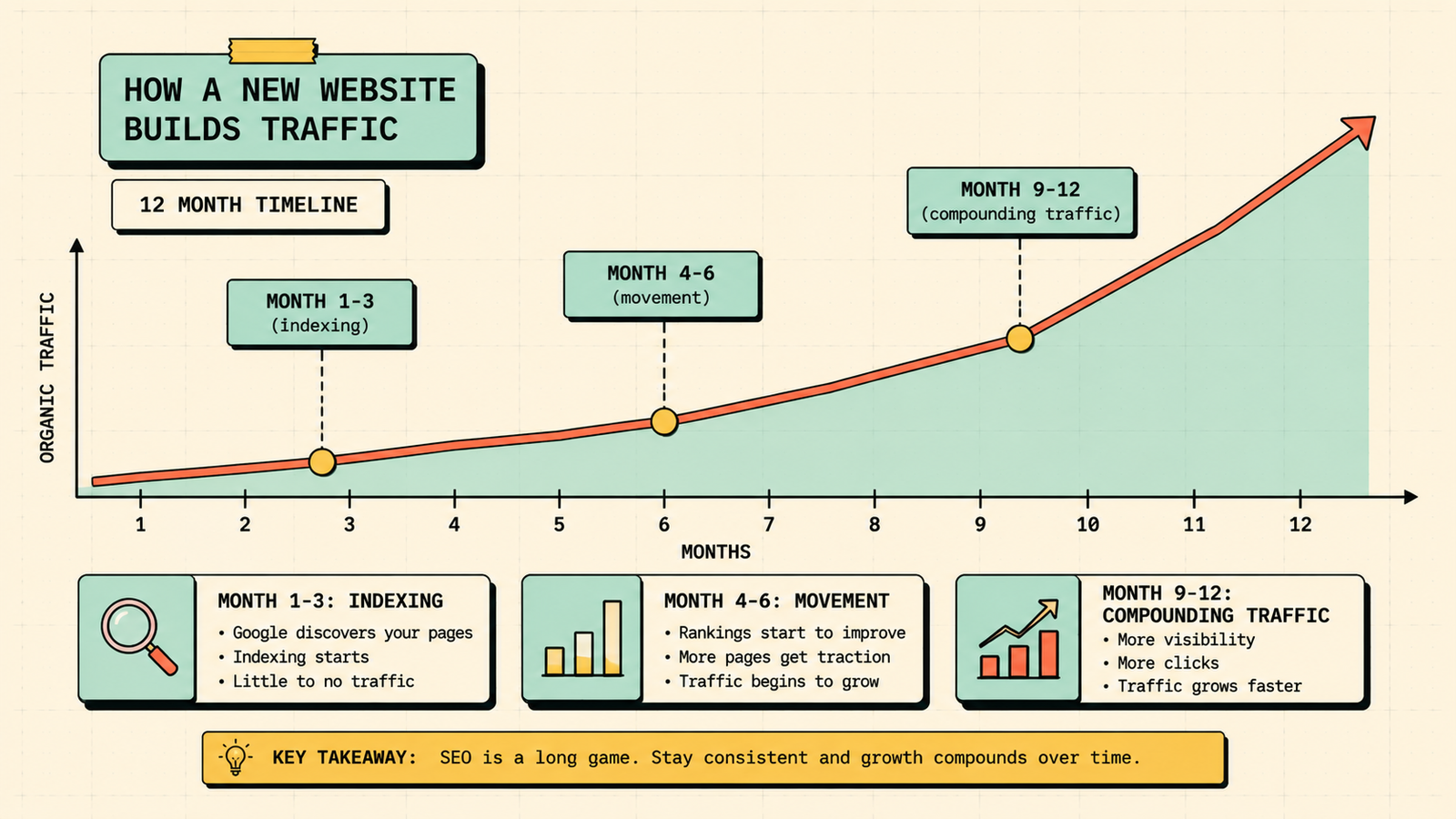
For a brand new site, expect little visible traffic in the first three months while Google crawls, indexes, and begins to trust you. Meaningful movement usually starts around the four to six month mark, and steady, compounding traffic tends to build by nine to twelve months if you keep publishing quality content and earning links. SEO rewards consistency over time, so the sites that win are the ones that keep going through the quiet early phase.
AEO vs SEO: How to Rank in AI Answers (ChatGPT, Gemini, Perplexity)
Quick wins to get traffic faster
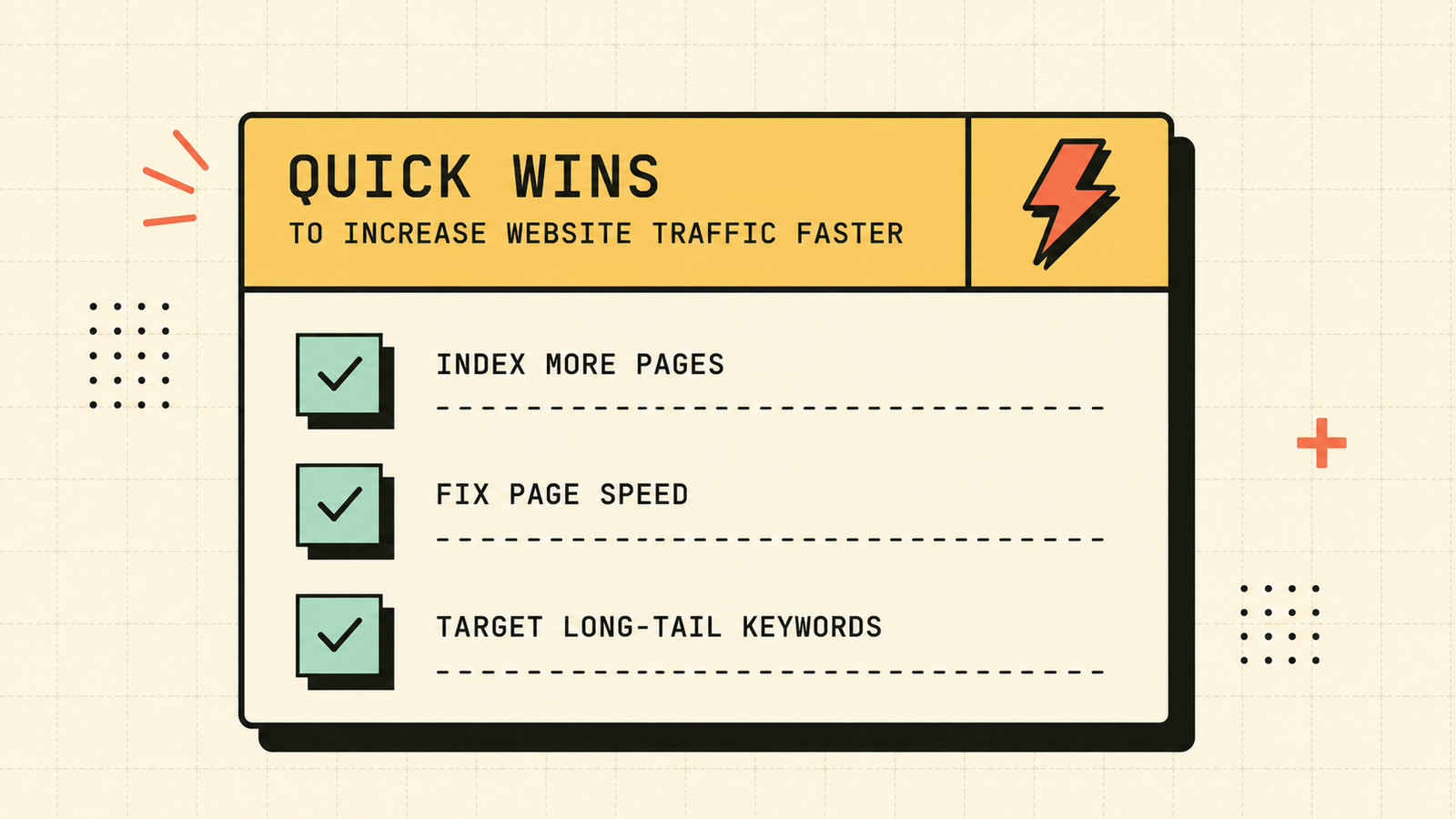
While the long game builds, you can create some momentum now:
- Get indexed. Make sure every important page is indexed.
- Fix technical issues. Address the biggest technical and speed issues first since they are often quick and high impact.
- Target easy wins. Go after a handful of easy long-tail keywords you can realistically win.
- Refresh existing content. Improve and expand your best existing pages instead of only making new ones.
- Share your content. Post in the places your audience already gathers to earn early visits and links.
Small, fast fixes often unlock traffic that was blocked rather than missing.
The bottom line for founders
No traffic almost always comes down to one of two things. Either Google cannot properly find and trust your site yet, or your pages are not built around what people actually search for. Work through the twelve reasons above and you will usually find your specific block. Fix that, stay consistent, and the traffic follows.
If you want a fast, expert diagnosis of exactly why your site is not ranking and a clear plan to fix it, LetMeRank runs a free traffic audit that pinpoints your problem and the highest-impact fixes first.
We will find exactly why you are not ranking.
Send us your website and we will pinpoint what is holding it back, then fix the highest-impact issues first.
Frequently Asked Questions
Why is my new website not getting any traffic?
How do I check if Google has indexed my website?
site:yourdomain.com in Google to see how many of your pages are indexed, or use the URL Inspection tool in Google Search Console. If pages are missing, submit your sitemap and request indexing for the important ones.Why did my website traffic suddenly drop?
noindex tag, a broken redirect after a site change, or a technical error blocking crawlers. Start by looking at what changed on your site right before the drop.