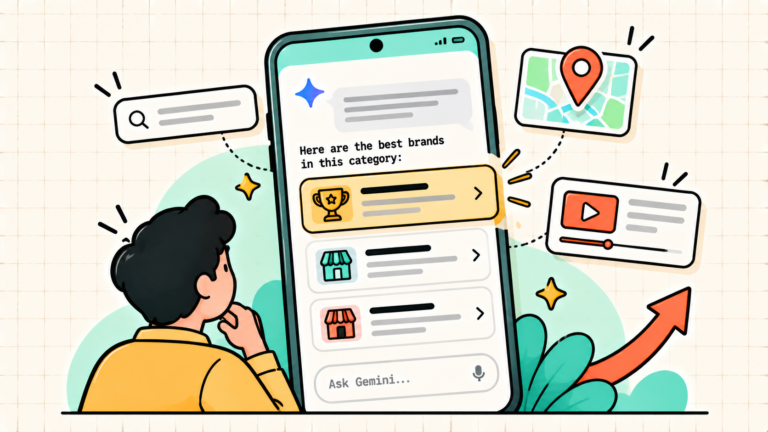
Your next customer might choose you without ever seeing your website, because an AI answered their question for them, and named a brand that wasn't yours.
That's the shift happening right now. People are asking Google's AI Mode, ChatGPT, and Perplexity questions they used to type into a search bar. The AI reads the web, picks a few sources, and writes one clean answer. If your brand isn't in that answer, you're invisible, even if you rank #1 on the old blue links.
Generative Engine Optimization (GEO) is how you fix that. This guide breaks down what GEO is, how these AI engines actually decide who to cite, and the specific moves that get your brand into the answer.
What is Generative Engine Optimization (GEO)?
Generative Engine Optimization is the practice of structuring your content so AI search engines, Google AI Mode, Google AI Overviews, ChatGPT, Perplexity, and Gemini, cite your brand in the answers they generate.
Traditional SEO tries to win a ranking position. GEO tries to win a mention inside the answer. The difference sounds small. It isn't.
| Traditional SEO | Generative Engine Optimization (GEO) | |
|---|---|---|
| Goal | Rank on the results page | Get cited inside the AI answer |
| Unit that wins | The page | The paragraph or passage |
| User action | Clicks your link | May never click, reads the answer |
| Wins by | Keywords, backlinks, authority | Full topic coverage, clear quotable answers, trust signals |
| Success looks like | Position 1 to 3 | Named in the AI response with a citation |
Here's the mindset shift for a founder: on AI search, you're not fighting for a spot on a list. You're auditioning to be the sentence the AI decides to use.
Why GEO matters right now
AI answers are quietly eating the clicks that used to come to your site. When someone gets a complete answer at the top of the page, a large share of them never scroll to the links below. That's the "zero-click" problem: the search happened, but nobody visited your site.
For a D2C or service founder, this hits where it hurts: your organic traffic can drop even while your rankings look fine. The traffic didn't go to a competitor's link, it got absorbed into an AI answer. The only defense is to be the source that answer is built from.
And there's an opportunity buried in the pain: most brands haven't adjusted yet. The businesses that structure content for GEO now will own the AI answers in their category before their competitors even notice the game changed.
How Google AI Mode actually decides what to show
This is the part most people get wrong, so it's worth understanding properly.
Google AI Mode takes your query and quietly breaks it into a set of sub-questions (this is called "query fan-out"). Ask "how to reduce CAC for my D2C brand," and behind the scenes it may also pull results for what is a good CAC, how to calculate CAC, organic vs paid CAC, CAC benchmarks, and more. It then assembles one answer from pages that rank across all of those.
Gemini doesn't cite your whole article. It lifts the specific passage that best answers a piece of the question. So the real unit of optimization is the self-contained paragraph, a chunk that makes complete sense even when pulled out on its own.
AI Mode and AI Overviews are built on the same crawl that powers regular Google results. There's no separate "AI crawler." So the old fundamentals, being crawlable, indexed, and relevant, are still the entry ticket. GEO is layered on top of solid SEO, not instead of it.
Content with strong experience and expertise signals gets cited disproportionately. Pages that reference many recognizable, real-world entities (brands, tools, people, places, numbers) are selected far more often than vague, generic content.
GEO vs SEO: what actually changes in your content
You don't throw away SEO. You extend it. Here's what shifts:
| What you already do (SEO) | What GEO adds on top |
|---|---|
| Target a primary keyword | Cover every sub-question a buyer would ask on the topic |
| Write for the reader | Write for the reader and for extraction: short, quotable answers |
| Use H2 and H3 for structure | Turn H2s into actual questions the AI is likely to ask |
| Build backlinks and authority | Add author credentials, cite sources, name real entities |
| Add basic schema | Add FAQ, Article, and author schema so machines parse you cleanly |
The 7 moves that get your brand cited
You can apply all seven to a single blog post. Together they turn an ordinary article into an AI-answer magnet.
- Answer first, elaborate second. Open every section with a direct, 2 to 3 sentence answer, then explain. That top block is what gets lifted into the AI response.
- Make headings into questions. "Pricing" becomes "How much does it cost?" You're matching the fan-out sub-queries word for word.
- Cover the full topic in one place. Address cost, timeline, alternatives, process, and risks, the questions that surround the main one. Depth beats a thin post targeting one phrase.
- Use tables, numbers, and dates. Comparison tables and specific figures ("₹X per month," "3:1 ratio," "in 2026") are the formats AI engines pull most. Vague claims don't get cited.
- Pack in real entities. Name actual brands, tools, platforms, and metrics. This signals expertise and helps the engine map your content to a topic.
- Show who wrote it and why they'd know. A named author with credentials, cited sources, and a clear "last updated" date all raise your trust score in the AI's eyes.
- Interlink your cluster. Connect related posts so your site shows up across multiple sub-queries in the same answer, and builds topical authority as a whole.
Is AI naming your brand, or your competitor?
We'll show you exactly which questions your buyers are asking the AI, who's getting the answer today, and the fastest fixes to start getting your brand cited.
GEO for ChatGPT and Perplexity, quick differences
Google isn't the only engine your buyers use. The content structure above works everywhere, but the way each engine finds sources differs slightly:
| Engine | What gets you cited |
|---|---|
| Google AI Mode / AI Overviews | Strong presence in Google's index, full question-space coverage, quotable passages |
| ChatGPT | Being mentioned across the web (reviews, listicles, forums, comparisons), clear brand associations |
| Perplexity | Fresh, well-structured, source-friendly pages it can crawl and quote in real time |
The pattern: structure your content once for extraction, then earn mentions across the web so every engine keeps running into your name.
How to know if GEO is working
You can't manage what you can't see. Track these:
- AI Overview appearances. Tools like Google Search Console and third-party rank trackers now flag when your pages surface in AI results.
- Branded mentions in AI answers. Periodically ask ChatGPT, Perplexity, and AI Mode the questions your buyers ask, and check whether you're named.
- Organic traffic quality. If impressions hold but clicks fall, AI is likely answering with (or without) you. Rising branded searches is a good sign the AI is doing your top-of-funnel work.
The bottom line for founders
AI search rewards the same thing good marketing always has, being genuinely useful, but it demands a new shape: complete topic coverage, clear quotable answers, real expertise, and clean structure. Get that right and the AI does your selling for you, naming your brand to buyers before they've even reached your site.
Get it wrong and you fund the competitor who got it right.
If you'd like a straight answer on where your brand currently stands in AI search, and the fastest fixes to start getting cited, LetMeRank runs a free GEO and AI-visibility audit. We'll show you exactly which questions your buyers are asking the AI, and who's getting the answer today.