You just launched a startup. You have a product, a small team, and a marketing budget that needs to stretch. Someone tells you to run Google Ads. Someone else says focus on SEO. Your cofounder wants to be on TikTok. And the marketing consultant you spoke to said you need to be on every channel. They are all wrong. A startup marketing on every channel at once is a startup marketing on no channel well. This guide covers where to actually focus your digital marketing when you have limited budget, limited time, and zero room for waste.
No theory. Just the channels, the order, and the playbook that works when resources are tight.
Why startup marketing is different
Startups face constraints that established businesses do not. Budget is limited, so every rupee needs to work. Time is limited, so the founder or a tiny team is doing marketing alongside building the product. There is no brand recognition yet, so every visitor is cold. And there is pressure to show traction fast, for investors, for customers, or for survival.
These constraints mean the usual advice ("be on all channels," "build a content engine," "invest in brand") is not wrong in principle but is wrong in timing. A startup needs to pick one or two channels, prove they work, then expand. Not the other way around.
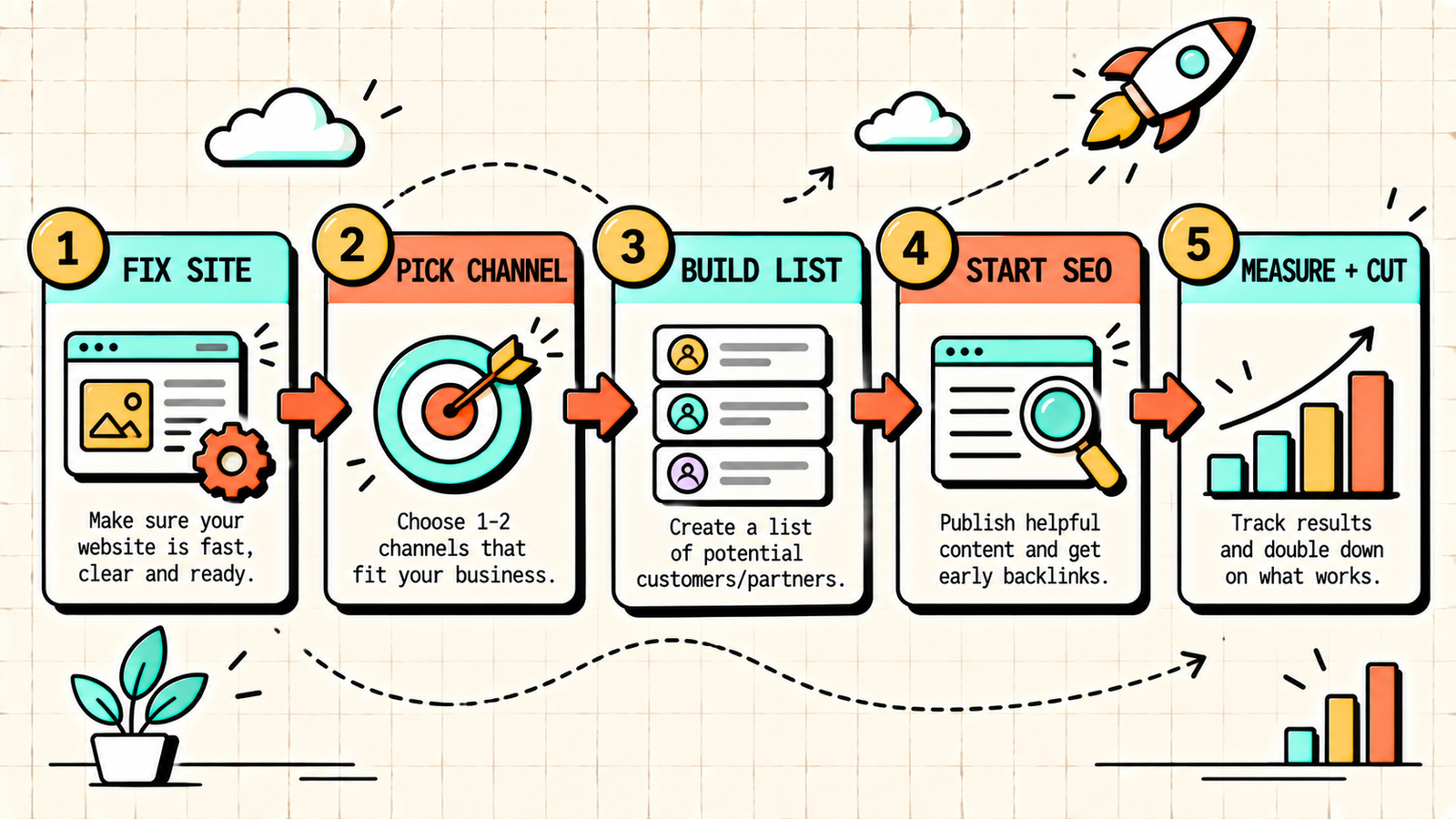
Step 1: Fix your website first
Before spending a single rupee on any channel, make sure your website converts. A startup that drives traffic to a confusing, slow, or unclear website is paying to lose visitors. Your website needs a clear headline that says what you do and who it is for in one sentence, a compelling value proposition visible without scrolling, a fast load time (under three seconds), mobile responsiveness, a single primary call to action (sign up, book a demo, buy, get a quote), and social proof if you have any (even one testimonial or logo is better than nothing). Get this right before you spend on traffic, because a 2 percent conversion rate on 1,000 visitors produces 20 customers while a 0.5 percent rate on the same traffic produces 5. Fix the site first.
Step 2: Pick your first channel
Do not try to be everywhere. Pick one primary channel based on your business type and double down until it works.
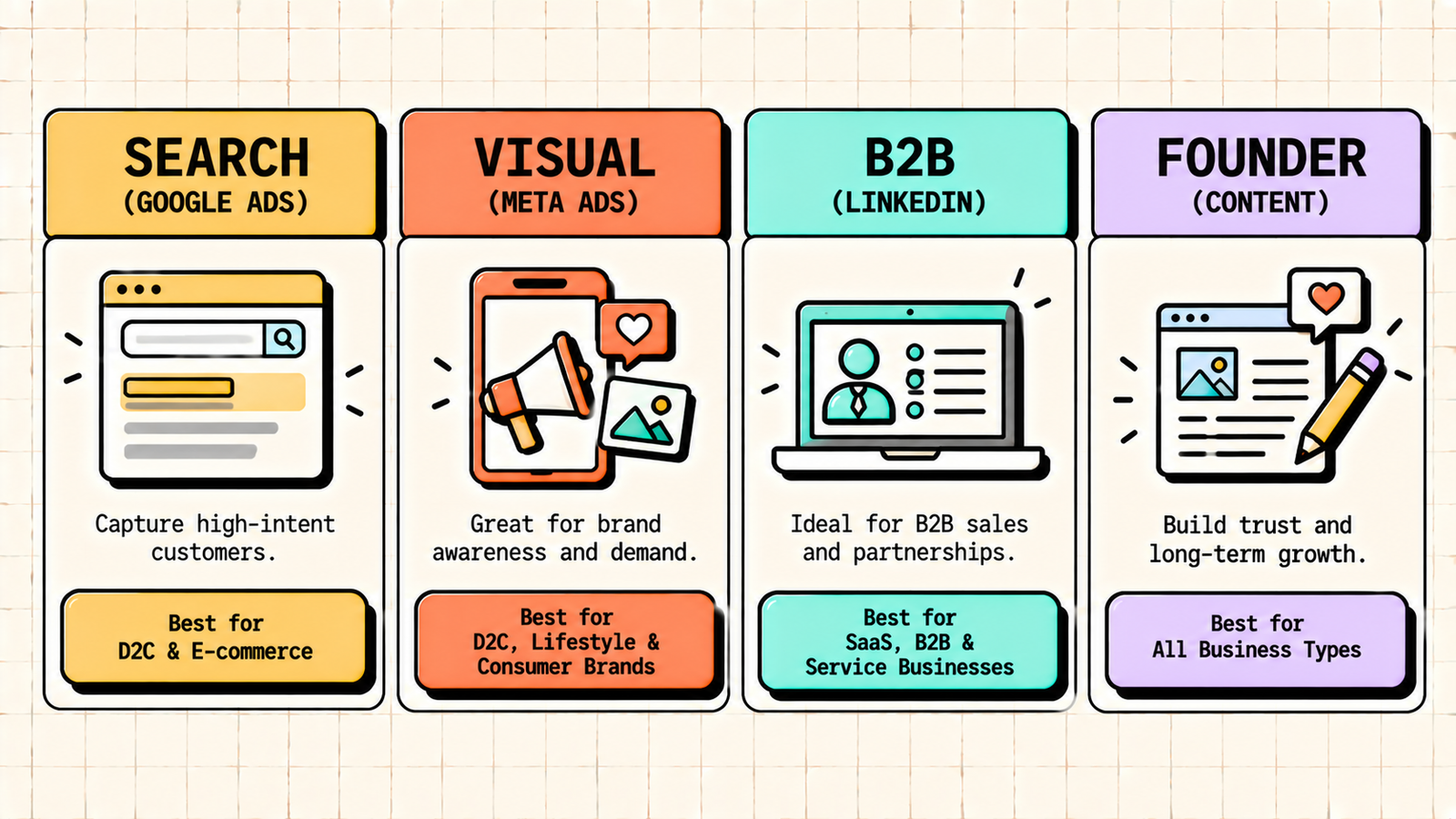
If your customers actively search for what you sell: Start with SEO and Google Ads. Someone searching "best project management tool" or "accountant in Durgapur" has intent. Capture it.
If your product needs to be seen to be wanted: Start with Meta Ads (Instagram and Facebook). Most D2C, consumer, and lifestyle products fall here. People do not search for products they do not know exist, so you need to show up in their feed.
If you sell to other businesses: Start with LinkedIn content and outreach. Your buyers are on LinkedIn in a professional mindset, and founder-led content builds credibility faster than any ad.
If you have a strong founder story: Start with content and social. Share your building journey, your opinions, and your expertise on LinkedIn, X, or YouTube. Personal brands attract audiences faster than company pages.
| Business type | First channel | Why |
|---|---|---|
| Search-driven (services, SaaS, local) | SEO + Google Ads | Captures existing intent |
| Visual/consumer (D2C, fashion, food) | Meta Ads (Instagram) | Creates demand through visuals |
| B2B (SaaS, agencies, consulting) | LinkedIn content + outreach | Reaches decision-makers directly |
| Founder-driven (personal brand) | Content (LinkedIn, YouTube, blog) | Builds trust through the person |
Step 3: Build an email list from day one
Whatever channel you choose, start collecting emails immediately. An email list is the only audience you truly own. Social followers, ad audiences, and search rankings can change overnight. Your email list stays yours.
Offer something valuable in exchange: a free guide, a discount, a waitlist, early access, or a useful tool. Then nurture that list with a welcome sequence and regular valuable emails. Email converts at higher rates than any other channel, costs almost nothing to run, and becomes more valuable as the list grows.
Step 4: Start content and SEO alongside (not instead of) your primary channel
Your primary channel drives immediate results. Content and SEO drive long-term, compounding results. Start both in parallel, but weight your effort toward the primary channel in months one through three, and gradually shift toward content and SEO as they start producing organic traffic.
Publish one blog post per week targeting a specific keyword your customers search for. This builds organic traffic that compounds over time, reduces your dependence on paid channels, and creates assets you can repurpose into social posts, emails, and lead magnets. A startup that publishes consistently for six months has a free traffic engine that works 24/7.
Step 5: Measure relentlessly and cut what does not work
Startups cannot afford to keep spending on channels that do not produce results. Set up conversion tracking from day one (Google Analytics, Meta Pixel, or whatever your channel requires) and measure cost per acquisition (CPA) for every channel. If a channel is not producing leads or sales at a sustainable cost within four to six weeks of testing, either adjust the approach or cut the spend and reallocate.
The metrics that matter: cost per lead or cost per acquisition (is the channel profitable?), conversion rate (is the website converting?), and payback period (how long until the customer covers their acquisition cost?). Everything else is secondary.
We'll show you exactly where to focus your startup marketing first.
Get a clear, data-backed plan to pick the right channel, fix your funnel, and grow without burning your limited budget.
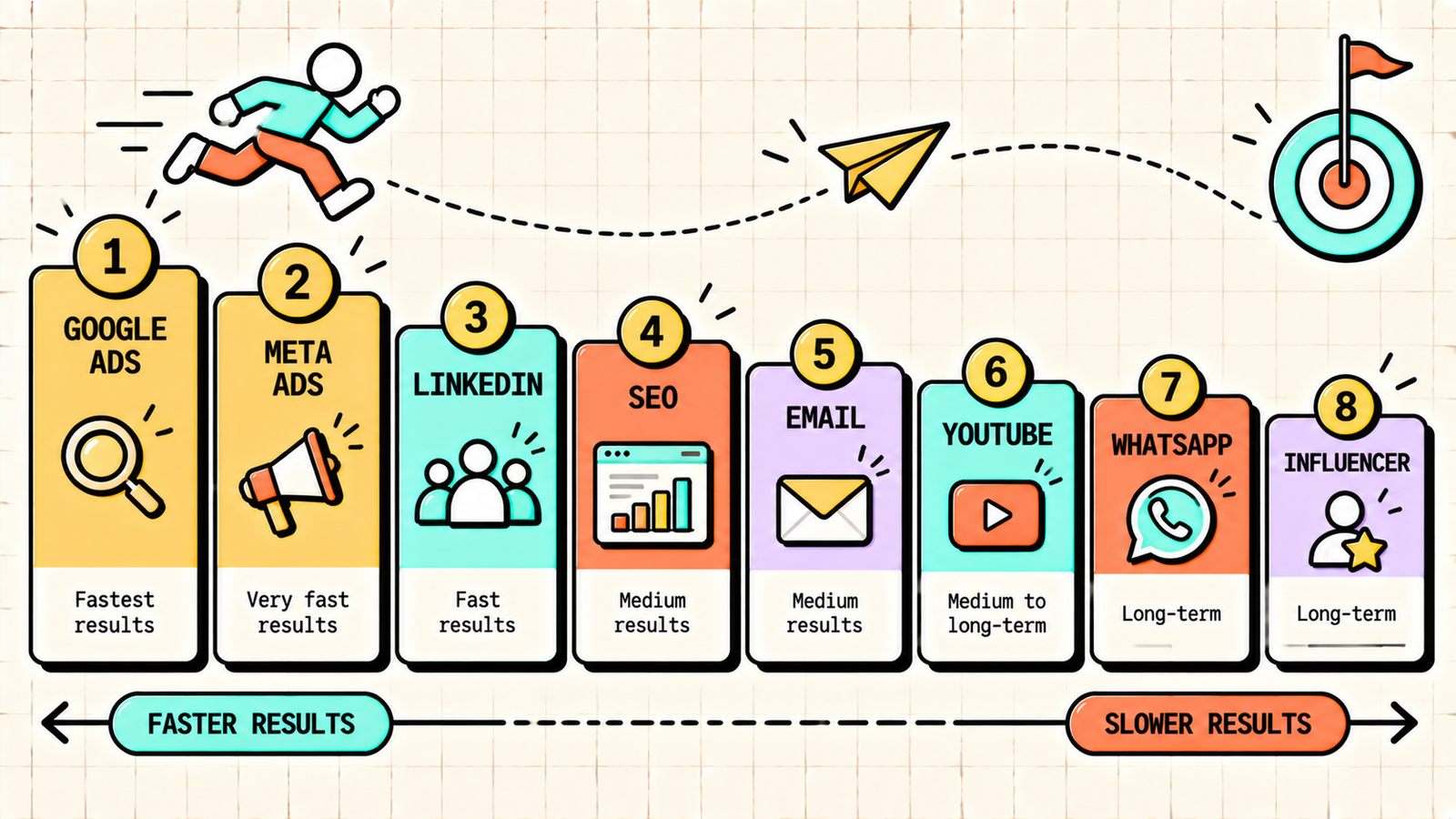
Common startup marketing channels ranked
| Channel | Speed | Cost | Best for | When to use |
|---|---|---|---|---|
| Google Ads (Search) | Instant | Medium to high | Capturing existing intent | When people search for what you sell |
| Meta Ads | Fast | Medium | Creating demand visually | D2C, consumer, visual products |
| LinkedIn (organic) | Slow | Free (time) | B2B, founder branding | When selling to other businesses |
| SEO and content | Slow (3-6 months) | Low (time) | Compounding long-term traffic | Always, alongside primary channel |
| Email marketing | Moderate | Very low | Nurturing and converting leads | From day one, every business |
| YouTube | Slow | Low (time) | Education, trust, long-form | When you can commit to video |
| Fast | Low | Engagement, repeat sales | Indian D2C and service businesses | |
| Influencer | Moderate | Variable | D2C brand discovery | When product is shareable and visual |
How much should a startup spend on marketing?
There is no universal answer, but some benchmarks help. Pre-revenue or early-revenue startups typically allocate 15 to 30 percent of projected revenue to marketing, with the majority going to the primary acquisition channel. Bootstrapped startups often spend almost nothing in cash and invest founder time instead (content, SEO, social, outreach). Funded startups can afford to test paid channels faster, but the principle is the same: spend on what produces results, cut what does not, and never spread budget across five channels when one has not been proven yet.
The healthiest approach: start with the cheapest channels (content, social, email), prove the product-market fit and conversion rate, then add paid channels to scale what is already working organically.
Startup marketing for D2C brands in India
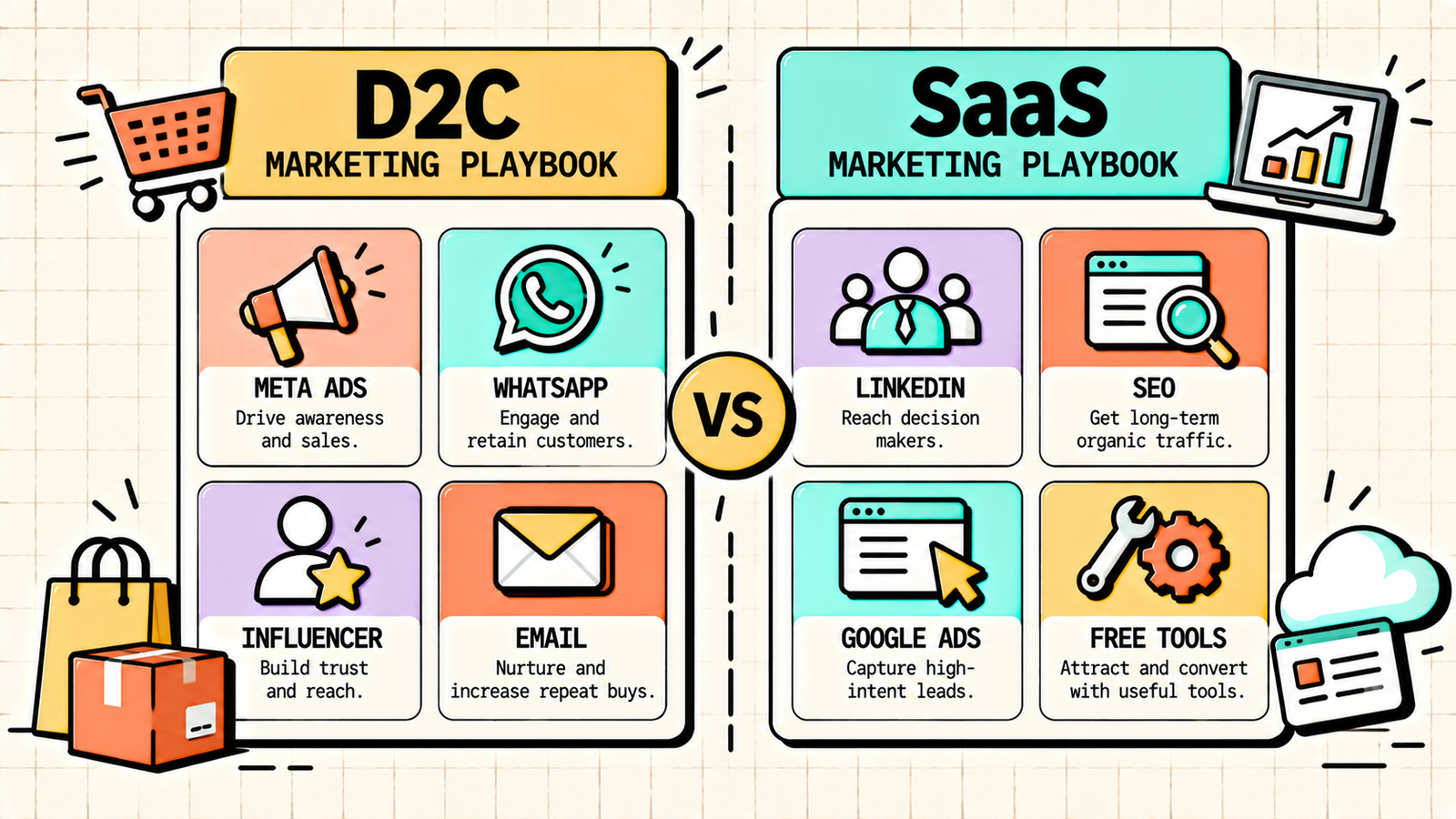
Indian D2C startups have a specific playbook that works. Launch with Meta Ads targeting your initial audience, since Instagram is where Indian consumers discover new brands. Add WhatsApp for post-purchase engagement, repeat orders, and community building. Run influencer seeding with micro-influencers (send free product, let organic coverage happen). Build email and SMS flows for cart abandonment, welcome sequences, and repeat purchase nudges. And start SEO and content in parallel to build a free traffic engine that reduces paid dependency over time. The D2C brands that survive in India are the ones that build organic and retention channels before the Meta Ads CPMs inevitably rise.
How to Improve Website Speed: The Complete Guide to a Faster Site
Startup marketing for SaaS and B2B
SaaS and B2B startups sell to a smaller, more specific audience, which changes the playbook. Start with founder-led LinkedIn content to build credibility and generate inbound interest. Create SEO content targeting the problems your product solves (not just the product itself). Use Google Ads for high-intent keywords where your product is a direct answer. Build a free tool or resource that earns backlinks and generates leads. And nurture every lead with email, because B2B sales cycles are longer and require multiple touches. The SaaS startups that grow fastest through marketing are the ones where the founder is visible, the content is genuinely helpful, and the product itself is part of the marketing through free tiers and tools.
Common startup marketing mistakes
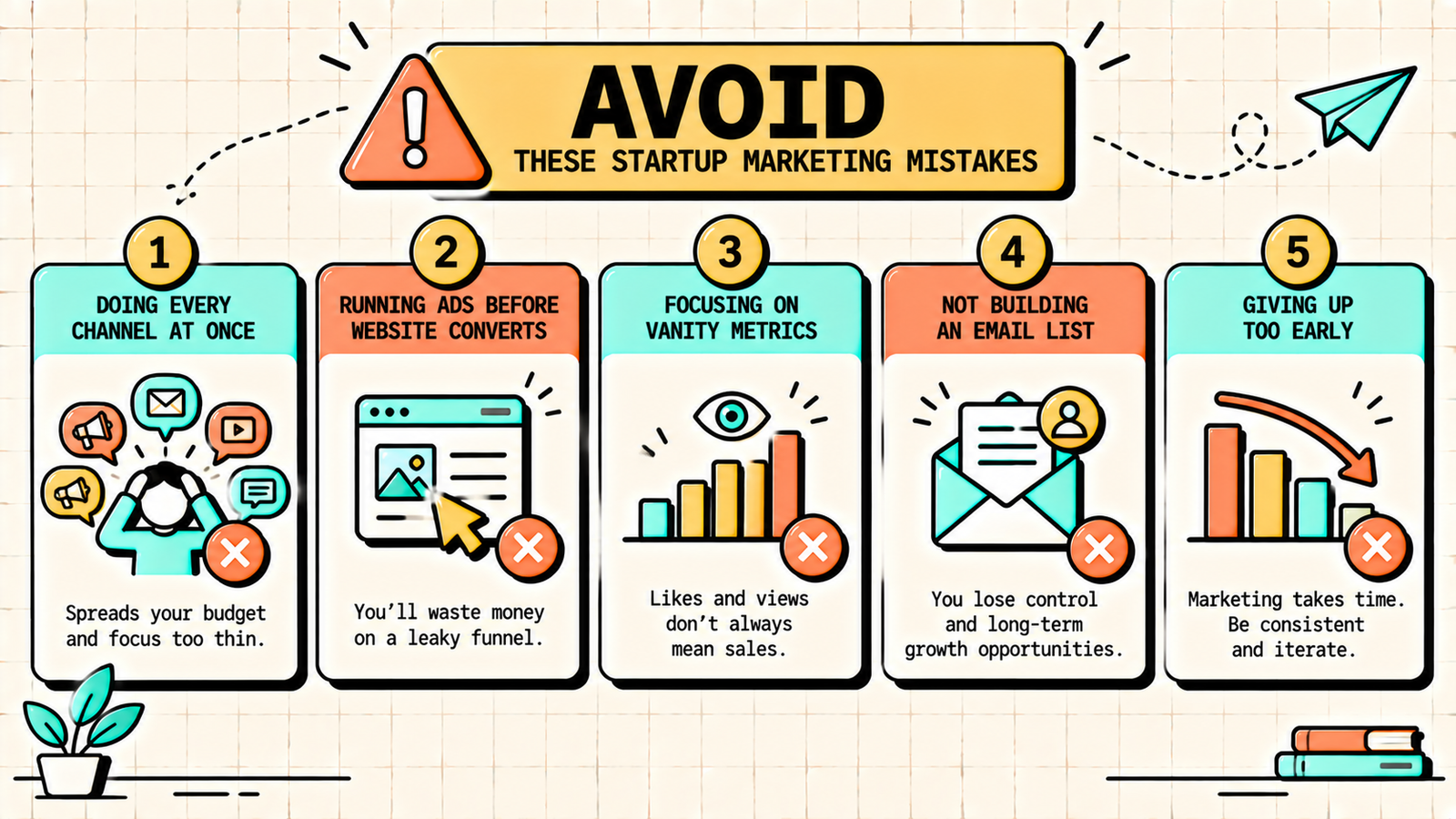
A few patterns waste the most money and time. Trying to be on every channel at once spreads resources too thin to produce results on any of them. Running paid ads before the website converts means paying to lose visitors. Hiring a marketing agency before understanding the basics yourself means you cannot evaluate whether their work is good. Chasing vanity metrics (followers, impressions, website visits) instead of measuring leads and sales gives you a dashboard that looks good while the business starves. Not building an email list from day one means every visitor who leaves is lost forever. And giving up on a channel after two weeks instead of giving it four to six weeks of proper testing abandons experiments before they have enough data to judge.
Google Ranking Factors: What Actually Matters for SEO
The bottom line
Startup marketing is about focus, not volume. Fix your website first. Pick one primary channel based on where your customers are. Start collecting emails from day one. Build content and SEO alongside your primary channel for long-term growth. Measure cost per acquisition relentlessly and cut what does not work. The startups that win at marketing are not the ones on every channel. They are the ones that mastered one channel before expanding to the next.
If you want experts to build your startup's organic and content engine, LetMeRank helps startups and founders grow through SEO, content, and AI search, starting with a free audit.