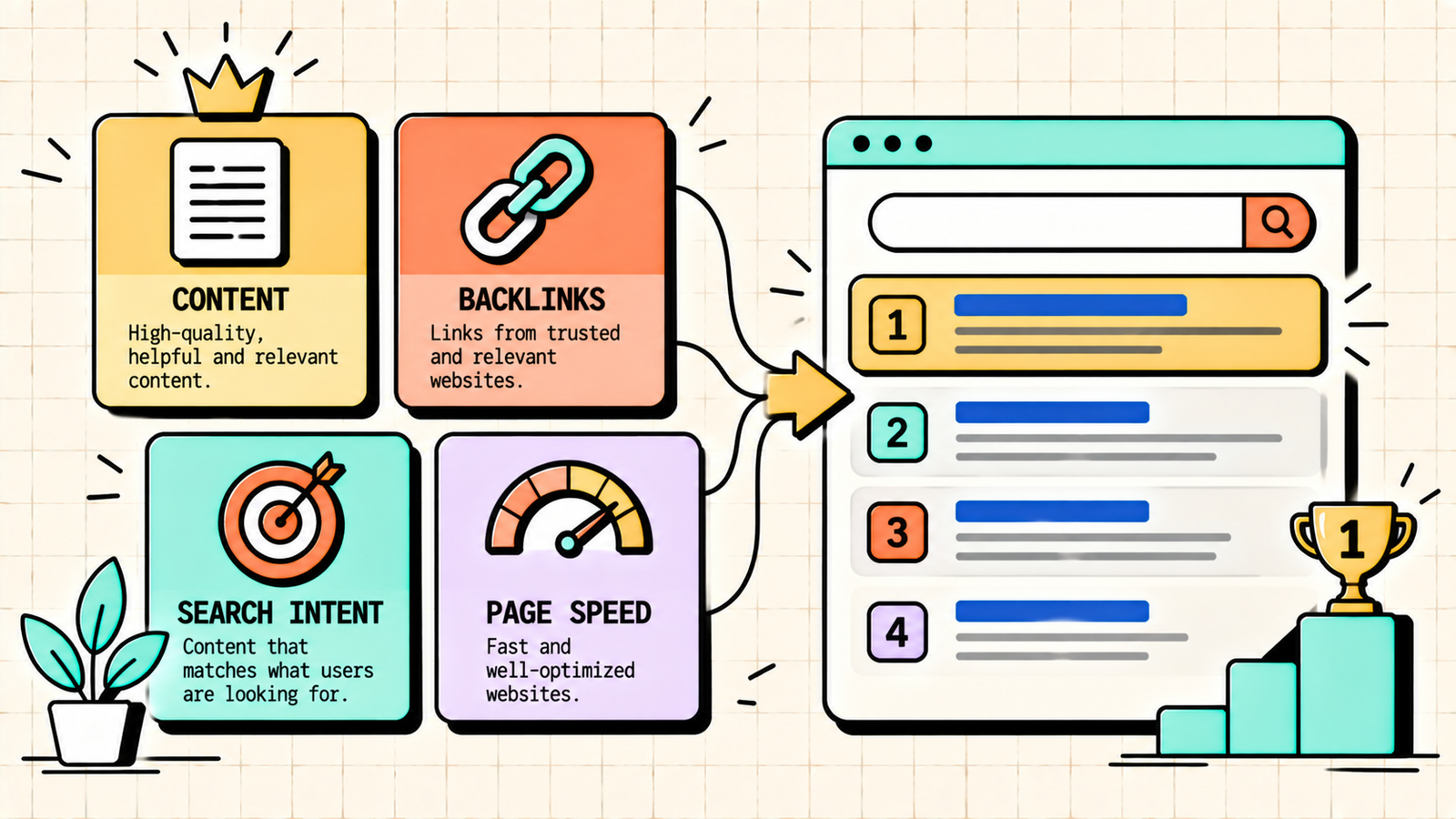
There are hundreds of supposed Google ranking factors floating around the internet. Some are real. Some are outdated. And some were never true in the first place. The problem is that most lists treat every factor as equally important, which leaves you trying to optimise for everything at once instead of focusing on what actually moves rankings. This guide cuts through the noise and covers the ranking factors that genuinely matter, the ones that are overhyped, and what to prioritise so your SEO effort goes where it counts.
How Google ranks pages
Before the factors, it helps to understand the process. When someone searches, Google sorts through billions of indexed pages and ranks them by which best answers that query. It does this using algorithms that evaluate hundreds of signals, but those signals cluster around a few core principles: relevance (how well the page matches the search), authority (how trusted and credible the site and page are), and experience (how useful and accessible the page is for the visitor). Every individual ranking factor is really a way Google measures one of those three things.
The ranking factors that matter most
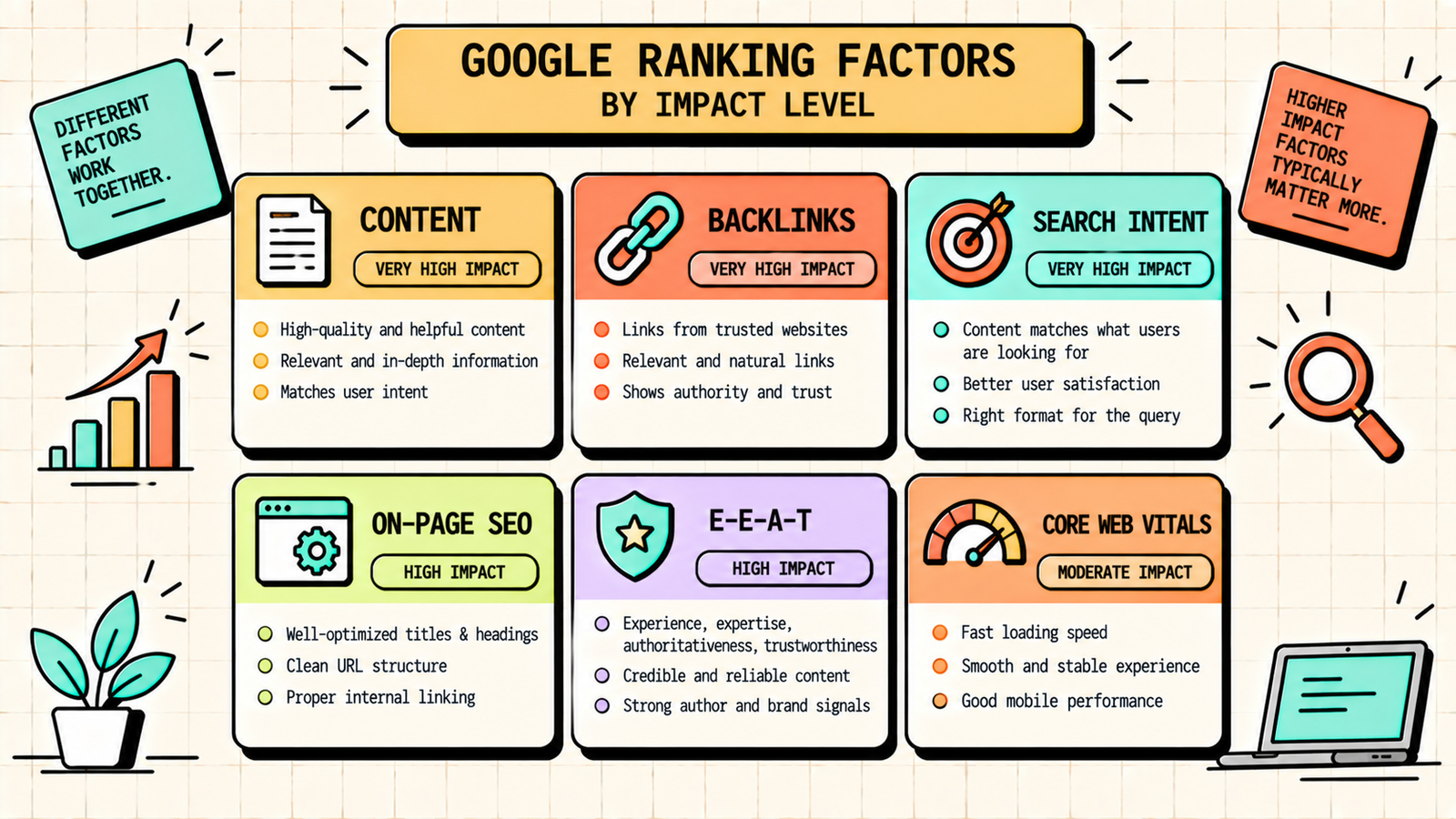
Not all factors are created equal. These are the ones that consistently make the biggest difference.
1. Content quality and relevance
This is the single most important factor. Google wants to show the most helpful, relevant result for every search. That means your content needs to thoroughly answer what the searcher is looking for, match the search intent (informational, commercial, transactional), be accurate, well-written, and genuinely useful, and cover the topic with enough depth that the searcher does not need to click back and try another result. Thin, generic, or outdated content does not rank regardless of how well you optimise everything else.
2. Backlinks
Backlinks from other reputable websites are still one of the strongest signals of authority. Each quality link is essentially a vote of confidence from another site. What matters most is the quality and relevance of the linking site, the number of unique domains linking to you (not just total links), and the natural diversity of your link profile. A few links from genuinely authoritative, relevant sites matter more than hundreds from low-quality directories.
3. Search intent match
Google evaluates whether your page matches the intent behind the search. If someone searches "best running shoes" and Google shows comparison articles, then a product page will not rank for that query no matter how well optimised it is. Matching intent means giving the searcher the type of content (format, depth, angle) that they expect. Check what already ranks for your keyword and match the pattern.
4. On-page SEO signals
These are the signals on your page that tell Google what it is about: title tags (the strongest on-page signal), heading structure (H1, H2, H3), keyword usage in the content (natural, not stuffed), meta descriptions (for CTR, not directly for ranking), URL structure (clean and descriptive), image alt text, and internal links. These are table stakes. Getting them right does not guarantee a ranking, but getting them wrong makes ranking much harder.
5. Page experience and Core Web Vitals
Google measures how good the experience is for visitors. Core Web Vitals track Largest Contentful Paint (how fast the main content loads), Interaction to Next Paint (how responsive the page is), and Cumulative Layout Shift (how stable the visual layout is). Beyond CWV, page experience includes mobile-friendliness, HTTPS security, and no intrusive interstitials (popups that block content). A fast, stable, mobile-friendly page has an edge over a slow, broken one.
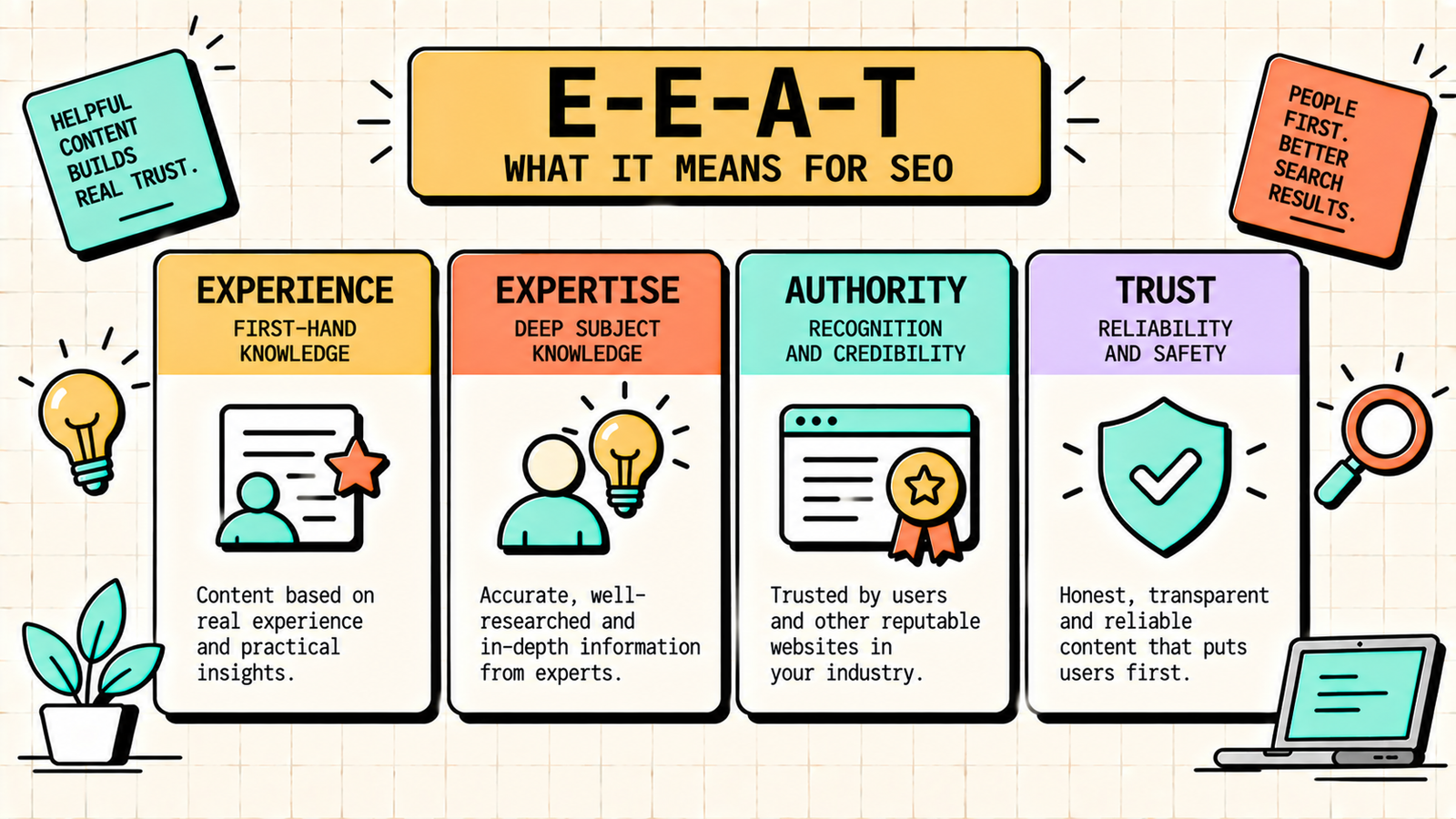
6. E-E-A-T (Experience, Expertise, Authoritativeness, Trustworthiness)
E-E-A-T is not a single ranking factor but a framework Google uses to evaluate content quality, especially for topics that affect health, finances, or safety (YMYL topics). Demonstrating real experience with the topic, expertise in the subject, authority in the field, and trustworthiness as a source all strengthen your content's ranking potential. In practice, this means author bios, credentials, real-world experience, accurate information, and a trustworthy site.
7. Site architecture and crawlability
Google needs to find, crawl, and index your pages before it can rank them. A clean site structure with logical hierarchy, a submitted XML sitemap, no blocked important pages, proper canonical tags, and fast crawl response helps Google process your site efficiently. Technical issues here can silently prevent pages from ranking.
Ranking factors compared by impact
| Factor | Impact | What to do |
|---|---|---|
| Content quality and relevance | Very high | Write the most helpful page on the topic |
| Backlinks | Very high | Earn links from authoritative, relevant sites |
| Search intent match | Very high | Match the format and depth searches expect |
| On-page SEO | High | Optimise titles, headings, keywords, URLs |
| Page experience / CWV | Moderate | Fast, mobile, stable, HTTPS |
| E-E-A-T | Moderate to high (YMYL) | Show expertise, credentials, real experience |
| Site architecture | High (foundational) | Clean structure, sitemap, no crawl blocks |
We'll find exactly which ranking factors are holding your site back.
Get a clear, data-backed plan to focus your SEO effort on the factors that actually move rankings and grow your organic traffic.
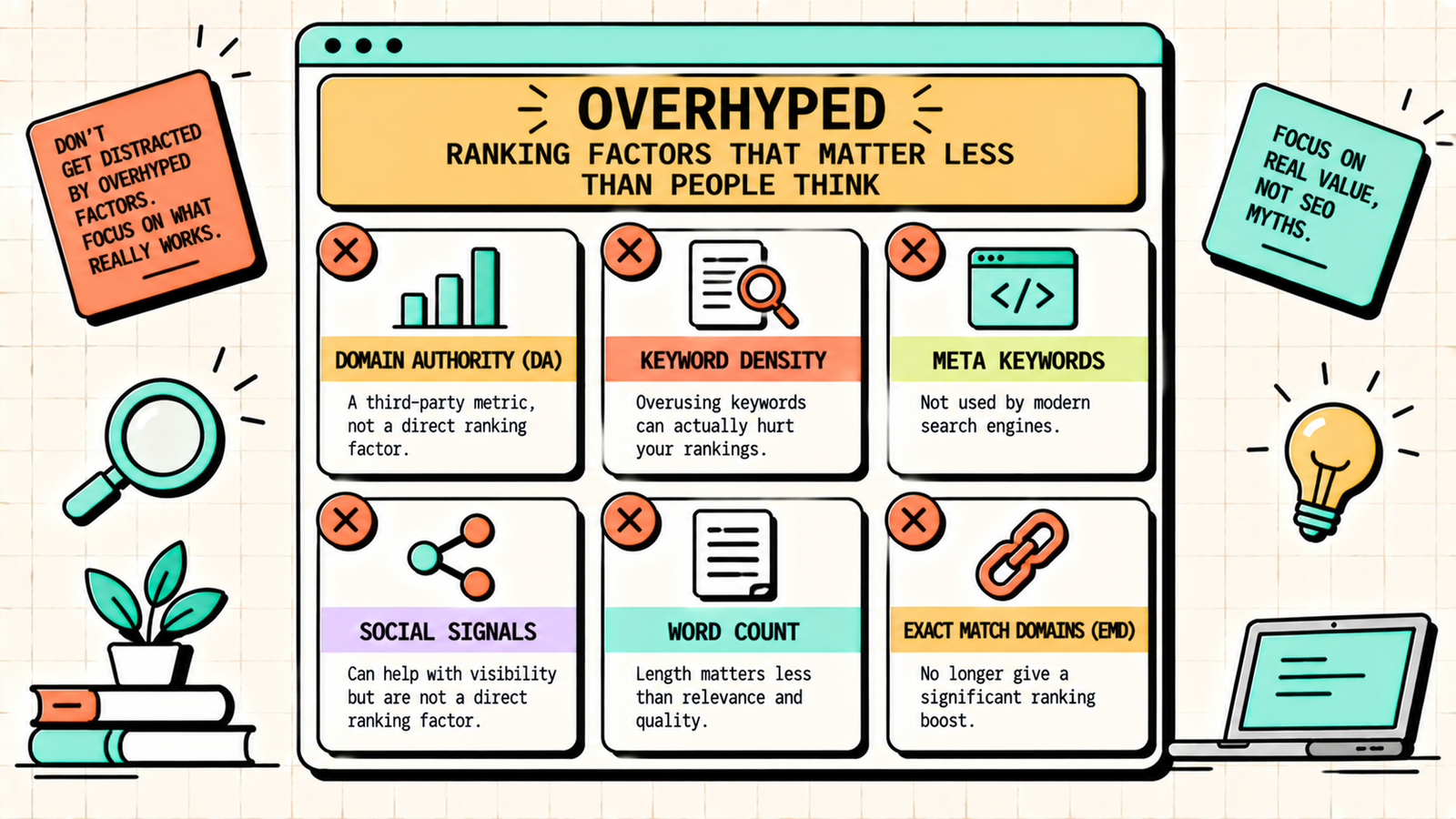
Factors that are overhyped or misunderstood
Several commonly cited "ranking factors" are either less important than people think or not ranking factors at all.
Domain Authority: DA is a Moz metric, not a Google signal. It correlates with rankings because backlinks correlate, but Google does not look at your DA score.
Keyword density: There is no magic percentage. Use your keyword naturally. Stuffing it hurts rather than helps.
Meta keywords tag: Google has not used this tag since at least 2009. Do not bother with it.
Social signals (likes, shares): Google has said social signals are not a direct ranking factor. Social activity can indirectly help by driving traffic and earning links, but likes do not boost rankings.
Word count: Longer content does not rank better because it is longer. It ranks better when the length reflects genuine depth. A 1,200-word post that fully answers the query can outrank a 3,000-word post full of filler.
Exact match domains: Having your keyword in the domain name is a negligible factor at best and has been since Google's EMD update in 2012.
Bounce rate: Google has said bounce rate (as measured in Analytics) is not a ranking factor. User satisfaction signals matter, but bounce rate specifically is not one Google uses.
What the Google ranking leak revealed
In 2024, leaked internal Google documents confirmed or clarified several things about how Google ranks pages. The documents showed that Google uses click data and user interaction signals more than it had publicly acknowledged, that there are different tiers of authority for different types of content, that Google tracks whether content is written by recognised authors, and that freshness and update signals matter for certain query types. The leak did not reveal a simple checklist of factors, but it reinforced that the core principles (quality, relevance, authority, user satisfaction) are genuinely what Google optimises for.
How ranking factors change over time
Google updates its algorithms constantly, with several major updates per year. The factors that matter evolve. In recent years, the shift has been toward content quality over keyword tricks (the Helpful Content updates), user experience signals (Core Web Vitals becoming a factor), AI-generated content evaluation (quality matters, not how it was made), and E-E-A-T emphasis (especially for YMYL topics). The trend is clear: Google is getting better at measuring genuine quality and worse at being tricked. The factors that matter most today, great content, real authority, good UX, are the same ones that have mattered for years. What has changed is that shortcuts and tricks work less and less.
Best CMS for SEO: WordPress, Shopify, Webflow and More Compared
Which factors to prioritise as a small business
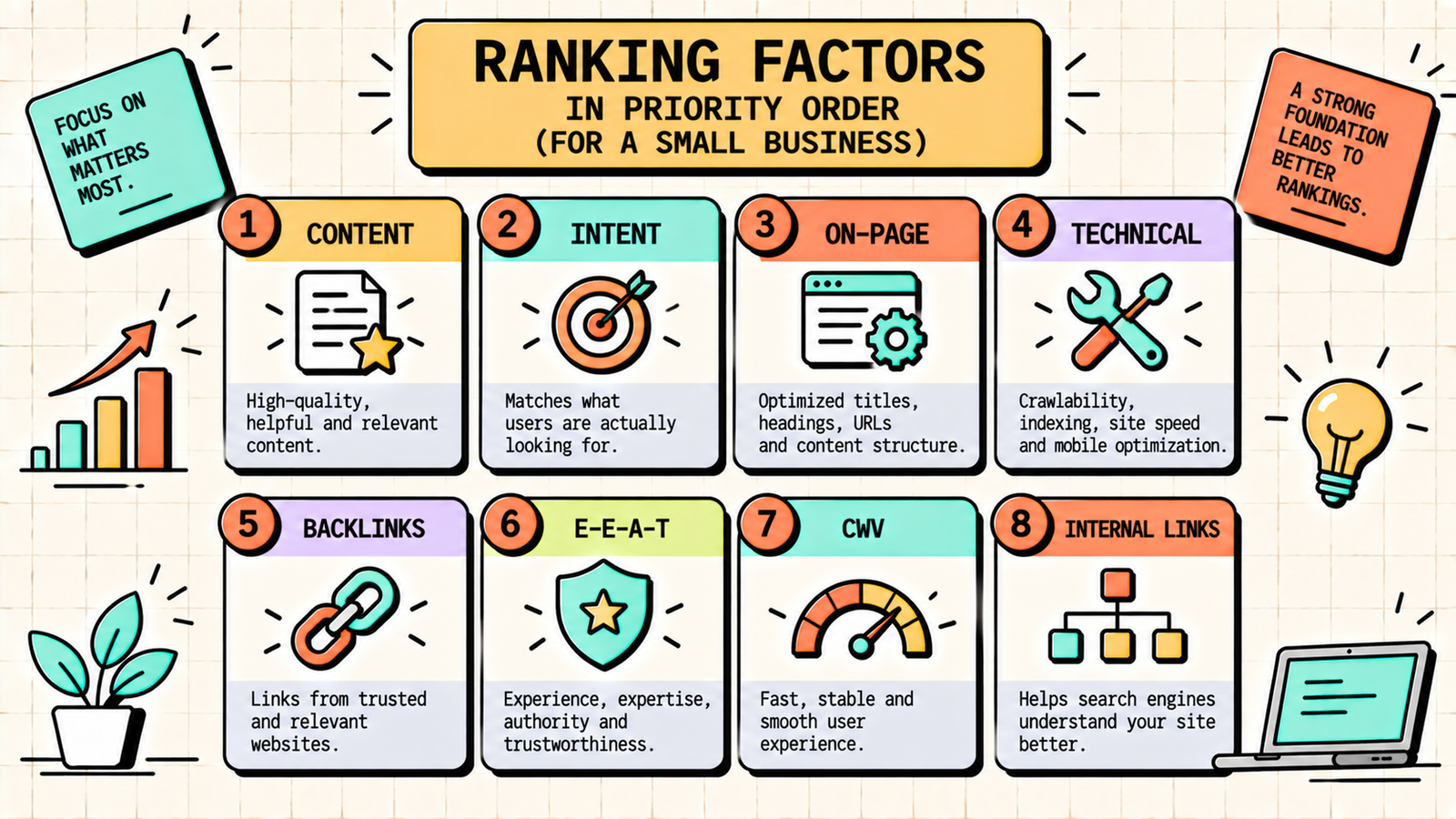
You cannot optimise everything at once. For a small business or new site, prioritise in this order. First, create genuinely helpful content that matches search intent for your target keywords. This is the foundation. Second, get your on-page SEO right on every important page (titles, headings, keywords, meta descriptions). Third, fix your technical basics (speed, mobile, HTTPS, indexing). Fourth, build a few quality backlinks through content, outreach, and relationships. Fifth, demonstrate E-E-A-T through author bios, real expertise, and accurate information. Sixth, monitor and improve page experience (Core Web Vitals). Work through them in this order, and you are spending your limited time where it makes the most difference.
The ranking factors checklist
| Priority | Factor | Action |
|---|---|---|
| 1 | Content quality | Write the best, most helpful page on the topic |
| 2 | Search intent | Match the format and depth top results use |
| 3 | On-page SEO | Title, headings, keyword, URL, meta, alt text |
| 4 | Technical | Speed, mobile, HTTPS, sitemap, indexing basics |
| 5 | Backlinks | Earn quality links from relevant sites |
| 6 | E-E-A-T | Author bios, credentials, accurate info |
| 7 | Page experience | Core Web Vitals, no intrusive popups |
| 8 | Internal linking | Connect related pages, spread authority |
Common mistakes when optimising for ranking factors
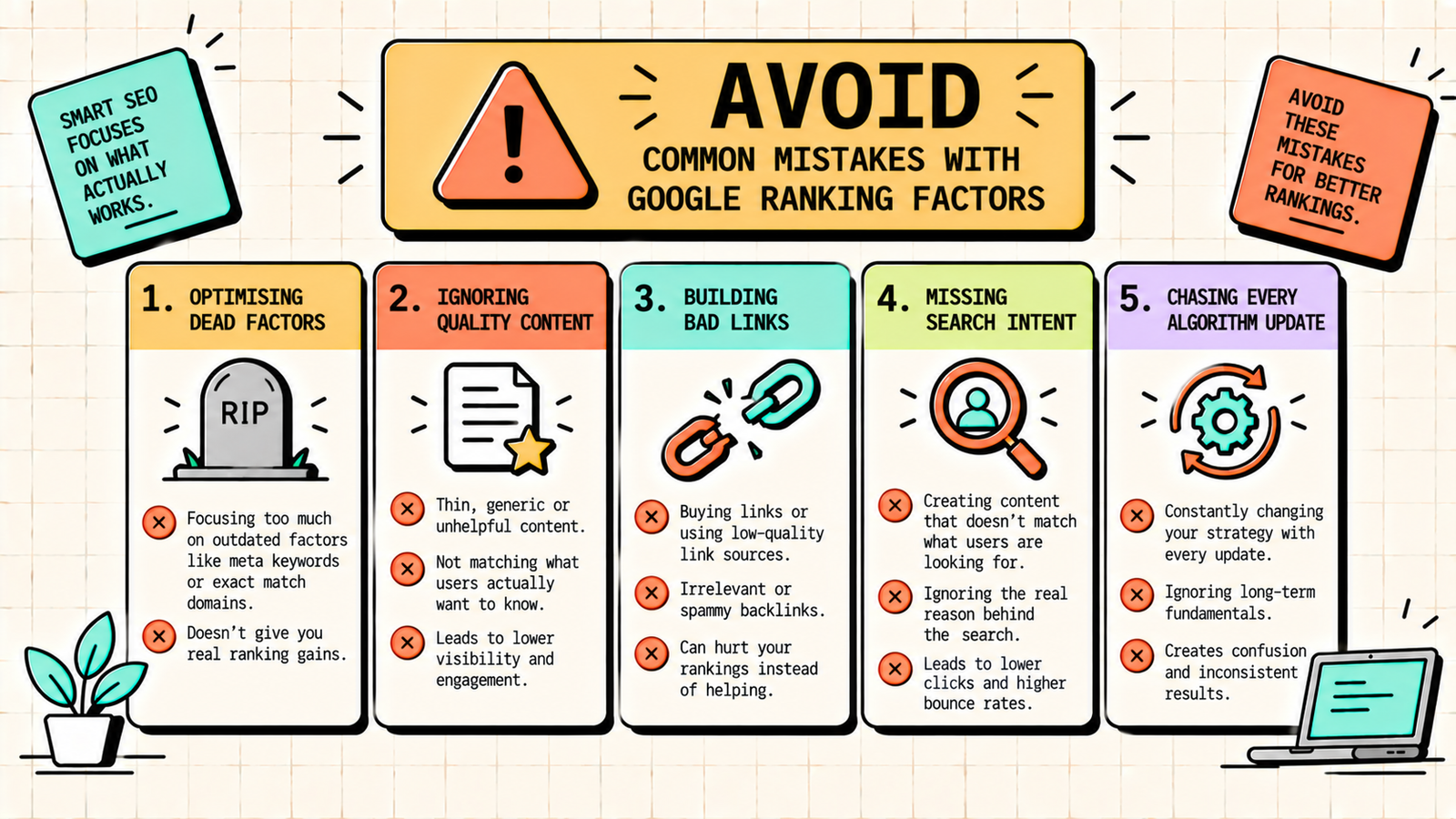
A few patterns waste the most effort. Optimising for factors that do not matter (keyword density, meta keywords, exact match domains) wastes time on things Google ignores. Focusing on technical SEO while neglecting content quality fixes the plumbing but leaves the house empty. Building low-quality backlinks in bulk risks a penalty and does not build real authority. Ignoring search intent means your page does not match what Google rewards for that query. And chasing every algorithm update instead of building genuine quality creates a reactive strategy that never compounds.
How to Write Meta Descriptions That Get Clicks (With Examples)
The bottom line
Google uses hundreds of signals, but the ones that matter most are content quality and relevance, backlinks, search intent match, on-page SEO, page experience, and E-E-A-T. Focus on these in order. Write the most helpful content, optimise your pages, fix the technical foundation, earn real authority, and demonstrate expertise. The businesses that rank consistently are the ones that do these fundamentals well, not the ones that chase every supposed factor on a list of 200. Focus on what matters, ignore what does not, and your rankings will reflect the genuine quality of your site and content rather than your ability to game a system that is built to resist gaming.
If you want experts to audit your site against the factors that actually matter, LetMeRank helps founders and brands rank through genuine quality, not tricks, starting with a free audit.