
You post every day, on every platform, about whatever comes to mind. Some posts do well. Most disappear, and you have no idea why, because there is no pattern behind what you publish.
Content pillars fix that. They are the three to five recurring themes that anchor everything you create, so every post has a purpose, your audience knows what to expect, and your content compounds into authority instead of evaporating into the feed. This guide covers what content pillars are, how to choose yours, how they work for both social media and SEO, and how to build a system that keeps your content focused without making it repetitive.
What are content pillars?
Content pillars are the core themes or topics your brand consistently creates content around. They define the lanes you stay in, so everything you publish connects to a larger story rather than being a random collection of one-off posts.
For example, a D2C skincare brand might have five pillars: product education, skincare routines, customer results, behind-the-scenes, and ingredient science. Every piece of content they create fits into one of those five categories. That focus is what builds recognition, because your audience learns what you stand for and why they should follow you.
Why do content pillars matter?
Without pillars, content creation is reactive: you wake up, wonder what to post, and grab whatever is easiest. With pillars, you have a framework that makes decisions faster, builds topical authority on your core subjects, trains your audience to expect and seek out your content, makes repurposing easier because themes are consistent, and prevents the drift that turns a focused brand into a noisy one.
Pillars do not limit creativity. They channel it, which is what makes the difference between a brand that builds an audience and one that just posts.
How do content pillars work for social media?
On social media, pillars keep your feed cohesive and your content strategy sustainable. Each pillar generates a repeating stream of post ideas, so you never start from zero.
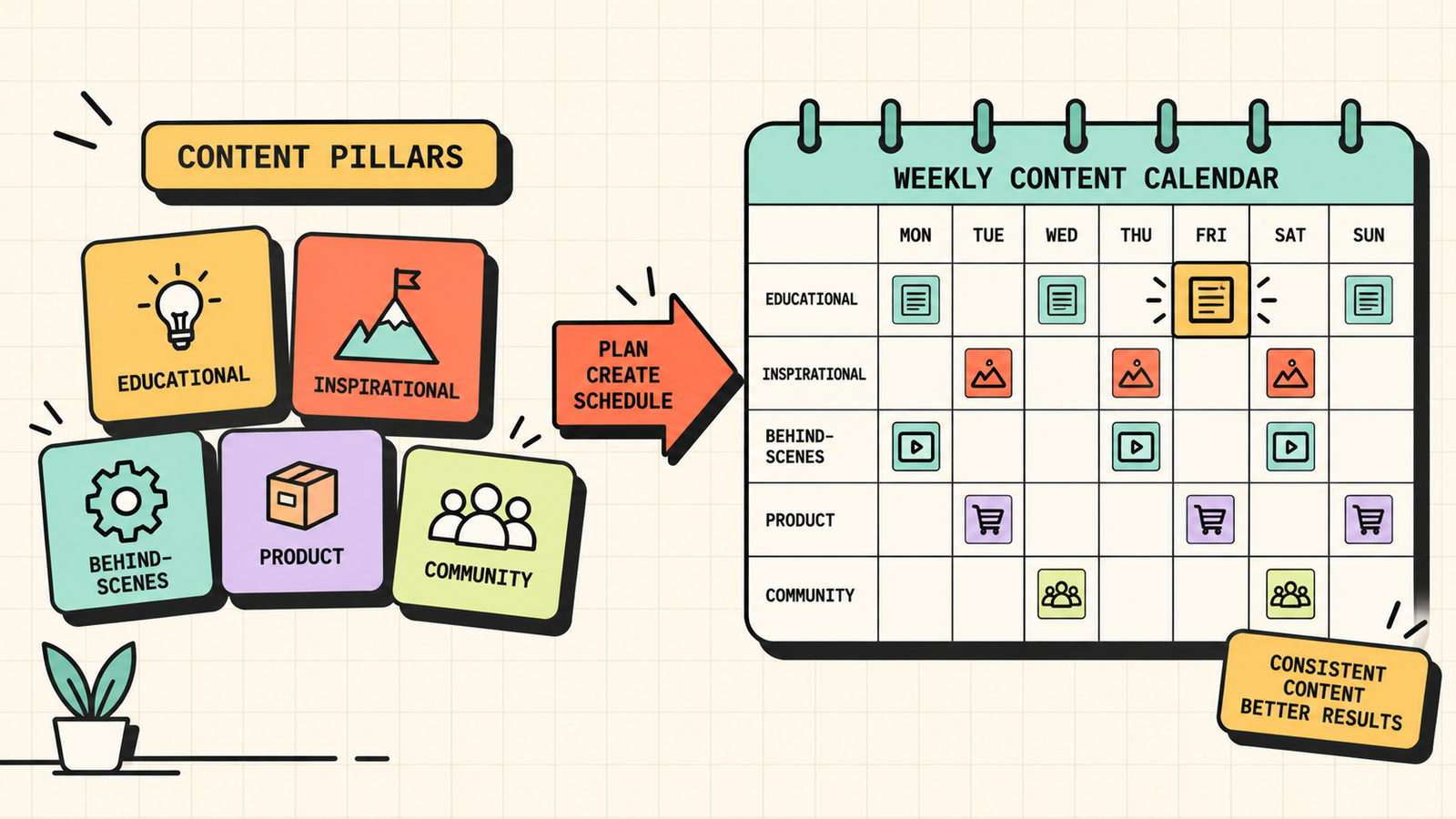
A common framework is three to five pillars, each producing one to two posts per week, rotating so no single pillar dominates. Here is how pillar types map to social content:
| Pillar type | What it does | Example posts |
|---|---|---|
| Educational | Teaches your audience something useful | Tips, how-tos, myth-busting, explainers |
| Inspirational | Motivates or shows what is possible | Customer results, transformations, testimonials |
| Behind-the-scenes | Builds trust through transparency | Process, team, making-of, day-in-the-life |
| Product or service | Shows what you sell and why it matters | Features, demos, use cases, launches |
| Community or engagement | Starts conversations and builds connection | Polls, questions, user-generated content, replies |
How to Do a Competitor Analysis
How do content pillars support SEO?
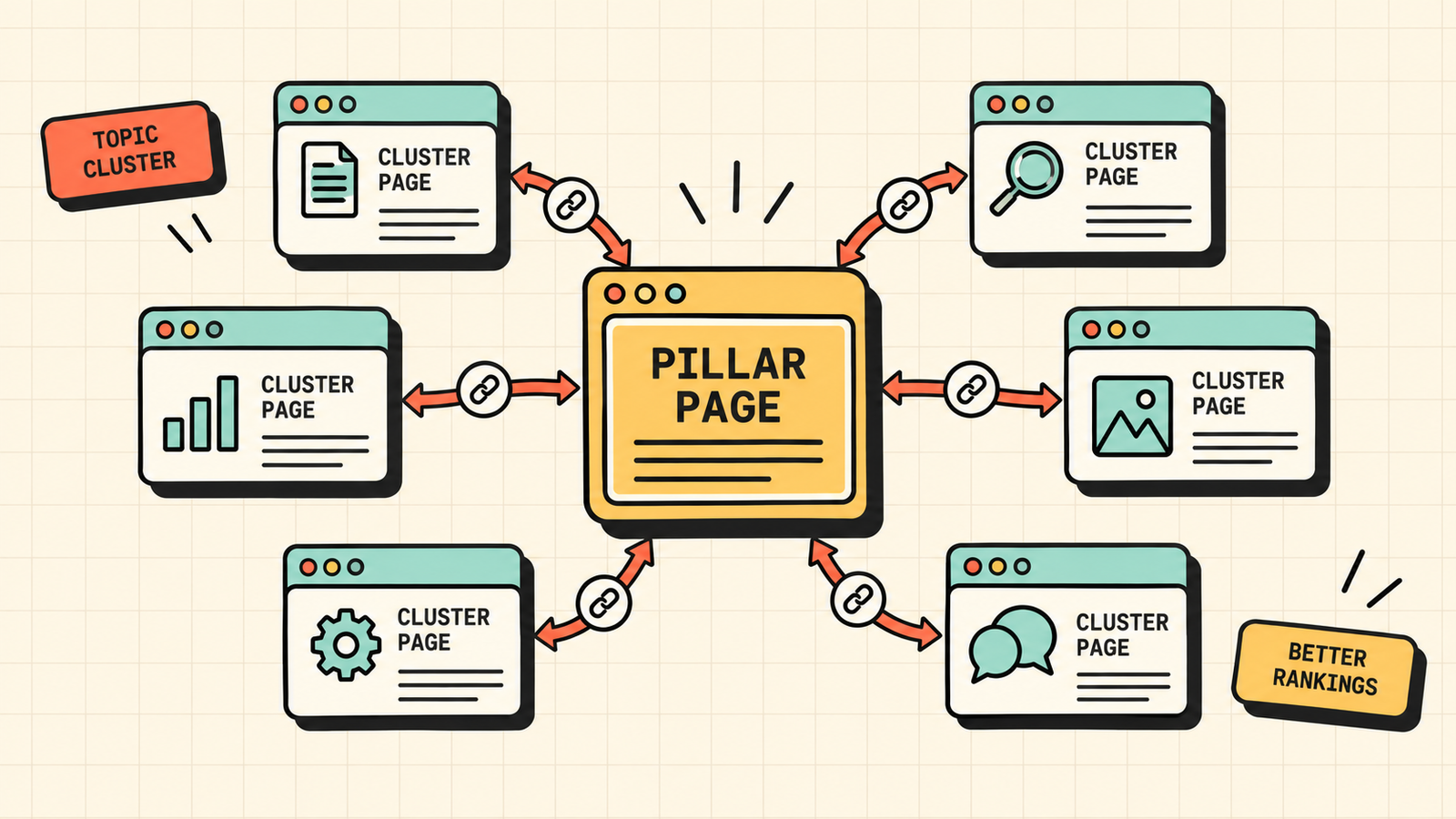
On the SEO side, content pillars work as topic clusters. You create a pillar page, a comprehensive guide on a core topic, and surround it with cluster pages, which are more specific posts on subtopics, all interlinked.
Google rewards this structure because it signals topical authority. Your site does not just have one page on a topic, it has a whole interconnected cluster that covers the subject deeply.
For example, an SEO agency's pillar might be "on-page SEO" with cluster pages on title tags, meta descriptions, heading structure, internal linking, image optimisation, and keyword placement. Each cluster page links to the pillar and to each other, building a web of authority that helps every page in the cluster rank better.
How should you choose your content pillars?
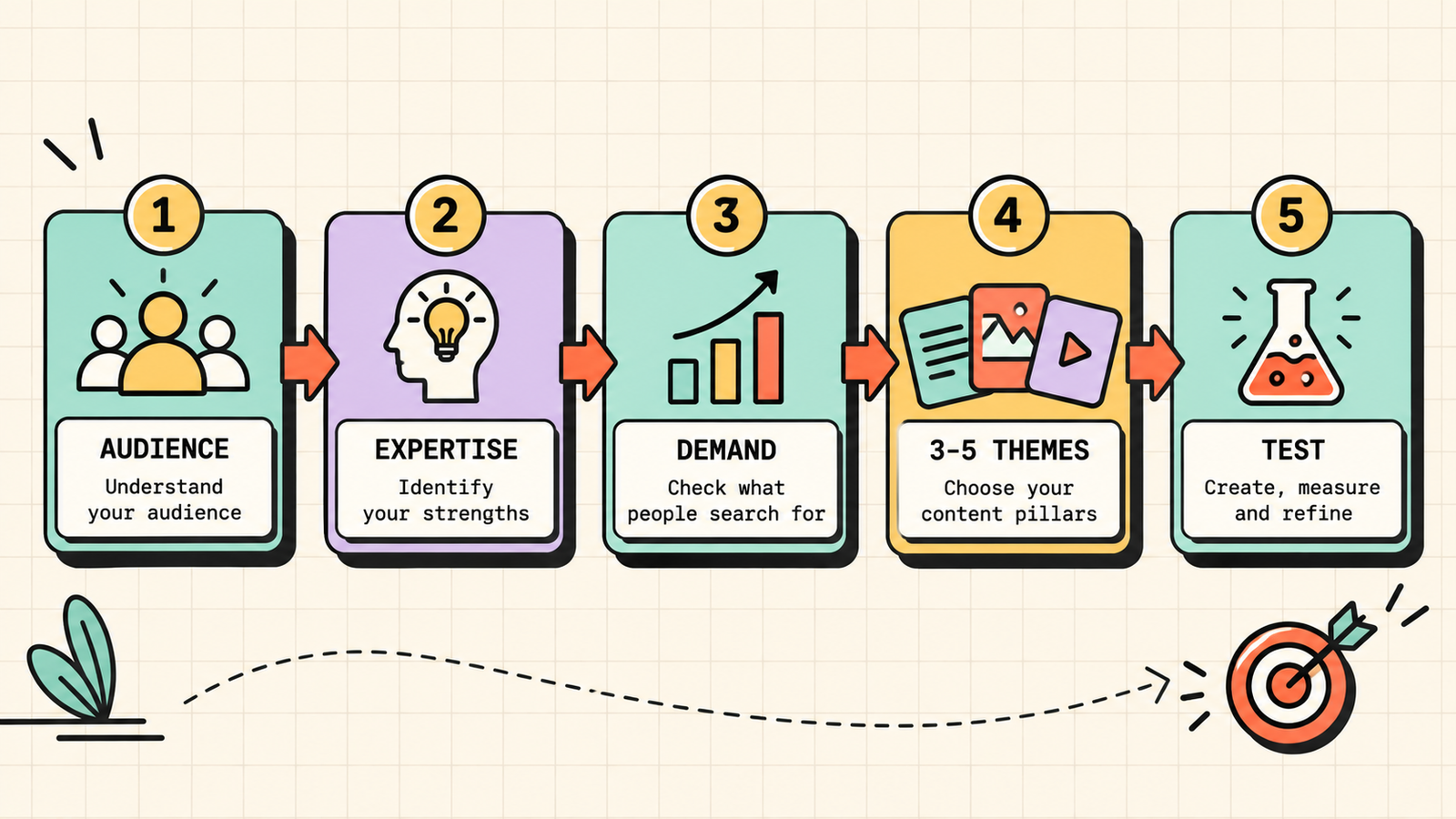
Start with your audience, align each theme with your expertise, and confirm there is real demand. Keep the final set to three to five pillars, then test and refine them based on performance.
- Start with your audience. What does your audience care about? What problems do they have? What questions do they ask? Your pillars should map to their needs, not just your product features. A pillar about "ingredient science" works for a skincare brand because the audience cares about what goes on their skin, not because the brand wants to talk about ingredients.
- Align with your expertise. Each pillar should be something you can create genuinely authoritative content about. If you cannot go deep on a topic with real knowledge and experience, it is not a strong pillar for your brand. Pillars built on genuine expertise perform better than ones built on what is trending.
- Check the demand. For SEO pillars, verify that people actually search for the topics. Use a keyword tool to check volume and competition. For social pillars, look at what content in your niche gets the most engagement. A pillar with no demand is a pillar nobody will find.
- Keep it to three to five. More than five pillars dilutes focus. Fewer than three makes your content feel narrow. The sweet spot is three to five themes that together cover your brand's territory without overlapping too much. You can always add or adjust later as you learn what resonates.
- Test and refine. Your first set of pillars is a hypothesis. Publish content across them for a few months, then review what performs best. Double down on the pillars that drive engagement, traffic, and results. Retire or replace the ones that consistently underperform. Pillars are a framework, not a prison.
We will define the content pillars that drive focused growth.
LetMeRank helps founders and brands grow through search and content. Start with a free audit and build a content strategy around the topics your audience needs.
What are content pillar examples by niche?
Effective pillar sets change by business type, audience, and expertise. Every pillar should connect to what the audience needs and what the brand can discuss with authority.
Product education, customer stories and UGC, behind-the-scenes, lifestyle and use cases, offers and launches.
Product tutorials, industry trends and insights, customer case studies, thought leadership, team and culture.
Lessons and experiences, industry opinions, tactical how-to content, personal stories, community engagement.
SEO and organic growth guides, AI tools and trends, client results and case studies, industry opinions, founder journey.
The key is that every pillar connects to your audience's needs and your brand's expertise. Copy someone else's pillars and you get their audience, not yours.
AI Tools for Marketing
How many content pillars should you have?
Three to five is the standard recommendation, and it works for a reason. Three gives you enough variety to stay interesting without spreading thin, while five is the upper limit before the pillars start overlapping or your team cannot produce enough content per pillar to build momentum.
If you are a solo creator or a small team, start with three. If you have a content team and multiple channels, four or five works. The number matters less than the commitment to actually publish consistently within each one.
How are content pillars, buckets, and categories different?
Content pillars are the strategic, brand-level themes you build your content around. Content buckets are the tactical formats within a pillar, while content categories are the organisational labels you use to sort published content.
A bucket might be a how-to, a listicle, a reel, or a carousel. In practice, most businesses only need to think about pillars. The buckets and categories follow naturally once the pillars are set.
How do you turn content pillars into a calendar?
Once your pillars are defined, building a calendar is straightforward. Assign each pillar a regular slot, plan two to four weeks ahead, and batch-create content by pillar.
For example, Monday is educational, Wednesday is behind-the-scenes, and Friday is product. Brainstorm three to five post ideas per pillar, then schedule them. Creating five educational posts in one sitting is faster than switching between themes, but leave room for timely, unplanned content that fits a pillar.
The calendar turns pillars from a concept into a system that runs week after week without the daily panic of "what do I post today."

What content pillar mistakes should you avoid?
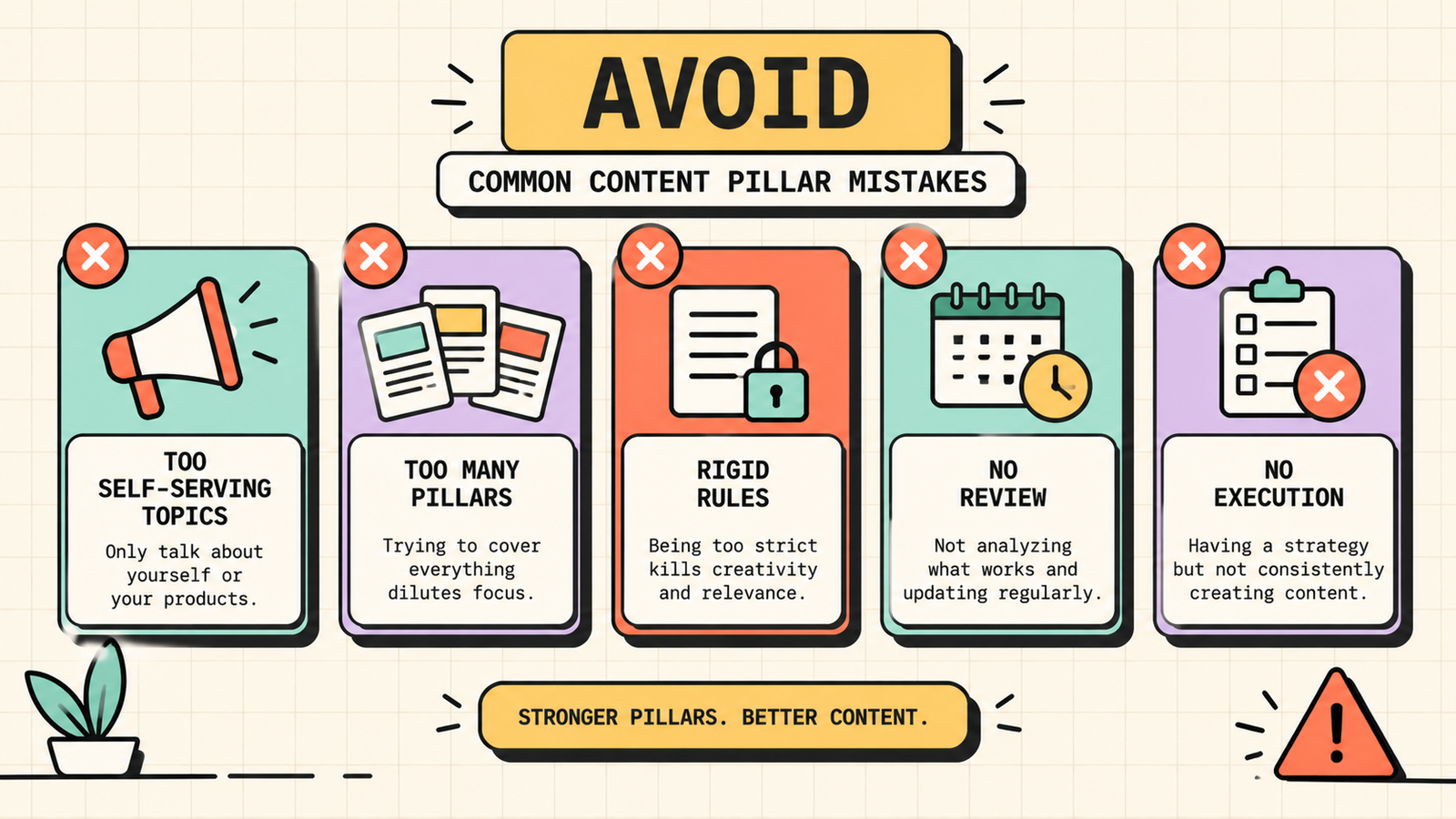
A few patterns make pillars useless. The most common problems are choosing self-serving themes, having too many pillars, treating them as rigid rules, and failing to review performance.
- Choosing pillars based on what you want to discuss rather than what your audience needs produces self-serving content.
- Having too many pillars spreads your effort so thin that no single theme builds momentum.
- Treating pillars as rigid rules rather than flexible guidelines makes your content feel formulaic.
- Not reviewing and adjusting pillars based on performance means you keep pushing themes that do not resonate.
- Defining pillars but not using them to plan content means you have a strategy document that sits in a drawer while you still post randomly.
How can you repurpose content across pillars?
Once your pillars are defined, repurposing becomes systematic rather than random. Each pillar can generate a content pipeline that feeds every platform without requiring you to create from scratch each time.
Take your best-performing blog post from your educational pillar and turn it into a carousel for Instagram, a thread for X, a short video for Reels, and an email newsletter. The content stays on-pillar across every format, which reinforces the theme and multiplies your reach from a single piece of work.
Then take a customer result from your inspirational pillar and turn it into a case study blog post, a testimonial graphic, and a founder-to-camera video. This is how small teams produce at the volume of larger ones: not by creating more, but by repurposing better within a clear structure.
Sales Funnel: What It Is, How to Build One, and Why Most Businesses Get It Wrong
How do you measure which pillars are working?
Track each pillar's performance separately so you can see which ones drive the most engagement, traffic, and conversions. Not all pillars will perform equally, and that is fine.
On social, note which pillar category gets the most saves, shares, and comments, not just likes. On your blog, check which pillar cluster drives the most organic traffic and the longest time on page.
If one pillar consistently underperforms after three months of consistent effort, either refine the angle or replace it with a theme your audience responds to. Let the data guide your pillar mix over time rather than committing permanently to your first hypothesis.
What is the bottom line?
Content pillars are how you turn random posting into a focused, compounding content strategy. Choose three to five themes that match your audience's needs and your brand's expertise, create content consistently within each, use them for both social media and SEO as topic clusters, and review regularly.
Pillars do not limit what you create. They make everything you create more purposeful, more recognisable, and more likely to build the audience and authority your brand needs.
If you want help defining your content pillars and building an SEO content strategy, LetMeRank helps founders and brands grow through search and content, starting with a free audit.