Ask ten founders whether to bet on SEO or paid ads and you will get ten different answers, most of them shaped by whatever worked or burned them last quarter. The honest answer is that neither one is better in a vacuum. They solve different problems, cost money in different ways, and pay you back on very different timelines. What actually matters is which one fits where your startup is right now, how much runway you have, and what you are trying to prove this quarter. This guide walks through the real differences, the costs, the timelines, the ROI, and exactly when each one makes sense so you can stop guessing and make the call with your eyes open.
What is the difference between SEO and paid ads?
SEO (search engine optimization) is the work of earning your way to the top of Google's unpaid results. You improve your website, publish content that answers what your buyers search for, fix technical issues, and build authority. When it works, you show up in search for free, every time, without paying per click.
Paid ads (also called PPC or performance marketing) are the opposite arrangement. You pay a platform like Google, Meta, or others to place your business in front of people, and you are charged either every time someone clicks or every time your ad is shown. The moment you stop paying, the traffic stops with you.
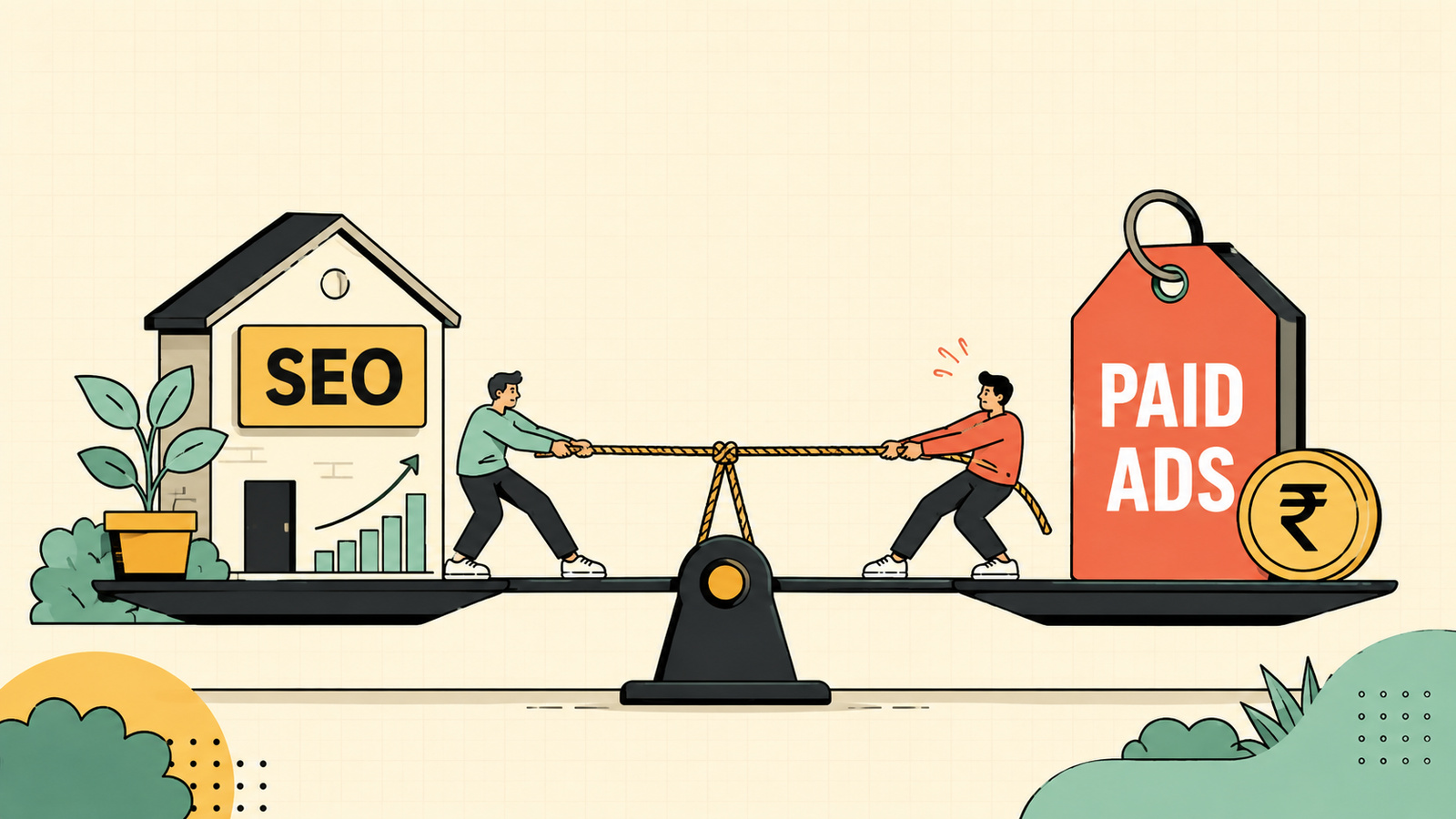
Here is the simplest way to hold the difference in your head. SEO is like buying a house. It costs more effort upfront and takes time to move into, but once you own it, you live there. Paid ads are like renting. You get the keys today, but you pay every single month, and the day you stop, you are out on the street.
SEO vs paid ads: the quick comparison
If you only read one section, read this table.
| Factor | SEO (organic) | Paid ads (PPC) |
|---|---|---|
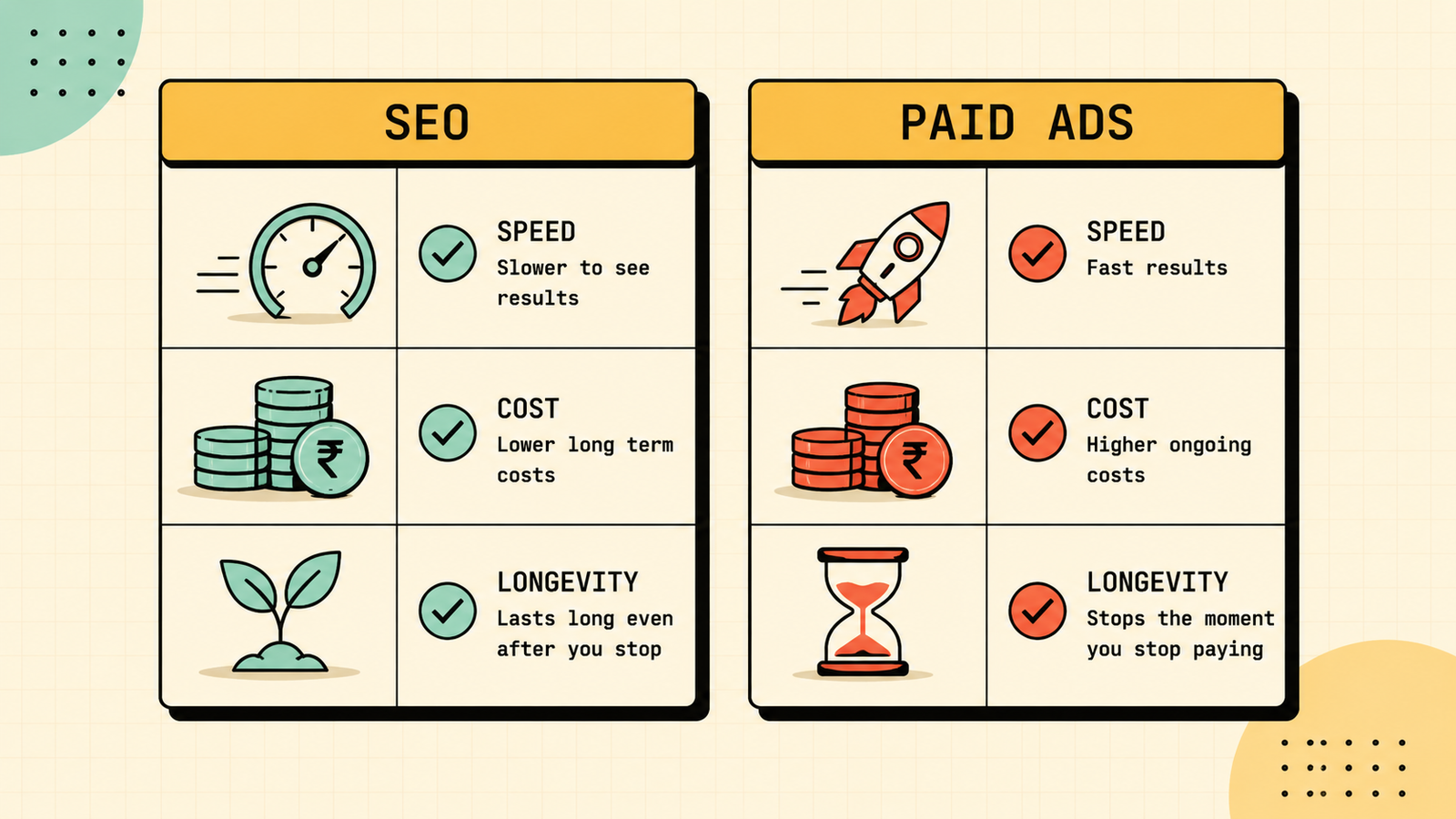
| Speed to results | Slow, builds over 3 to 6 months | Instant, traffic the same day |
| Cost model | Invest in content and effort | Pay per click or per impression |
| Cost over time | Falls as content compounds | Rises as competition and auctions inflate |
| Traffic when you stop | Keeps flowing | Stops immediately |
| Trust from users | Higher, people trust organic results | Lower, users know it is an ad |
| Best for | Long-term, compounding growth | Speed, testing, and short campaigns |
| Long-term ROI | High and durable | Depends entirely on ongoing spend |
| Control over timing | Low, Google decides rankings | High, switch on and off instantly |
Neither column is the winner. The right choice depends on what you need most today: speed or staying power.
How much do SEO and paid ads actually cost?
Cost is where most founders make their decision, so let us be specific.
With paid ads, your money buys clicks directly. You set a budget, the platform spends it, and you get traffic while the money lasts. In competitive categories, a single click can cost anywhere from a few rupees to well over a hundred, and in crowded spaces like fintech or insurance it can climb much higher. The math is brutally simple. More competition means a higher cost per click, which means a higher cost per customer. And that number tends to creep up every year as more brands bid for the same eyeballs.
With SEO, your money buys assets instead of clicks. You are paying for content, technical work, and expertise that keep working long after the invoice is paid. In India, ongoing SEO typically runs from around 15,000 to over 1,00,000 rupees a month depending on how competitive your keywords are and how much content you need. That may look similar to an ad budget on paper, but the outcome is different. An ad budget disappears the moment it is spent. An SEO budget builds a library of pages that keep pulling in visitors for months or years.
The key insight on cost is this. Paid ads have a low starting cost but a high ongoing cost that never goes away. SEO has a higher upfront investment of time and money but a cost per visitor that keeps falling as your content compounds. Over a two-year window, organic traffic is almost always the cheaper source of customers.
How long does each take to show results?
This is the trade-off that decides a lot of budgets.
Paid ads work immediately. You can launch a campaign this morning and have visitors, and possibly sales, by this afternoon. That speed is genuinely valuable when you are testing a new product, validating demand, or need cash flow now.
SEO is a slower game. For a new or young website, meaningful ranking movement usually starts around the four to six month mark, and full momentum builds closer to nine to twelve months. It feels painfully slow at first because you are doing work with little visible payoff. Then something shifts. The pages you published months ago start ranking, traffic compounds, and the channel that felt like a money pit becomes your cheapest source of customers.

| Timeframe | Paid ads | SEO |
|---|---|---|
| Day 1 | Live traffic and possible sales | Groundwork only, no visible results |
| Month 1 to 3 | Steady traffic while you pay | Foundation, audits, content, early signals |
| Month 4 to 6 | Same, as long as budget continues | Rankings start moving, first organic wins |
| Month 9 to 12 | Same, costs often higher than before | Compounding traffic, lower cost per customer |
Notice the pattern in the paid column. It is flat. You get the same output as long as you keep feeding it. The SEO column keeps climbing.
SEO vs Paid Ads: full strategy guide
Which one delivers better ROI?
Return on investment depends on your time horizon, and this is where the two channels split hard.
In the short term, paid ads usually win. You can measure exactly what you spent and what came back within days, and a well-run campaign can be profitable from week one. For a founder who needs proof of concept fast, that clarity is worth a lot.
In the long term, SEO usually wins by a wide margin. Because organic traffic does not cost you per click, every visitor it sends over time is effectively free. A single well-ranked article can bring in thousands of visitors a year without you spending another rupee on it. When you divide the total cost of your SEO investment by the traffic it generates over eighteen or twenty-four months, the cost per visitor often drops to a fraction of what paid traffic costs.
The most useful way to think about it: paid ads rent you results, SEO builds you an asset. Renting can be smart when you need speed. Owning wins when you are playing a long game.
SEO vs Google Ads vs Meta Ads
"Paid ads" is not one thing, so it helps to break it down against SEO.
| Channel | What it is best at | The catch |
|---|---|---|
| SEO | Capturing high-intent buyers who are already searching, at a falling long-term cost | Takes months to build |
| Google Ads | Reaching people at the exact moment they search, instantly | You pay for every click, and costs rise in competitive niches |
| Meta Ads | Creating demand and reaching people who are not searching yet | Interruptive, needs strong creative, and audiences fatigue |
Google Ads and SEO actually target the same intent, which is someone typing a query into search. The difference is that one is paid and instant while the other is earned and durable. Meta Ads play a different role. They create demand rather than capture it, which is why many D2C brands use Meta to build awareness and SEO to capture the buyers that awareness eventually sends searching.
The pros and cons of SEO
Pros: it builds a compounding asset, the traffic is free once you rank, users trust organic results more than ads, and the cost per customer falls over time. It also keeps working during a cash crunch, since your rankings do not vanish the day you pause spending.
Cons: it is slow to start, it demands consistent effort, and you do not control the timing because Google decides who ranks. Algorithm updates can also shift your traffic, so it needs ongoing attention rather than a one-time fix.
The pros and cons of paid ads
Pros: results are instant, the data is crystal clear, you control exactly when campaigns run, and you can scale spend up or down in a day. It is the fastest way to test offers, messaging, and new products.
Cons: the moment you stop paying, the traffic dies, costs tend to rise every year, and in competitive categories your margins get squeezed hard. You are also renting an audience you never truly own, which leaves you exposed to platform price hikes and policy changes.
When should a startup choose SEO?
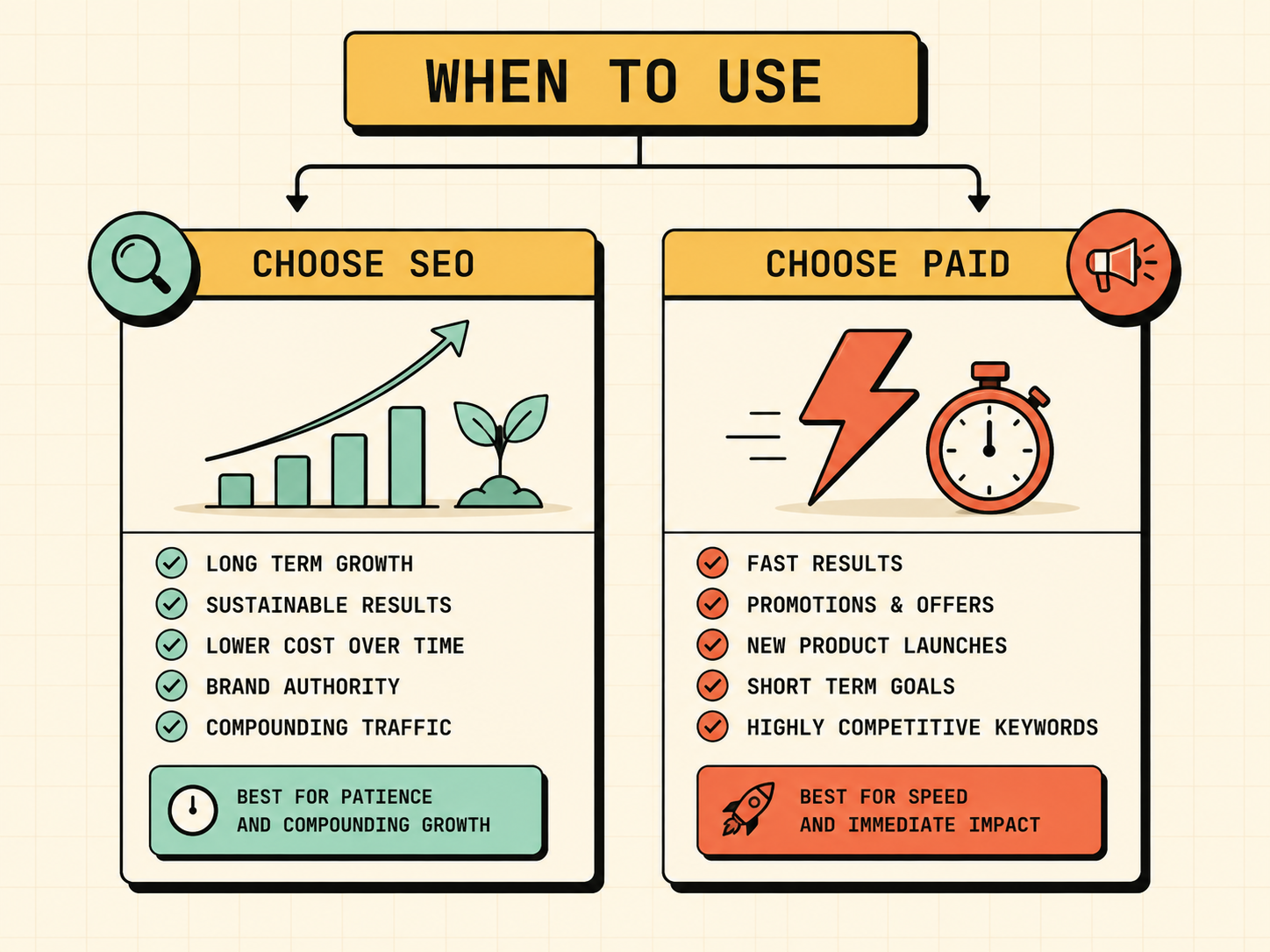
Lead with SEO when you are building for the long haul and want a channel whose economics improve over time. It is the right first bet if your customers actively search for what you sell, if you have the patience to wait a few months for compounding to kick in, and if you want to reduce your dependence on paid platforms. It suits content-friendly businesses, considered purchases, and any founder who wants to stop renting traffic and start owning it.
When should a startup choose paid ads?
Reach for paid ads when speed matters more than anything else. They are the right call when you are launching a new product and need demand today, when you are validating whether people will actually pay before you invest in slower channels, when you have a time-sensitive sale or campaign, or when you need revenue flowing while your SEO builds in the background. If you have a budget and need results this week, paid is your lever.
We'll show you exactly where your next customer should come from.
Get a clear, data-backed plan to balance paid speed with organic staying power, based on your category and runway.
Can you do both? The smart budget split
For most startups the real answer is not SEO or paid ads. It is both, in the right sequence.
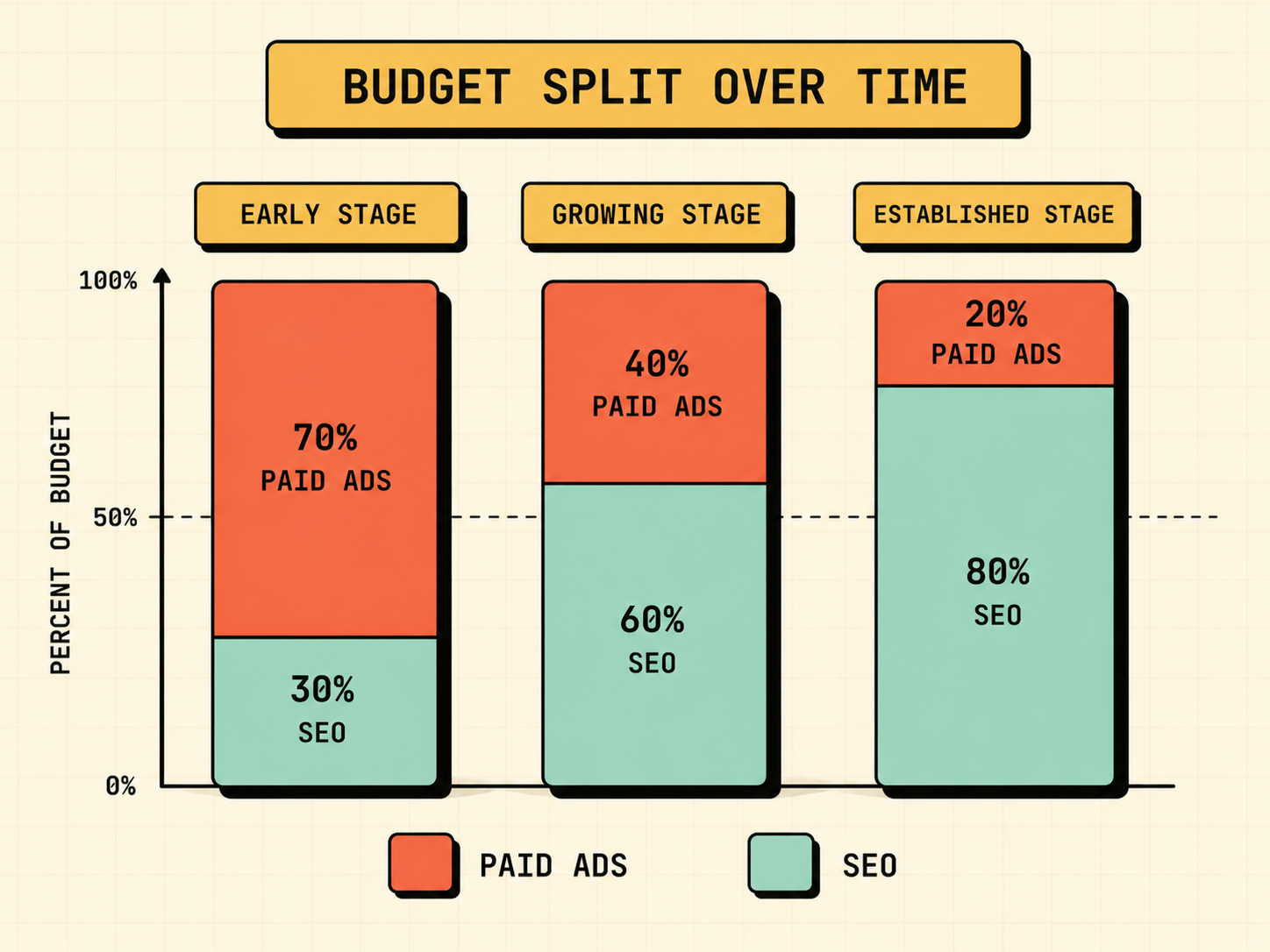
The strongest play is to run paid ads for immediate traffic and revenue while you invest in SEO to lower your long-term cost of growth. Paid keeps the lights on and gives you fast data on what messaging converts, and those learnings feed straight into the content and keywords you target organically. Meanwhile SEO quietly builds, and over time it takes on more and more of your traffic so you can dial back paid spend without losing customers.
A simple way to think about the split by stage:
| Stage | Suggested focus |
|---|---|
| Early, need proof and cash flow | Heavier on paid ads, start SEO foundations |
| Growing, want to cut CAC | Balanced split, SEO gaining share |
| Established, want durable margins | Heavier on SEO, paid used for launches and pushes |
The goal is to shift your traffic mix from mostly rented to mostly owned as you mature, so that a single ad-platform price hike can never put your growth at risk.
SEO vs paid ads for D2C and ecommerce
D2C brands feel this trade-off most sharply because rising ad costs hit their margins directly. Many built their early growth entirely on Meta and Google Ads, then watched their customer acquisition cost climb until profitability disappeared. For these brands, SEO and its newer cousin GEO (getting cited in AI search answers) are not a nice-to-have. They are how you build a base of customers who cost less to acquire every month instead of more. The winning D2C playbook in 2026 uses paid for speed and launches, and organic to structurally lower blended acquisition cost over the long run.
LetMeRank
The bottom line for founders
If you need results this week, paid ads win. If you want results that keep paying you for years, SEO wins. Most startups should not pick a side. They should use paid to move fast today and build SEO so growth gets cheaper tomorrow. The mistake is not choosing one over the other. The mistake is renting forever and never building anything you own.
If you want a clear plan for how to balance the two based on your category, your competition, and your runway, LetMeRank runs a free strategy session to map out exactly where your next customer should come from.