
Fintech is one of the hardest categories in search. Your competitors include banks with decades of authority, aggregators like BankBazaar and Paisabazaar with thousands of pages, and media sites that rank for every money question. On top of that, Google holds financial content to a stricter standard than almost anything else, because bad financial advice can genuinely hurt people. And yet fintech is also one of the categories where SEO pays off most. Customer acquisition costs for loans, cards, insurance, and investing apps are brutal on paid channels, and a single ranking page can bring in high-intent users for years.
This guide covers how SEO works differently for fintech, the content and pages that actually rank, how to handle trust and compliance, and the playbook for Indian fintech brands that cannot outspend the giants.
Why SEO is different for fintech
Two things make fintech SEO its own discipline.
It is YMYL content. Google classifies financial information as "Your Money or Your Life," meaning content that can affect people's financial wellbeing. For these topics, Google applies much higher expectations of experience, expertise, authority, and trust (E-E-A-T). Thin, anonymous, or inaccurate financial content struggles to rank no matter how well it is optimised.
It is regulated. Indian fintech brands operate under regulators such as RBI, SEBI, and IRDAI depending on the product. Your content has to stay within advertising and disclosure norms: no promised returns, clear terms, correct risk disclosures. SEO content that ignores compliance creates legal risk, and content that is accurate and properly disclosed also tends to be more trustworthy in Google's eyes.
What fintech users search for
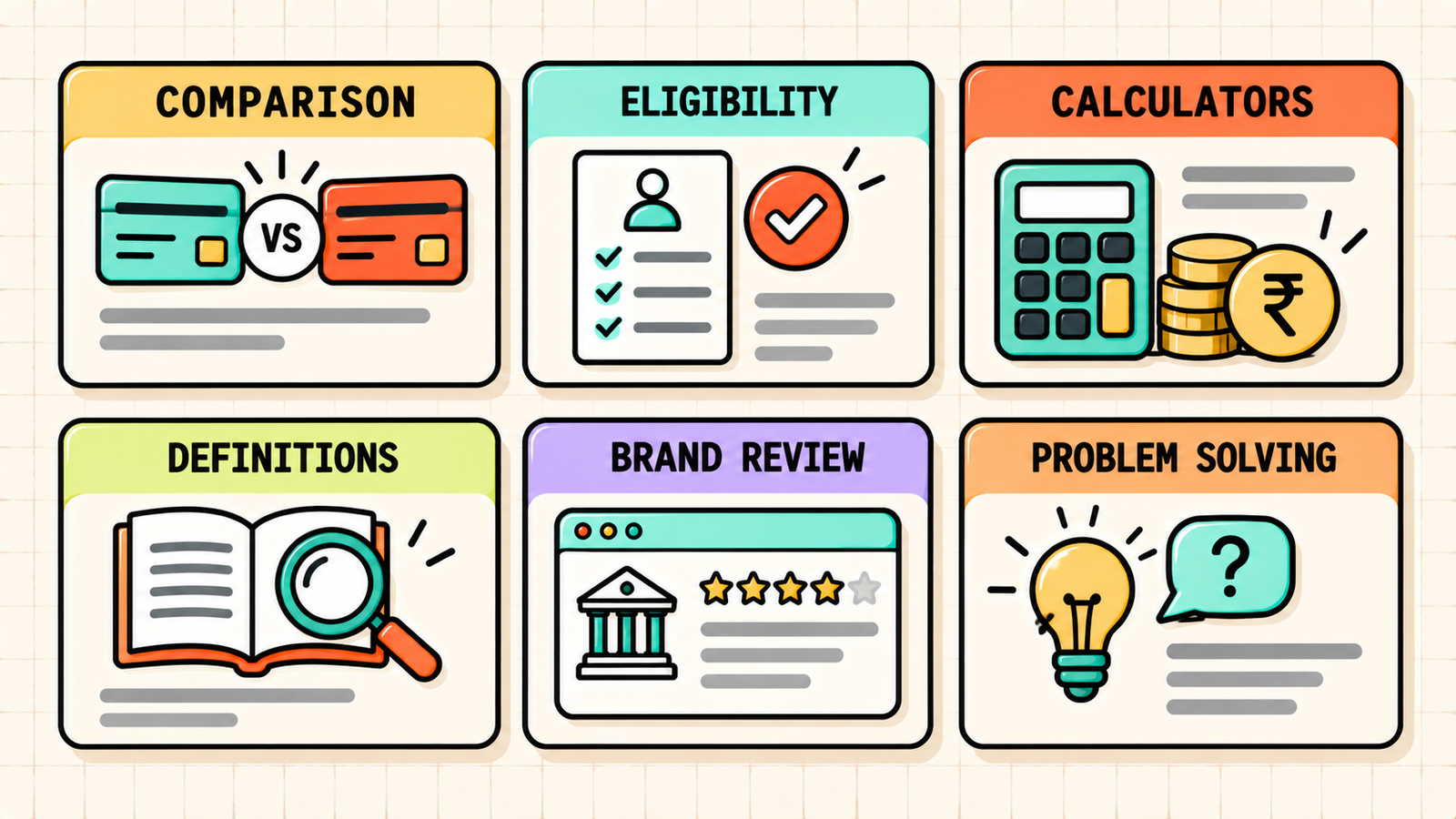
Fintech search intent falls into a few clear groups, and each needs a different type of page.
| Search type | Example queries | Best page type |
|---|---|---|
| Product comparison | best credit card for travel India, best personal loan app | Comparison pages, product pages |
| Eligibility and process | how to check CIBIL score, home loan eligibility for salaried | Guides and calculators |
| Calculations | EMI calculator, SIP calculator, GST calculator | Interactive tools |
| Definitions | what is UPI Lite, what is a credit score | Glossary and explainer pages |
| Brand evaluation | [brand] review, is [brand] safe, [brand] charges | Branded pages, FAQ, trust pages |
| Problem solving | UPI payment failed money deducted, how to improve credit score | Help content, guides |
Big aggregators dominate broad comparison terms. Smaller fintech brands win on long-tail, process, problem-solving, and branded searches.
The fintech SEO playbook
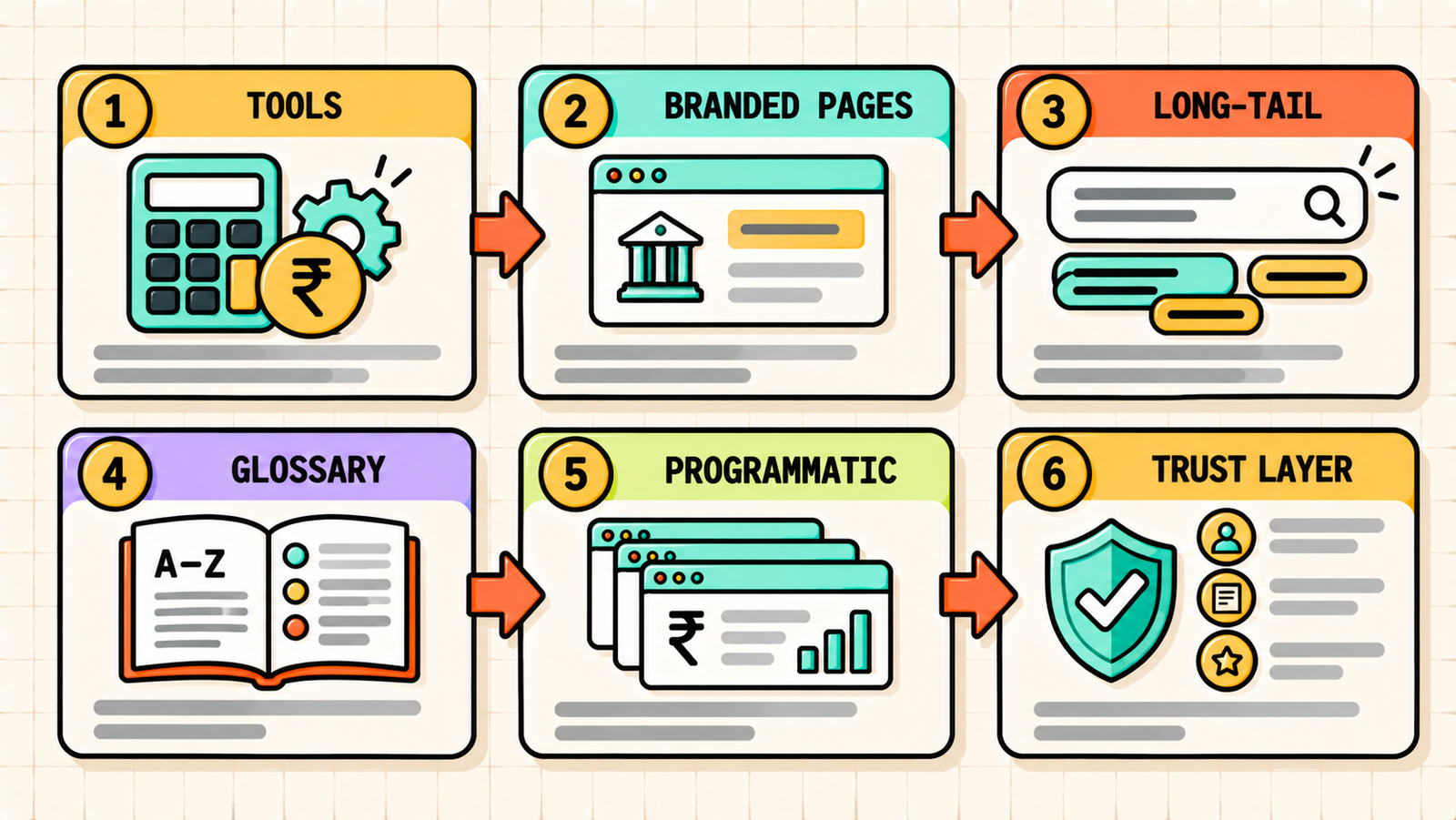
1. Build calculators and tools
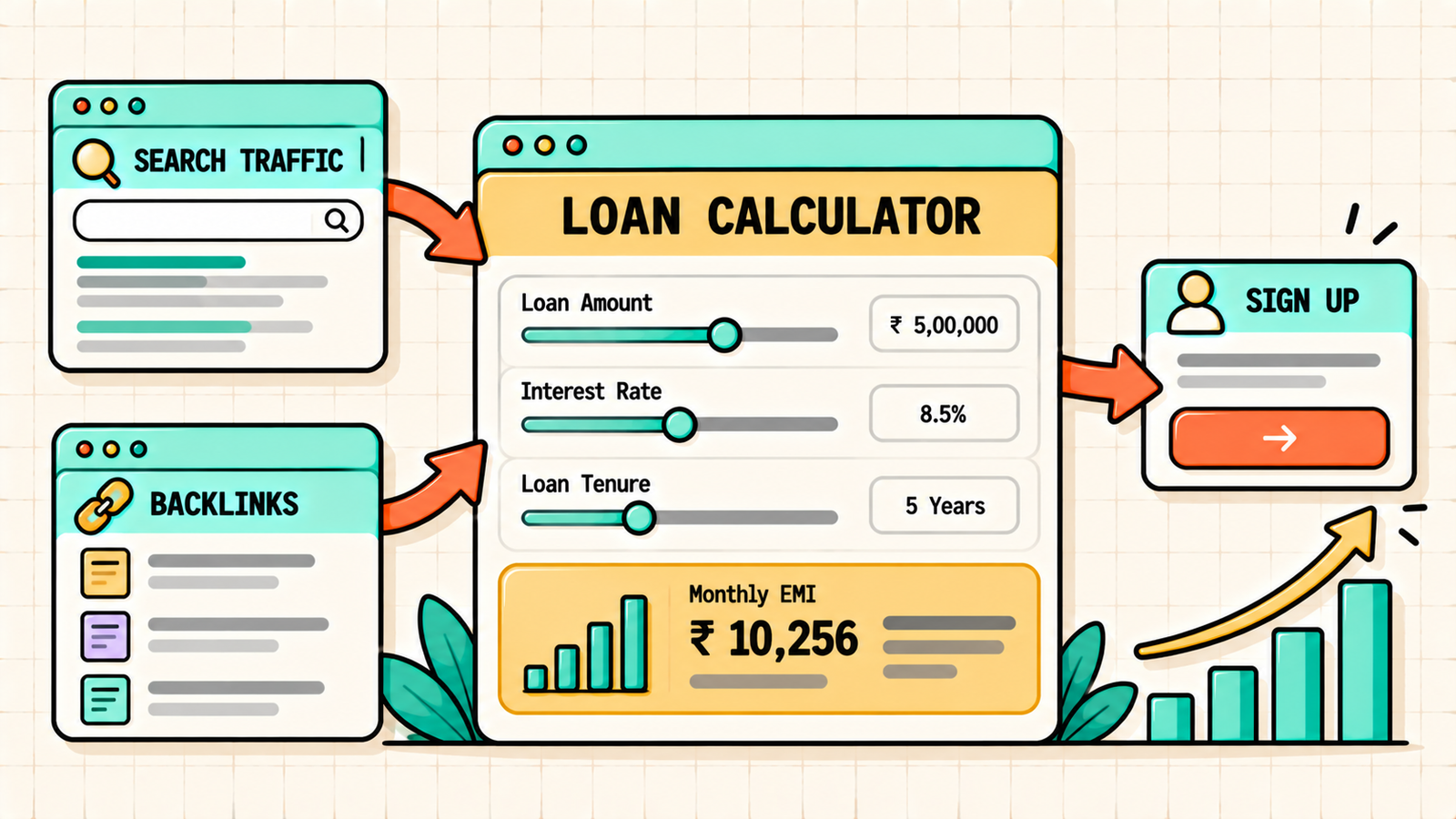
Calculators are the single most powerful SEO asset in fintech. EMI, SIP, FD, loan eligibility, income tax, GST, and credit card interest calculators attract large, recurring search volume, earn backlinks naturally, and put users one click away from your product. A useful, fast, mobile-friendly calculator with a short explanation and FAQ below it can outperform dozens of blog posts. Build tools specific to your product: a lending app needs loan calculators, an investment app needs return calculators, a payments product might need fee or GST calculators.
2. Own your branded searches
Every fintech user checks "[brand] review," "[brand] charges," "is [brand] safe," and "[brand] customer care" before trusting you with money. If those results are dominated by complaint forums, outdated reviews, or competitors, you lose users at the last step. Create clear pages for fees and charges, security and safety, regulatory status, customer support, and honest FAQs. These pages convert and protect your reputation.
3. Target long-tail and process queries
You will not outrank BankBazaar for "personal loan." You can rank for "personal loan for freelancers without salary slip," "how to close a credit card in India," or "UPI payment pending what to do." These queries have clear intent, lower competition, and users who need exactly what you offer.
4. Create a glossary and explainer hub
Fintech is full of jargon: CIBIL, NACH mandate, foreclosure charges, expense ratio, KYC types, UPI AutoPay. A well-organised glossary with one clear page per term, linked to your guides and product pages, builds topical authority and captures definition searches. Done well, it also becomes a strong source for AI answers.
5. Use programmatic SEO carefully
Fintech has natural programmatic opportunities: IFSC code pages, bank-wise interest rates, city-wise loan pages, and currency or rate pages. They can drive large traffic, but only if every page has genuinely useful, accurate, regularly updated data. Thin templated pages with copied data get ignored or hurt your site's quality signals.
6. Make trust visible on every page
On YMYL pages, show who wrote the content and who reviewed it (ideally someone with relevant financial credentials). Add update dates and update the content when rates, rules, or fees change. Cite official sources such as RBI circulars, SEBI guidelines, and NPCI documentation. Show your regulatory registration, grievance redressal details, and security practices clearly. Trust is not a page. It is a layer across the whole site.
7. Create content in Hindi and regional languages
A large share of India's new fintech users are first-time borrowers and investors from Tier 2 and Tier 3 cities who search in Hindi or Hinglish: "CIBIL score kaise badhaye," "loan kaise milega bina salary slip." Competition for these queries is far lower than for their English equivalents, and simple, accurate content in the user's language builds trust faster than polished English pages.
We'll find exactly what's holding your fintech brand back in search.
Get a clear, data-backed plan to build trust, win high-intent queries, and grow organic sign-ups at a lower acquisition cost.
Content compliance checklist for fintech SEO
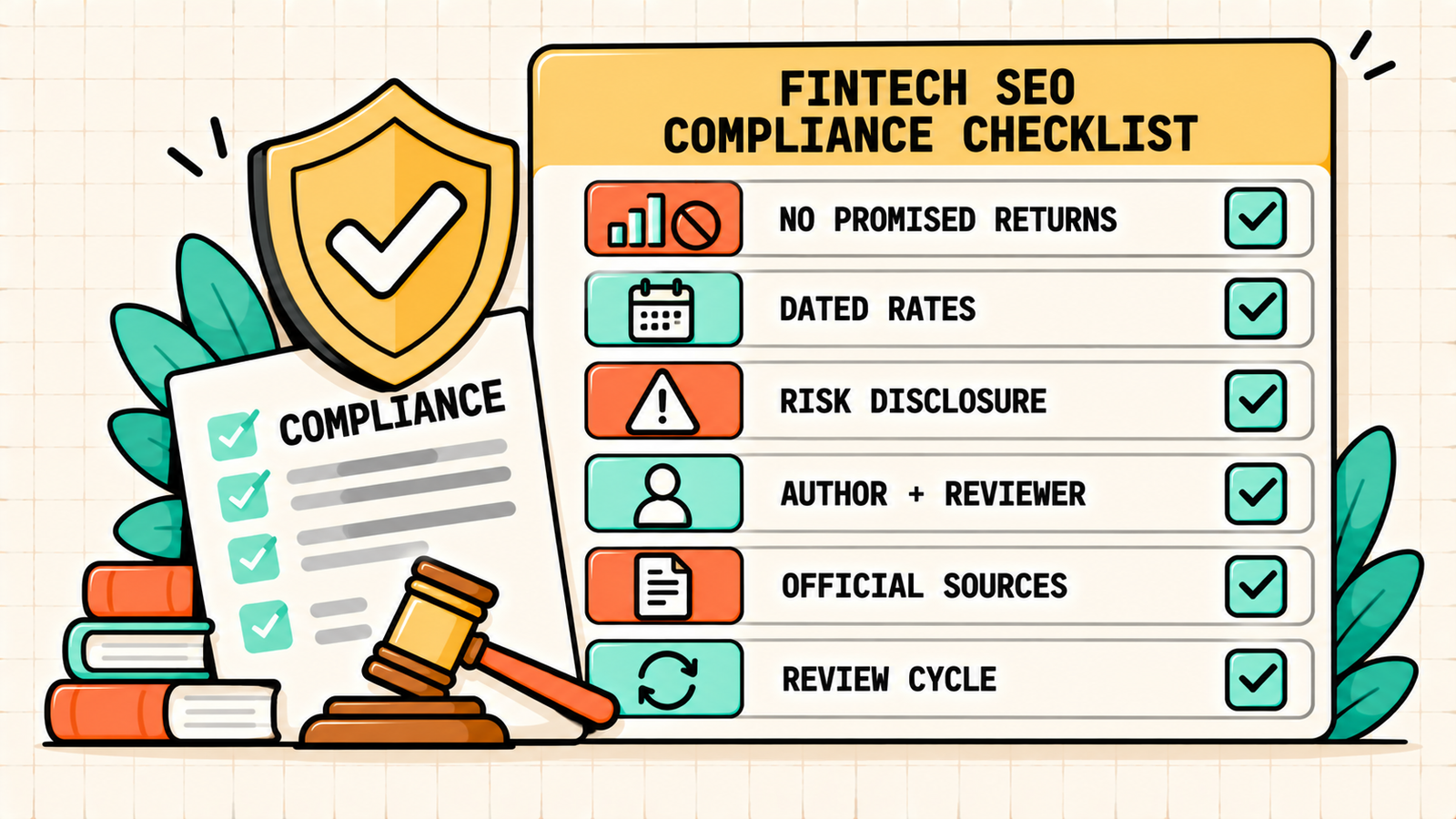
| Check | Why it matters |
|---|---|
| No guaranteed or promised returns | Regulatory risk and trust damage |
| Interest rates and fees stated with dates and conditions | Accuracy, user trust, fewer complaints |
| Risk disclosures on investment content | Required for investment-related products |
| Named author and expert reviewer | E-E-A-T for YMYL content |
| Citations to official sources | Accuracy and credibility |
| Clear distinction between education and advice | Avoids appearing to give unregistered advice |
| Regular review cycle for rates, rules and charges | Outdated financial info harms users and rankings |
Have your compliance team review templates for each content type once, so writers can produce content quickly within approved boundaries.
Technical SEO for fintech sites and apps
Fintech products often live inside apps, behind logins, or in heavy JavaScript frameworks, which creates SEO problems. Make sure public pages (product pages, calculators, guides, glossary) are server-rendered or pre-rendered so Google can read them. Keep calculators fast on mid-range Android phones, since most Indian users are on mobile. Use app indexing and clear app store links so search traffic can move into your app. Add FAQ, Article, Organization, and SoftwareApplication or FinancialProduct schema where relevant. And keep login and dashboard pages out of the index so crawl budget goes to the pages that matter.
Fintech SEO and AI search
Users increasingly ask ChatGPT, Gemini, and Perplexity questions like "which credit card is best for online shopping in India" or "is this loan app RBI registered." AI tools are cautious with financial topics and tend to cite sources that look authoritative, current, and precise. Clear definitions, accurate fee tables with dates, official source citations, and consistent brand information across your site, app stores, and regulator listings all make your brand easier for AI systems to describe correctly. Being mentioned on trusted Indian finance publications helps AI tools treat your brand as a credible option.
AEO Services: How to Get Your Brand Cited by ChatGPT, Gemini and Perplexity
Link building for fintech brands
Fintech needs authority, and authority needs links from credible sources. The approaches that work best are original data (publish insights from your own anonymised product data, such as average loan amounts by city or UPI usage trends, which journalists love to cite), expert commentary (offer your founders and finance experts as sources for business and personal finance journalists), free tools that other sites link to as a resource, partnerships with banks, NBFCs, and platforms that list partners on their sites, and founder visibility through podcasts, startup publications, and industry events. Avoid paid link schemes entirely. In a YMYL category, a low-quality link profile is a liability rather than a shortcut.
How to measure fintech SEO success
Traffic alone is a weak measure for fintech. Track the metrics that connect to the business: organic sign-ups or applications (set up conversion events in Google Analytics), calculator usage that leads to sign-up, app installs from organic search, rankings and click-through rate for branded and trust queries, and cost per acquisition from organic compared to paid channels. Review these monthly. The goal is not the most visitors. It is the most qualified, trusting users at the lowest acquisition cost.
How long does fintech SEO take?
Fintech is competitive and trust-heavy, so expect longer timelines than most categories. Branded and trust pages can improve within weeks. Calculators and long-tail guides typically start ranking in three to six months. Competitive comparison and product category terms often take nine to eighteen months and require a meaningful backlink and PR effort. The brands that win are the ones that build tools and trust early, publish consistently, and stay accurate as rules and rates change.
Common fintech SEO mistakes
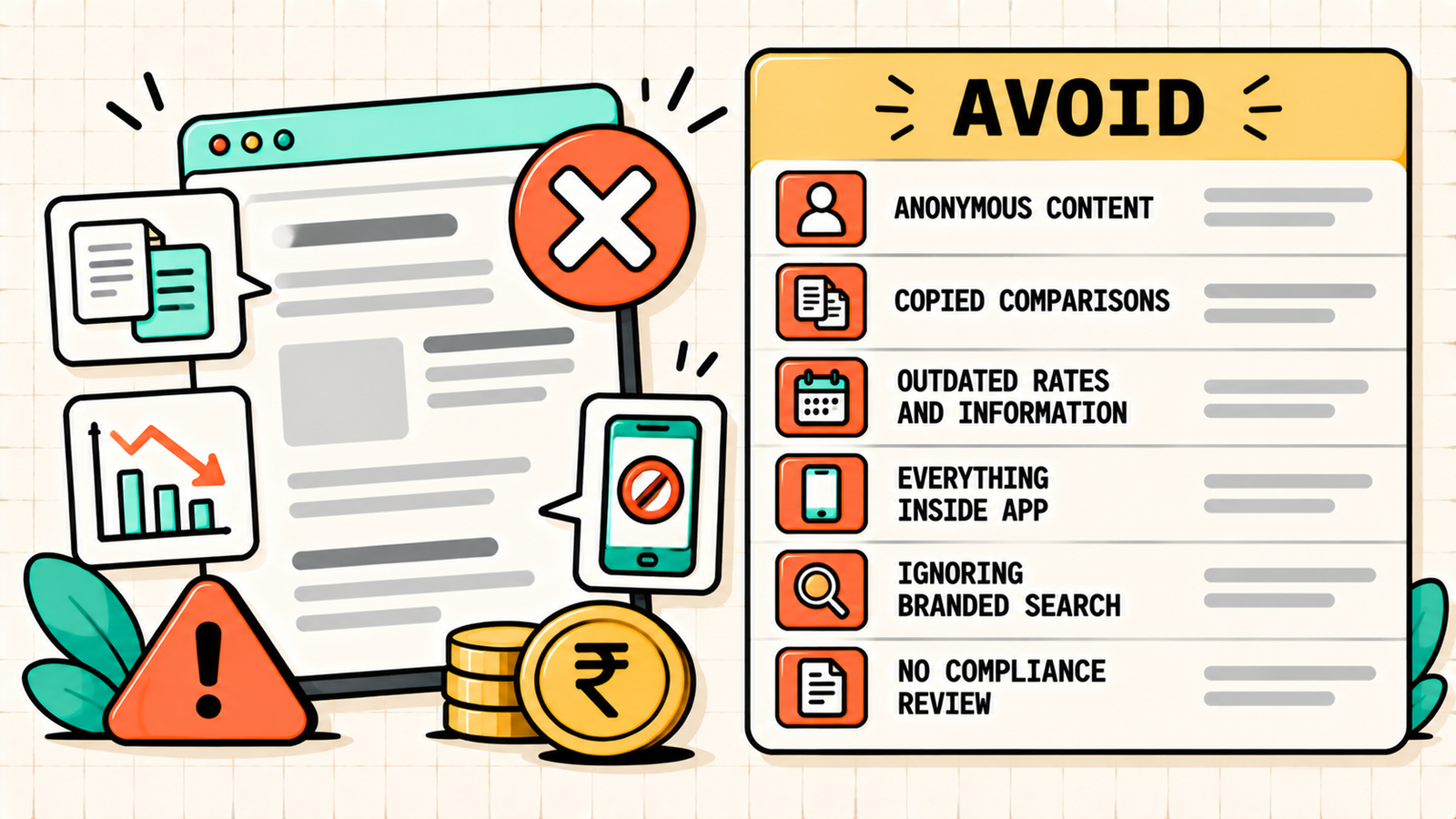
A few patterns appear again and again. Publishing anonymous financial content with no author or reviewer undermines trust. Copying aggregator-style comparison pages without unique data rarely ranks. Letting interest rates and fees go out of date misleads users and erodes credibility. Hiding everything useful inside the app leaves nothing for Google to index. Ignoring branded searches lets complaint sites define your reputation. And publishing content without compliance review creates risk that can cost far more than any traffic gain.
Schema Markup for SEO: How to Add Structured Data to Your Site
The bottom line
SEO for fintech works when you combine usefulness with visible trust. Build calculators and tools, own your branded and trust searches, target long-tail and process queries the aggregators ignore, create a glossary hub, use programmatic SEO only with accurate data, and make authorship, sources, and compliance visible on every page. It takes longer than in most categories, but in a market where paid acquisition is expensive, every page that earns a user's trust keeps paying back.
If you want an SEO audit built specifically for a fintech product, LetMeRank works with Indian fintech brands on SEO, trust content, and AI search visibility, starting with a free audit.