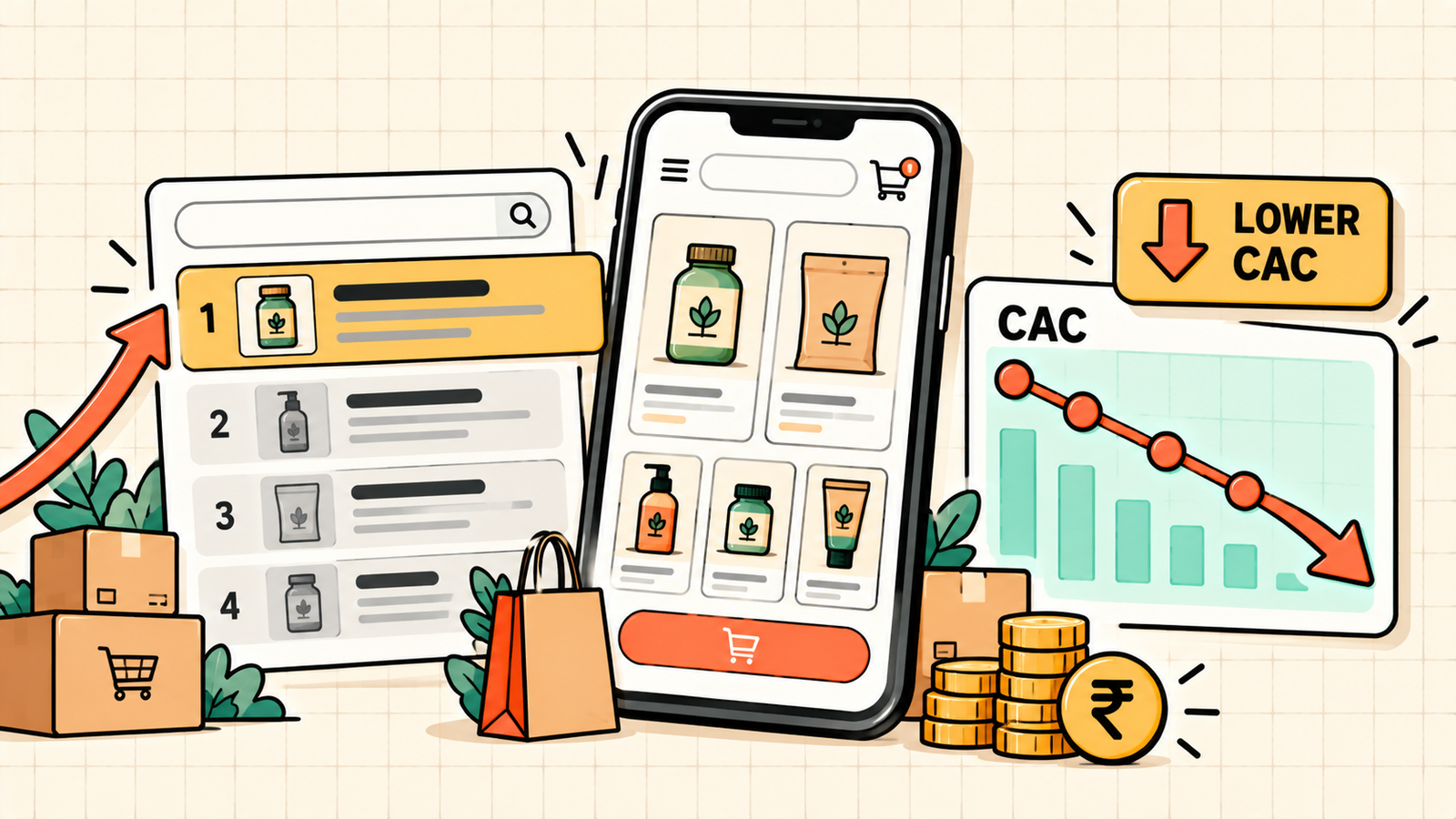
Every Indian D2C founder hits the same wall. Meta Ads worked beautifully at launch. Then CPMs climbed, ROAS slid from 4x to 2x, festive season bidding wars ate the margin, and suddenly growth depends on a budget line that only goes up. SEO is the channel that breaks that dependency. Not generic SEO advice written for American SaaS companies, but SEO built for how Indian shoppers actually search: in Hinglish, on mobile, comparing prices across Amazon, Flipkart, Nykaa, and your own site, and increasingly asking ChatGPT which brand to trust. This guide covers the SEO playbook for Indian D2C brands, the pages that drive revenue, how to compete with marketplaces, and the mistakes we see most often when auditing D2C stores.
Why SEO matters for Indian D2C brands
Paid acquisition in India has a ceiling. As more D2C brands compete for the same audiences, Meta and Google costs rise, especially around Diwali, Navratri, and sale events. SEO changes the economics: once a category page or buying guide ranks, every visitor it brings costs nothing extra. That lowers your blended customer acquisition cost and improves LTV:CAC, which is the number investors and profitability both care about.
SEO also captures a buyer Meta cannot reach well: the person actively searching. Someone typing "best onion hair oil for hair fall" or "protein bar without sugar India" has intent right now. Ads interrupt. Search answers.
How Indian shoppers actually search
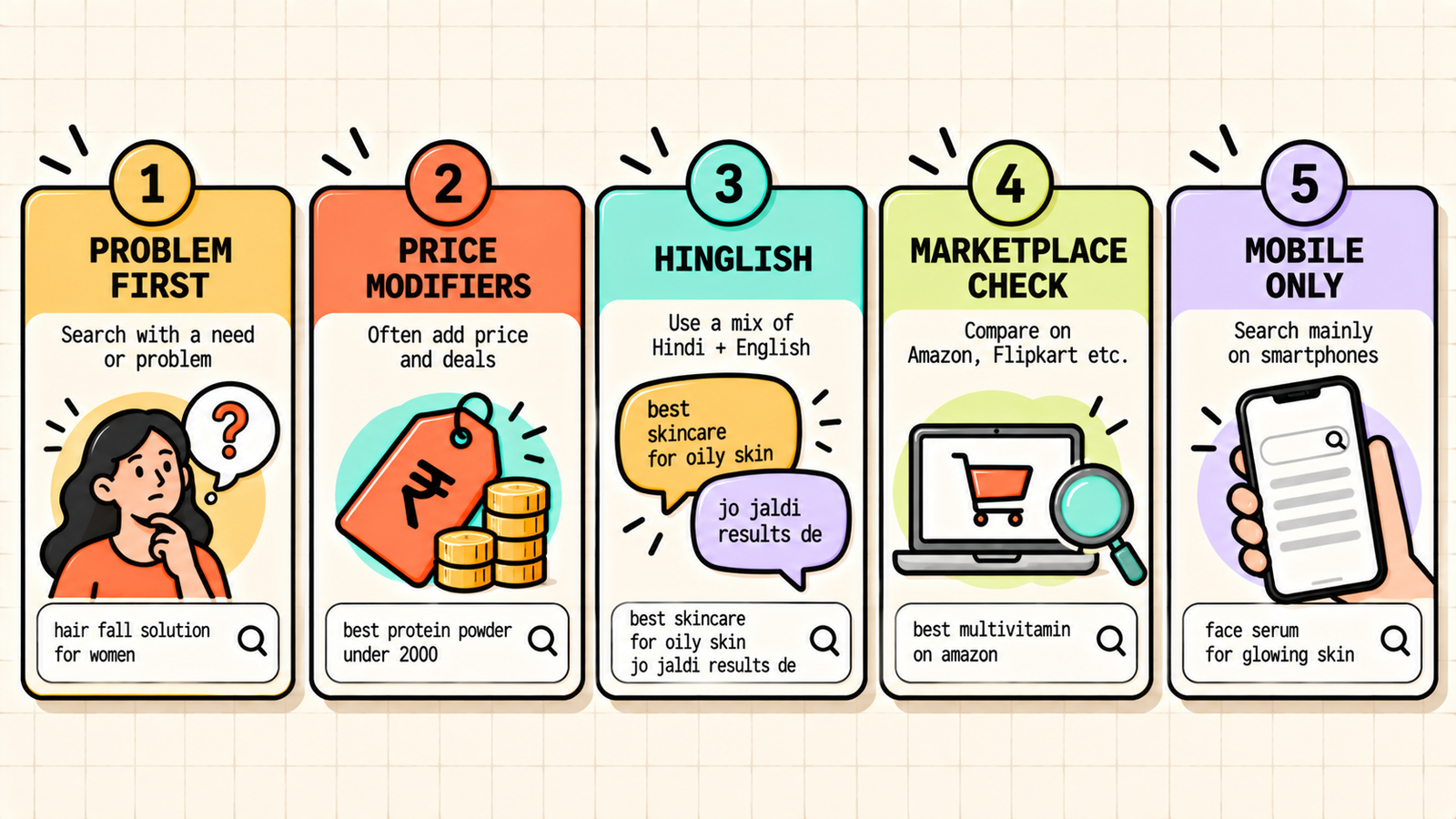
Your SEO strategy has to match real search behaviour, which differs from what most global guides assume.
Problem-first searches. Shoppers search the problem before the product: "hair fall in winter remedy," "acne marks removal cream for oily skin," "high protein breakfast vegetarian." Content that answers the problem and then introduces the product converts far better than a product page alone.
Price and value modifiers. "Under 500," "best budget," "worth it," "price in India," and "COD available" appear constantly. Indian buyers compare value openly.
Hinglish and regional phrasing. Queries like "baalon ke liye best oil" and "chehre ke daag kaise hatiye" have real volume. Few brands create content for them.
Marketplace comparison. Shoppers check Amazon, Flipkart, Nykaa, or Myntra before buying direct. Many search "[brand name] review" or "[brand name] vs [competitor]" before deciding where to buy.
Mobile, always. The overwhelming majority of D2C traffic in India is mobile, often on mid-range Android phones and patchy networks. Speed is not optional.
The pages that drive D2C revenue from SEO
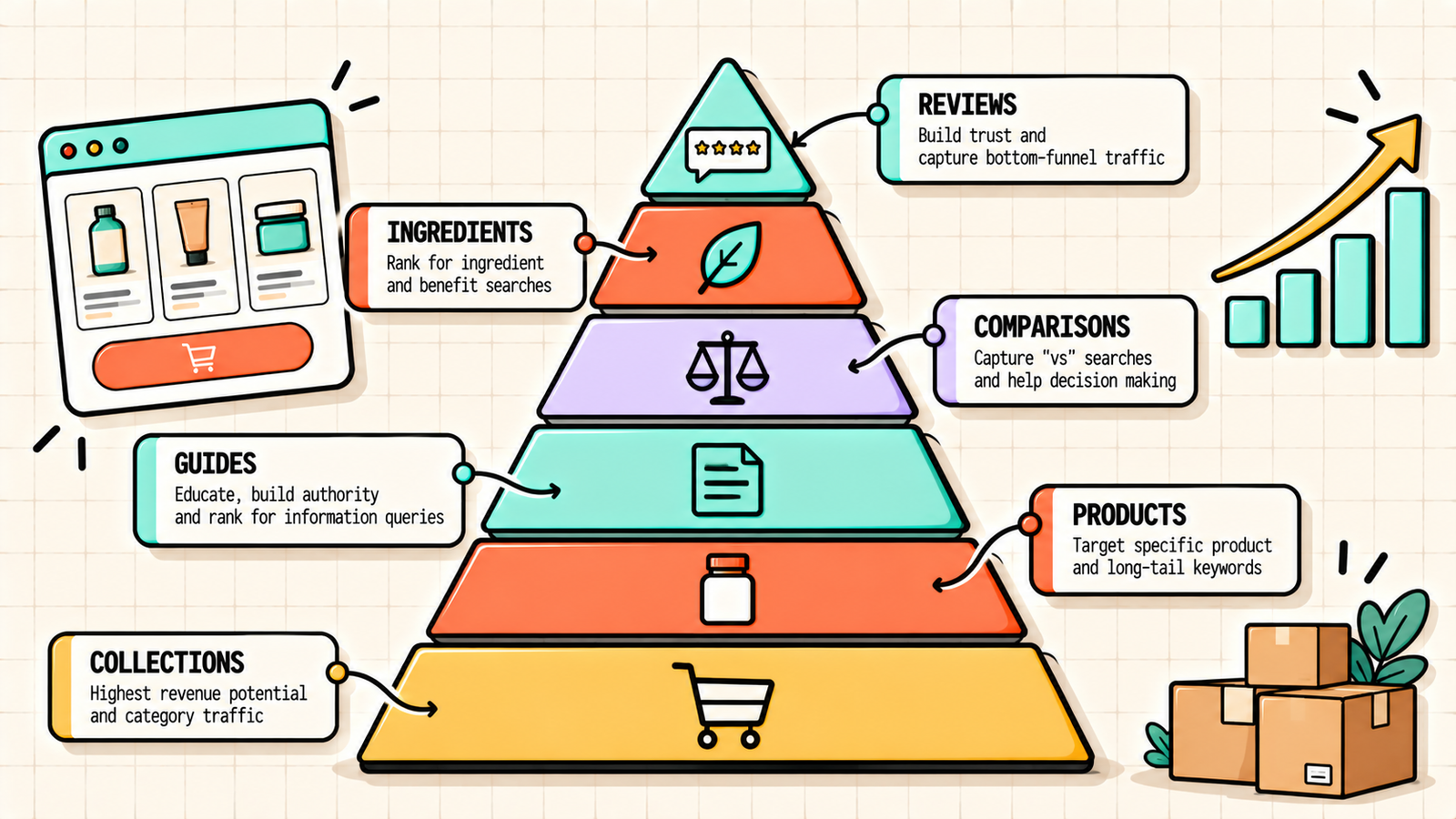
Not every page is equal. These are the ones that move revenue, in priority order.
| Page type | Example keywords | Why it matters |
|---|---|---|
| Collection / category pages | "onion hair oil," "vegan protein powder" | Highest commercial intent, biggest revenue driver |
| Product pages | "[product name] price," "[product] for dry skin" | Converts branded and specific searches |
| Problem-solution guides | "how to reduce hair fall naturally" | Captures buyers earlier, feeds collections |
| Comparison pages | "[your brand] vs [competitor]," "best X under 500" | Wins high-intent shoppers deciding between options |
| Ingredient / benefit pages | "benefits of rosemary oil for hair" | Builds authority, captures research traffic |
| Review and UGC pages | "[brand] reviews" | Controls your own branded search results |
Most D2C stores invest in product pages and ignore collection pages and comparison content, which is backwards. Collection pages are where the largest commercial search volume sits.
Planning SEO around the Indian festive calendar
Indian D2C demand spikes around Diwali, Navratri, Raksha Bandhan, wedding season, and big sale events. Search interest for gifting, hampers, and "best X for gift" queries rises weeks before the festival itself. Because SEO takes time to rank, festive pages should be published or refreshed six to eight weeks ahead, not the week before. Keep the same URL every year (for example /collections/diwali-gifts without a year in the address) so the page builds authority season after season instead of starting from zero each time.
We'll find exactly where your D2C store is losing organic revenue.
Get a clear, data-backed plan to lower your CAC, win the searches your buyers actually make, and grow organic revenue.
Shopify SEO basics for D2C brands
Most Indian D2C brands run on Shopify, which handles a lot of SEO well but needs specific fixes.
Write unique collection descriptions. Add 150 to 300 words of genuinely useful text to each collection page, answering what shoppers want to know: who it is for, how to choose, key ingredients or features. Place a short version above the products and the rest below.
Fix duplicate product URLs. Shopify creates product URLs both inside and outside collections. Make sure internal links point to the canonical /products/ URL.
Compress images and limit apps. Heavy apps and uncompressed banners are the most common reasons Indian D2C stores fail Core Web Vitals on mobile. Remove apps you do not use and check theme code for leftover snippets.
Add Product schema with reviews. Price, availability, and rating in search results raise click-through rates. Make sure your review app outputs valid schema.
Use clean, short handles. /products/onion-hair-oil beats /products/onion-hair-oil-for-hair-growth-and-hair-fall-control-200ml-new.
How to compete with Amazon, Flipkart and Nykaa in search
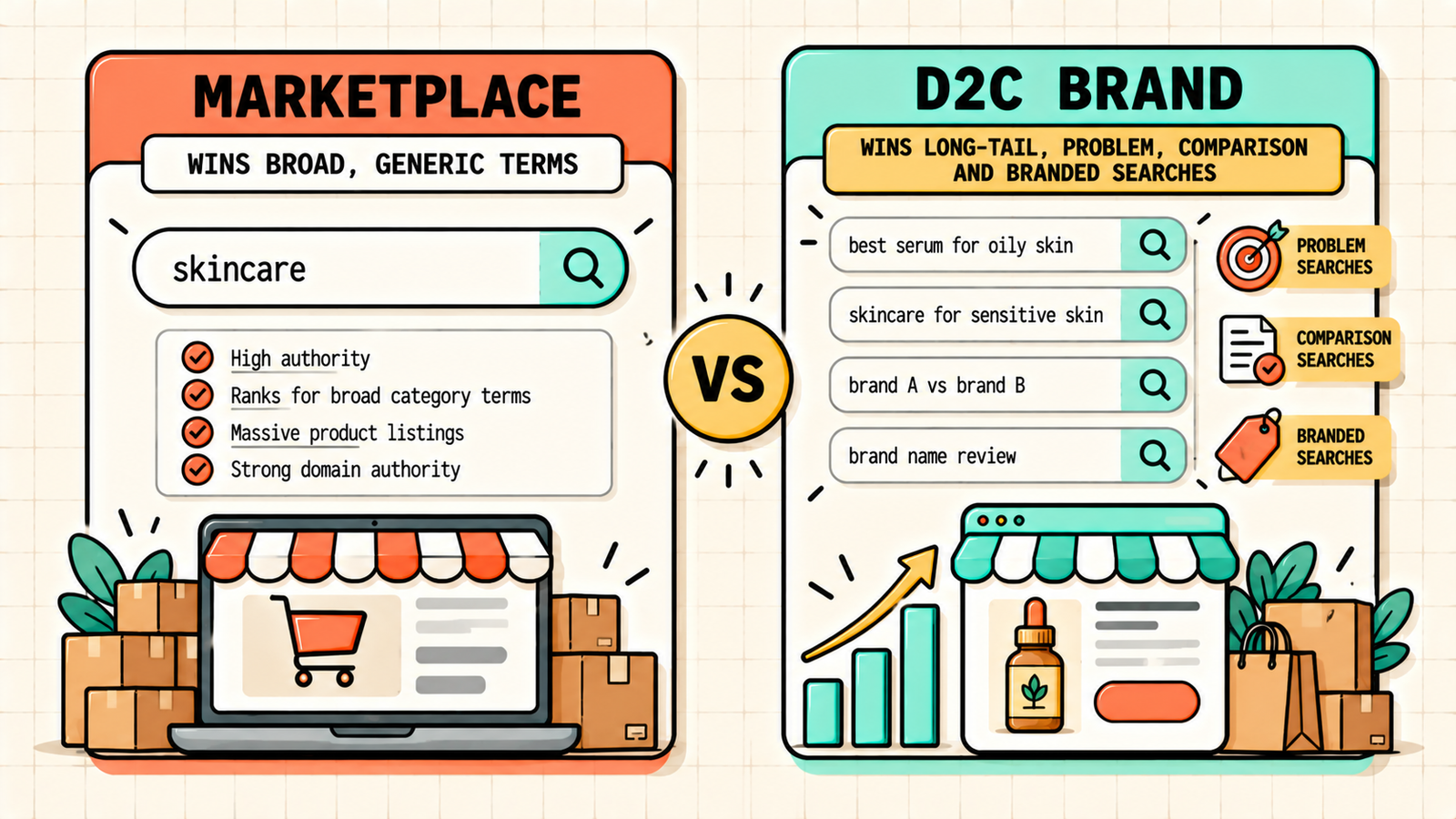
You will not outrank Amazon for "hair oil." You do not need to. Marketplaces win broad, generic searches. D2C brands win on specificity, expertise, and trust.
Target long-tail and problem-based queries where marketplace listing pages are weak, such as "hair oil for hair fall due to dandruff." Publish expert content (ingredient explanations, routines, how-to-choose guides) that marketplaces cannot produce. Own your branded searches so that "[brand] review," "[brand] price," and "[brand] vs [competitor]" lead to your site, not a marketplace or a reseller. And give a reason to buy direct, such as bundles, exclusive sizes, faster support, or loyalty rewards, mentioned clearly on product pages.
Content strategy for D2C SEO
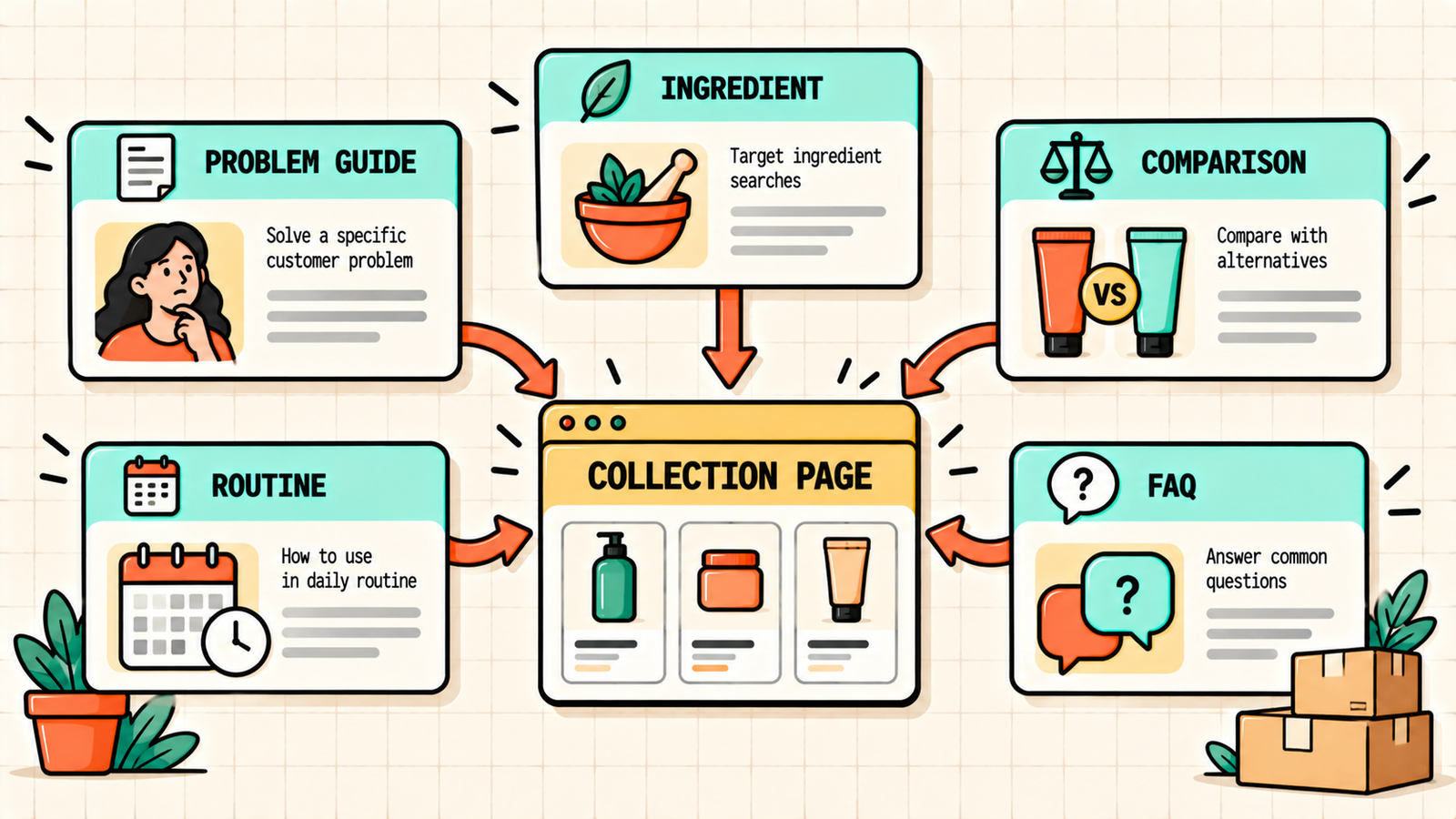
A D2C content plan should feed your collection pages, not exist separately. Pick your three to five core collections. For each, build a cluster of supporting content: problem guides, ingredient explainers, comparisons, and routines, all linking to the collection page. This tells Google your site is an authority on that category and passes internal link value to the pages that make money.
Answer real customer questions. Your support inbox, WhatsApp chats, Amazon Q&A, and product reviews are full of the exact questions your buyers search. Turn the most common ones into content.
Add expertise. If a dermatologist, nutritionist, or formulator works with you, have them review content and show their name and credentials. In health, beauty, and nutrition, Google applies higher trust standards, and real expertise is a competitive edge.
D2C SEO and AI search
Shoppers increasingly ask ChatGPT, Gemini, and Perplexity questions like "best sunscreen for oily skin in India" or "which protein powder is safe for beginners." These tools mention a handful of brands. To be one of them, you need clear, specific content on your own site, consistent brand information everywhere, and mentions on the sources AI tools cite: review sites, comparison articles, YouTube reviews, Reddit threads, and Indian publications. Brands that combine SEO with this kind of reputation building show up in both Google and AI answers.
How long does D2C SEO take?
For a new or low-authority store, expect three to six months for long-tail and collection pages to start ranking, and six to twelve months for meaningful revenue impact. Branded search fixes and product page optimisation can show results faster, sometimes within weeks. The stores that see results earliest are the ones that fix technical basics first, focus on a few core collections instead of everything at once, and earn a handful of quality links from Indian publications and partner brands.
How much should a D2C brand spend on SEO?
A practical way to think about it: SEO spend should be judged against what the same revenue would cost through ads. If organic traffic eventually replaces even 20 percent of the revenue you currently buy through Meta and Google, the saving usually exceeds the SEO budget many times over. In India, D2C brands typically spend somewhere between 30,000 and 1,50,000 rupees per month on SEO, depending on catalogue size, content volume, and whether link building is included. Smaller brands can start lean: fix technical issues once, write collection descriptions in-house, and publish two strong guides a month. Whatever you spend, track organic revenue in Google Analytics (Shopify's own reports also show sales by referring source) so the channel is judged on revenue, not just traffic.
D2C SEO checklist
| Area | Action |
|---|---|
| Technical | Mobile speed, Core Web Vitals, canonical product URLs, sitemap |
| Collections | Unique 150 to 300 word descriptions, FAQ, internal links |
| Products | Clear benefits, specs, usage, reviews, Product schema |
| Content | Problem guides and comparisons linked to collections |
| Branded search | Own "[brand] review," "[brand] price," "[brand] vs" queries |
| Trust | Expert reviewers, real reviews, clear policies, COD and returns info |
| Authority | Links from Indian publications, partners, founder interviews |
| AI search | Consistent brand info, mentions on cited review sources |
AEO Services: How to Get Your Brand Cited by ChatGPT, Gemini and Perplexity
Common D2C SEO mistakes
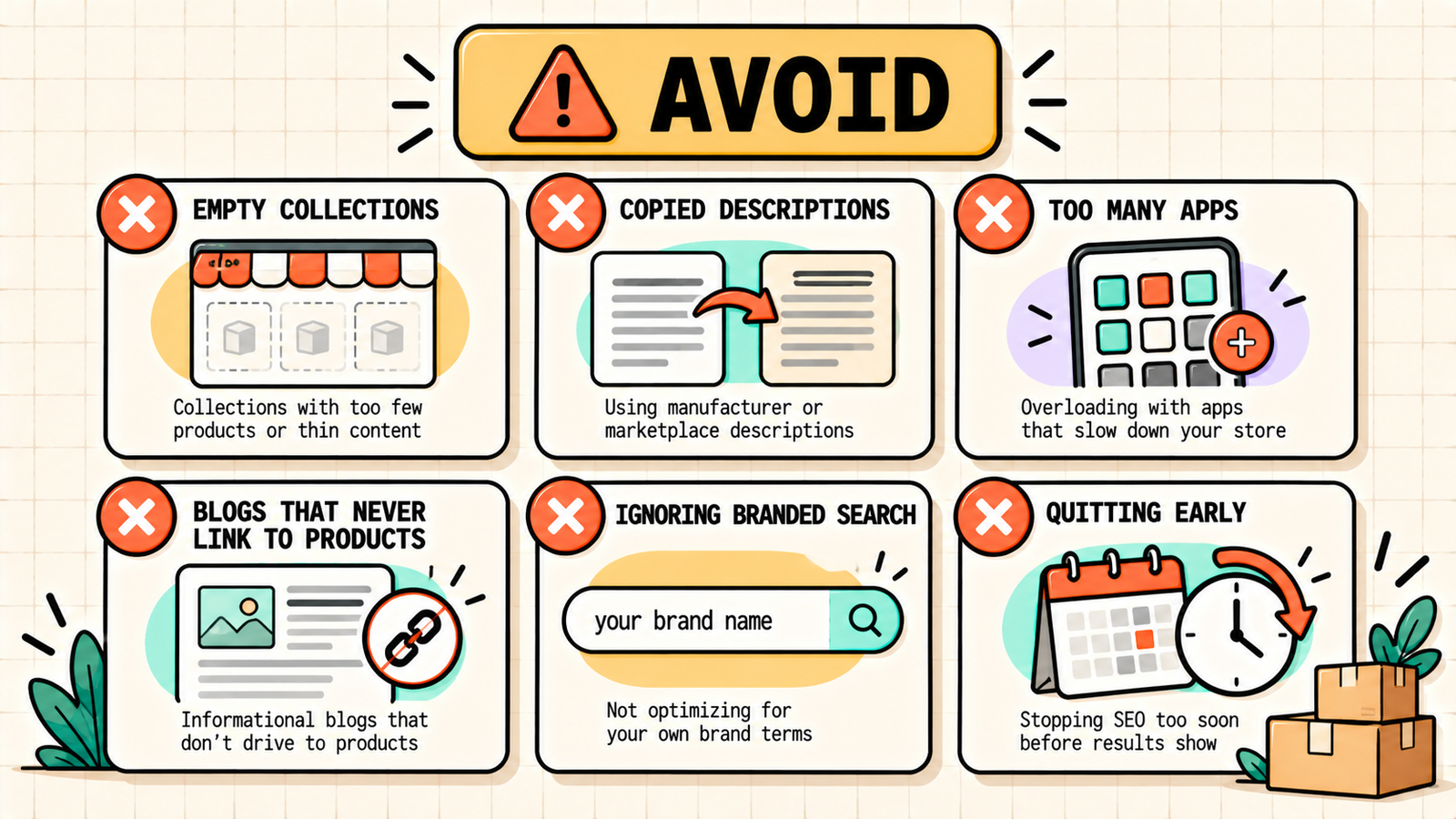
A few patterns appear in almost every D2C audit. Empty collection pages with only a product grid give Google nothing to rank. Copying manufacturer descriptions across products creates duplicate content. Installing dozens of Shopify apps slows the site on mobile. Publishing generic lifestyle blogs that never link to products builds traffic that does not convert. Ignoring branded search lets marketplaces and resellers own your name. And expecting SEO to replace ads in the first month leads brands to quit just before it starts working.
Schema Markup for SEO: How to Add Structured Data to Your Site
The bottom line
For Indian D2C brands, SEO is the channel that brings CAC down once paid ads plateau. Match how Indian shoppers search, prioritise collection pages, fix Shopify basics, win long-tail and problem-based queries marketplaces ignore, own your branded searches, and build content clusters that feed the pages that sell. Add real expertise and earn mentions so AI assistants recommend you too. It takes months, but every page that ranks keeps working without a bid.
If you want a D2C-specific SEO audit of your store, LetMeRank works with Indian D2C brands, including Shark Tank India brands, to grow organic revenue and lower CAC, starting with a free audit.