Someone told you your domain authority is 12 and that is why you are not ranking. Or you checked a competitor's DA and it is 60 and now you feel like catching up is impossible. Either way, you are confused about what this number actually means and whether you should care. Here is the short answer: domain authority is a useful reference point, but it is not what most people think it is, and obsessing over it is one of the most common SEO distractions.
This guide covers what domain authority actually is, how it works, what it does and does not tell you, how to improve it, and the myths that waste the most time.
What is domain authority?
Domain Authority (DA) is a metric created by Moz that predicts how likely a website is to rank in search results. It is scored on a scale from 1 to 100, with higher scores meaning a stronger ability to rank. It is calculated based primarily on the quality and quantity of backlinks pointing to your site.
Here is the critical thing most people miss: DA is not a Google metric. Google does not use domain authority in its ranking algorithm. It is a third-party metric created by Moz to help SEOs compare the relative strength of websites. Other SEO tools have their own versions: Ahrefs has Domain Rating (DR), Semrush has Authority Score, and each calculates it differently. They are all estimates, not official measurements.
Domain authority vs page authority
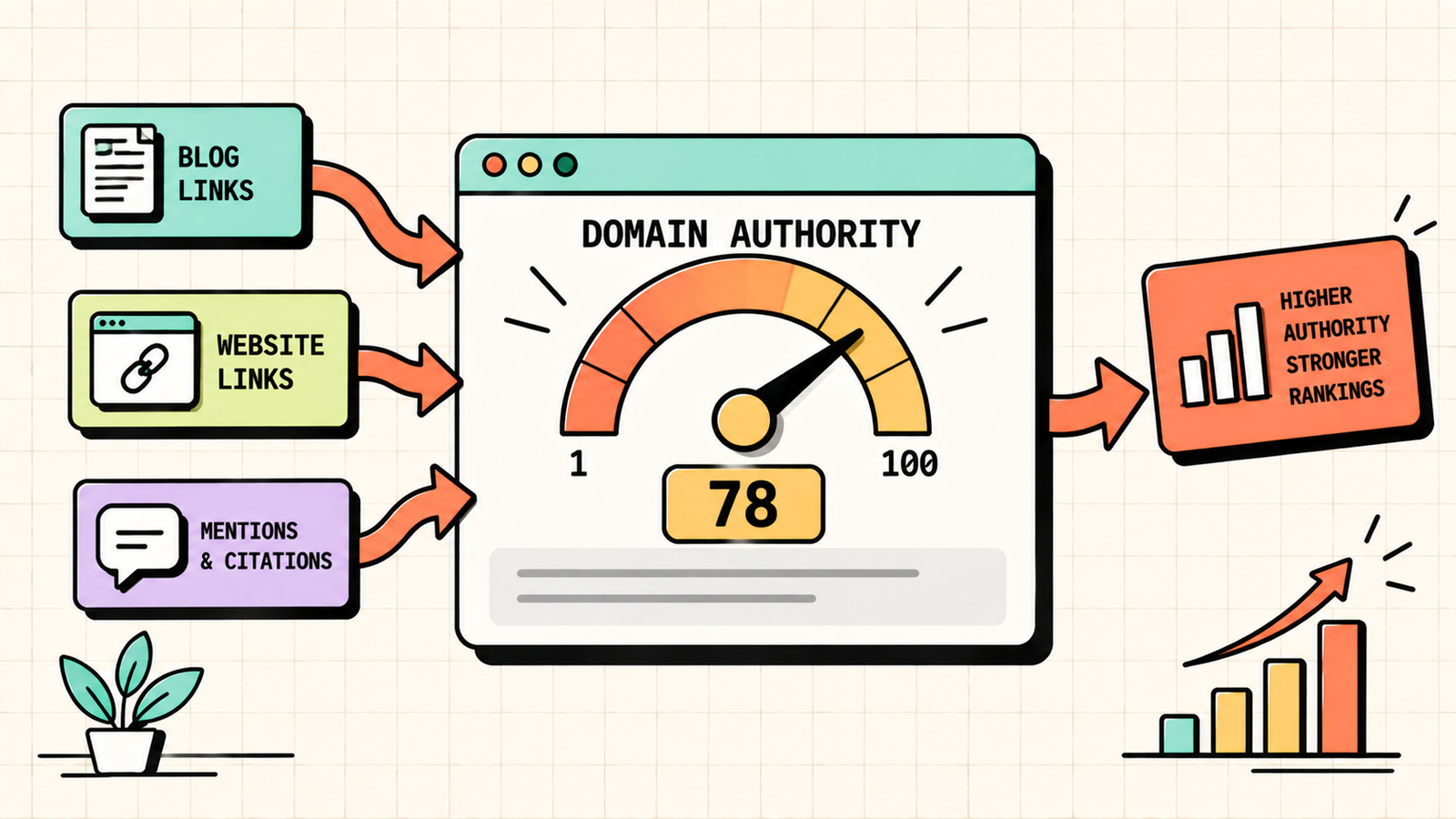
DA measures the overall strength of your entire domain. Page Authority (PA) measures the strength of a single page. Both are Moz metrics, and both are based primarily on backlinks.
| Domain Authority (DA) | Page Authority (PA) | |
|---|---|---|
| What it measures | Strength of the entire domain | Strength of a single page |
| Based on | Backlinks to the whole site | Backlinks to that specific page |
| Scale | 1 to 100 | 1 to 100 |
| Best for | Comparing sites overall | Comparing specific pages |
In practice, DA gives you a rough sense of a site's overall competitive strength, while PA tells you how strong a specific page is. A page with high PA on a site with moderate DA can still rank well for its keyword.
What is a good domain authority score?
There is no universal "good" score. DA only matters relative to the sites you are competing against. Here is the general range:
| DA Range | What it means |
|---|---|
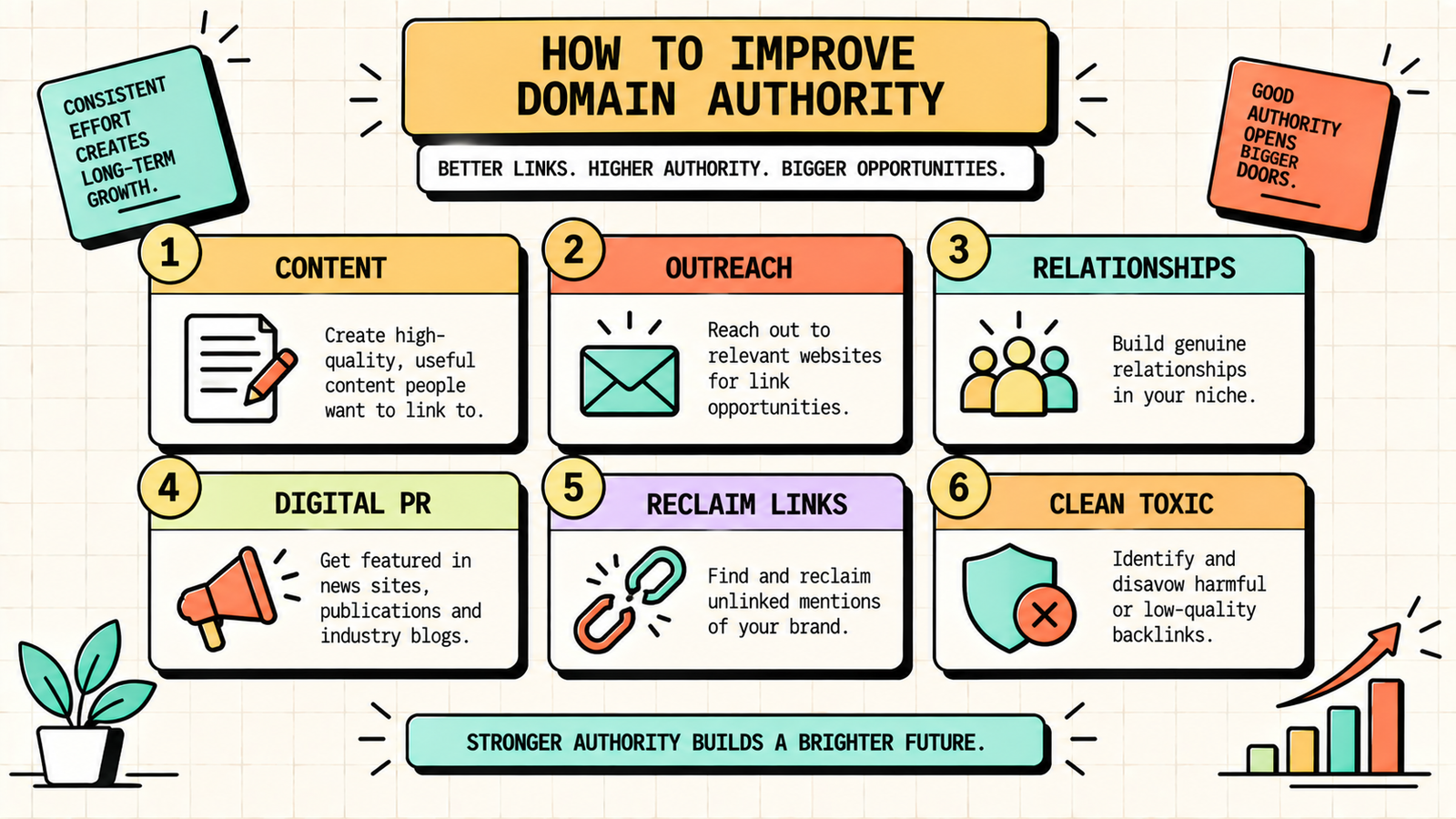
| 1 to 10 | Brand new or very small site |
| 10 to 20 | Young site building early authority |
| 20 to 40 | Established small to mid-size site |
| 40 to 60 | Strong site with a solid backlink profile |
| 60 to 80 | Very authoritative site |
| 80 to 100 | Major brands and media (Google, BBC, Wikipedia) |
A new small business at DA 15 competing against other local businesses at DA 10 to 25 is in a strong position. That same DA 15 trying to outrank Forbes (DA 95) for a competitive keyword is not. The number only matters in context.
How domain authority is calculated
Moz calculates DA primarily from the quantity and quality of external backlinks pointing to your domain, the linking root domains (how many unique websites link to you, not just total links), the diversity and trustworthiness of those linking domains, and a machine learning model that predicts how these factors correlate with Google rankings. More links from more unique, high-quality websites means a higher DA. Links from spammy or irrelevant sites do not help and can even hurt.
Ahrefs calculates DR differently, focusing on the quantity of unique referring domains and the strength of those domains. Semrush's Authority Score blends backlinks with organic traffic and other signals. Each tool gives a different number for the same site, which is why you should pick one tool and stick with it for consistent tracking.
Does Google use domain authority?
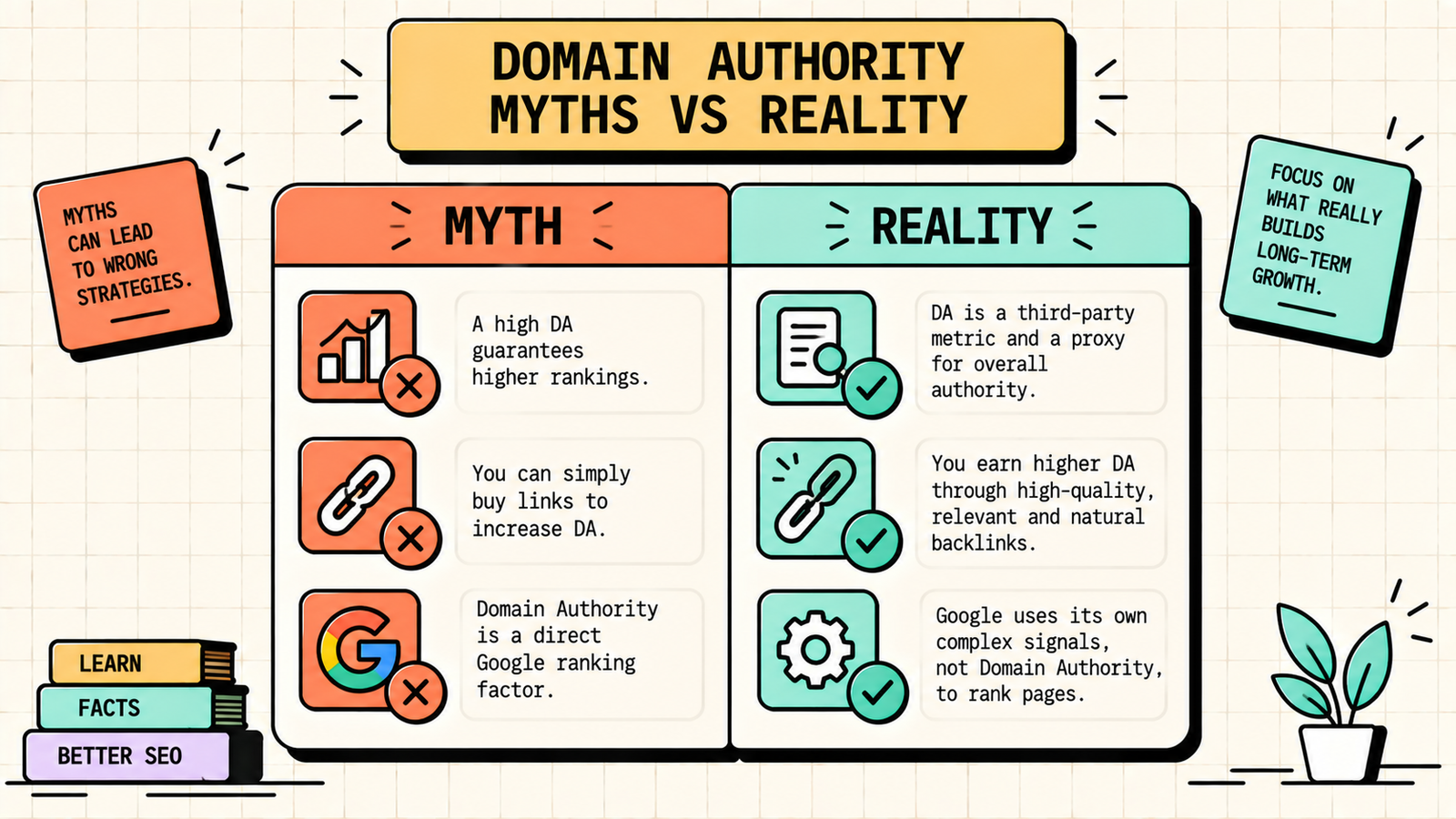
No. Google has repeatedly confirmed that it does not use Moz's Domain Authority or any similar third-party metric in its ranking algorithm. Google has its own internal signals for evaluating site quality and authority, but those are not the same as DA and are not publicly scored.
That said, DA correlates with rankings because the things that raise DA (quality backlinks from authoritative sites) are also things that help you rank. So while Google does not look at your DA number, the factors behind it overlap with genuine ranking signals. Think of DA as a useful proxy, not a direct ranking factor.
We'll show you exactly how to build authority the right way.
Get a clear, data-backed plan to earn quality backlinks, improve your rankings, and grow organic traffic sustainably.
How to improve your domain authority
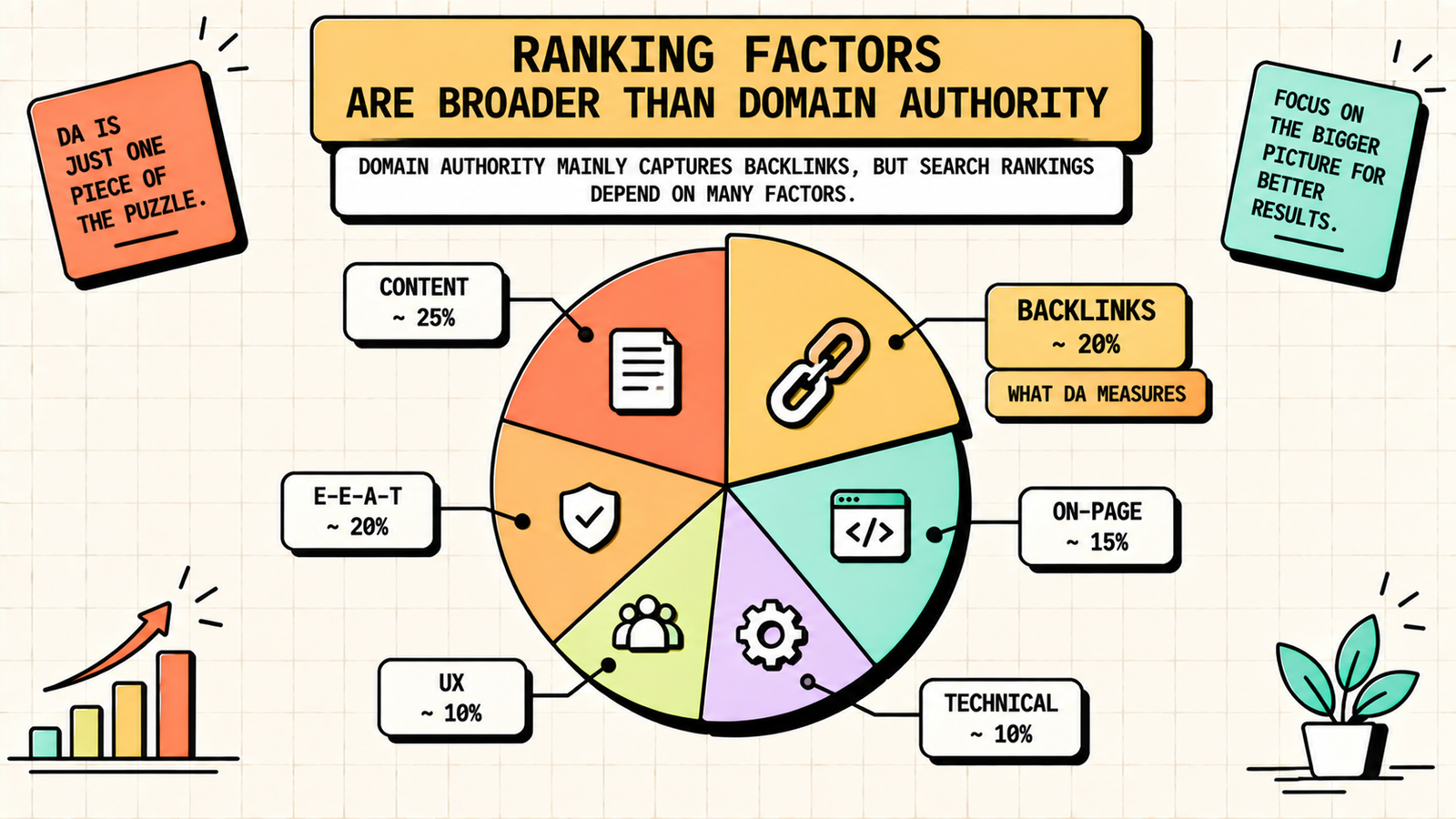
1. Create link-worthy content
The most sustainable way to earn backlinks is to create content that other sites want to reference: original research, data studies, comprehensive guides, useful tools, and unique frameworks. Content that is genuinely the best resource on a topic earns links naturally over time.
2. Do outreach and guest posting
Reach out to relevant blogs, publications, and industry sites and offer to contribute valuable content. A guest post on a reputable site earns a quality backlink and puts your brand in front of a new audience. Focus on relevance and quality over volume.
3. Build relationships in your industry
Genuine relationships with other businesses, bloggers, journalists, and creators lead to natural link opportunities: interviews, collaborations, mentions, and resource inclusions. Networking is an underrated link-building strategy because it produces the most authentic, lasting links.
4. Earn digital PR mentions
Get your brand mentioned in news, industry publications, and media. This can be through expert commentary, original data journalists can cite, press releases for genuine news, and tools like HARO (Help a Reporter Out) where journalists seek sources. A single link from a high-authority news site can move your DA more than dozens of low-quality links.
5. Fix and reclaim lost links
Check your backlink profile for links that point to pages that no longer exist (404 errors). Redirect those pages to the most relevant live page so the link equity is not wasted. Also look for unlinked brand mentions (sites that mention your brand but do not link) and ask them to add the link.
6. Remove or disavow toxic links
If your backlink profile includes spammy, paid, or irrelevant links, they can drag down your quality signals. Use Google's Disavow Tool as a last resort for clearly toxic links you cannot get removed. Focus on building good links rather than obsessing over removing bad ones, but clean up anything obviously harmful.
How long does it take to improve domain authority?
DA moves slowly. It is a lagging indicator that reflects the cumulative effect of your link-building over months and years. Expect minimal movement in the first three months of a new link-building effort. Noticeable improvement in DA typically takes six to twelve months of consistent work. And the jumps get harder: going from 10 to 20 is much easier than going from 40 to 50, because the scale is logarithmic. Do not check your DA weekly. Check it quarterly and focus on the activities (creating content, earning links) rather than the number.
Domain authority myths that waste your time
A few misconceptions lead people to make bad decisions.
Myth: A higher DA means you will rank higher. Reality: DA correlates with ranking ability but does not cause it. A low-DA page with perfect intent match, great content, and a few strong links can outrank a high-DA page that is less relevant.
Myth: You need a high DA to rank. Reality: Pages rank, not domains. A page with strong on-page SEO, matched intent, and a few quality backlinks can rank on page one even if the domain's DA is modest, especially for lower-competition keywords.
Myth: You should buy links to raise your DA. Reality: Buying links violates Google's guidelines and risks a penalty. The links that raise DA sustainably are the same ones that help you rank: earned from real sites through real value.
Myth: DA is the most important SEO metric. Reality: Organic traffic, keyword rankings, and conversions are far more important. DA is a diagnostic tool, not a goal. Chasing a DA number instead of creating content and earning links naturally is optimising for the wrong thing.
Myth: All DA checkers show the same score. Reality: Each tool (Moz, Ahrefs, Semrush) calculates authority differently. Pick one and track consistently. Comparing your Moz DA against a competitor's Ahrefs DR is meaningless.
SEO Reporting: What to Track, How to Report, and the Tools That Help
Domain authority vs actual ranking factors
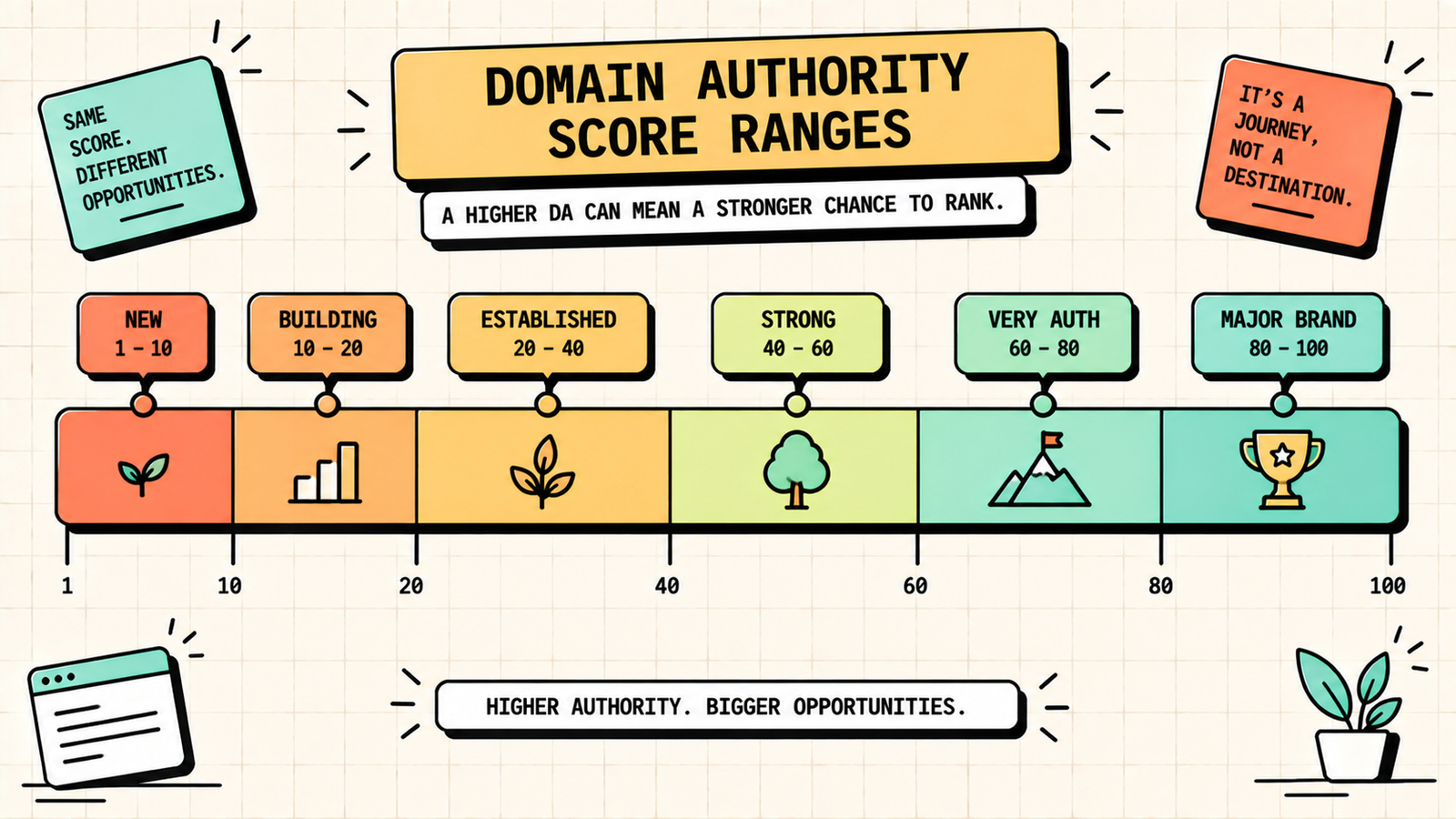
DA is a proxy. The actual factors that determine whether you rank are content quality and relevance (does your page best answer the search), backlinks (do authoritative sites link to you, which is what DA measures), on-page SEO (does Google understand what the page is about), technical health (can Google crawl and index your site), user experience (does the page load fast, work on mobile, and satisfy the visitor), and E-E-A-T signals (does your site demonstrate experience, expertise, authority, and trust). DA captures one piece of this puzzle (backlinks). Focusing on all of them is what actually moves rankings.
SEO for Small Business: The Complete DIY Guide to Ranking Without a Big Budget
The bottom line
Domain authority is a useful reference point for comparing the relative backlink strength of websites, but it is not a Google ranking factor and it is not the most important SEO metric. Improve it by earning quality backlinks through great content, outreach, relationships, and digital PR. But focus your energy on the things that actually rank you: relevant content, on-page optimisation, technical health, and user experience. DA is a symptom of doing SEO well, not the cause of it. Chase the activities that build authority, not the number itself, and the number follows naturally as a byproduct of the real work. The businesses with the strongest authority are always the ones that focused on being genuinely useful, not the ones that chased a score.
If you want experts to build your site's authority and rankings the right way, LetMeRank helps founders and brands grow through SEO, content, and link building, starting with a free audit.